Choosing and Using the Right Charger for a Lithium E-Rickshaw Battery
A lithium pack is only as safe as the charger it meets every night. Why a lead-acid charger must not be used, what a matched charger means, how cheap copies and loose plugs cause damage, and the signs a charger is failing.
Published: 14 November 2026
Charging · 5 min read
The charger decides how the battery is treated every night
A driver will think hard before spending on a lithium battery, and then plug it into whatever charger is lying in the garage. That is backwards. The battery is charged several hundred times a year, and every one of those charges is controlled by the charger. A good pack on the wrong charger has a hard life; a good pack on the right charger mostly looks after itself.
This matters most in the e-rickshaw trade because so many vehicles in Uttar Pradesh, Bihar, Delhi-NCR and Haryana started life on lead-acid. When the owner moves to lithium, the old charger is still there, it fits the socket, and it seems to work. It is the wrong tool.
Why a lead-acid charger must not be used
Lead-acid and lithium batteries want to be charged in different ways.
A lead-acid charger pushes the battery up to a high voltage, holds it there, then keeps a lower “float” voltage on it for as long as it stays plugged in. Many also run an equalising charge from time to time — a deliberate overcharge that stirs up the acid. All of that is good for lead-acid.
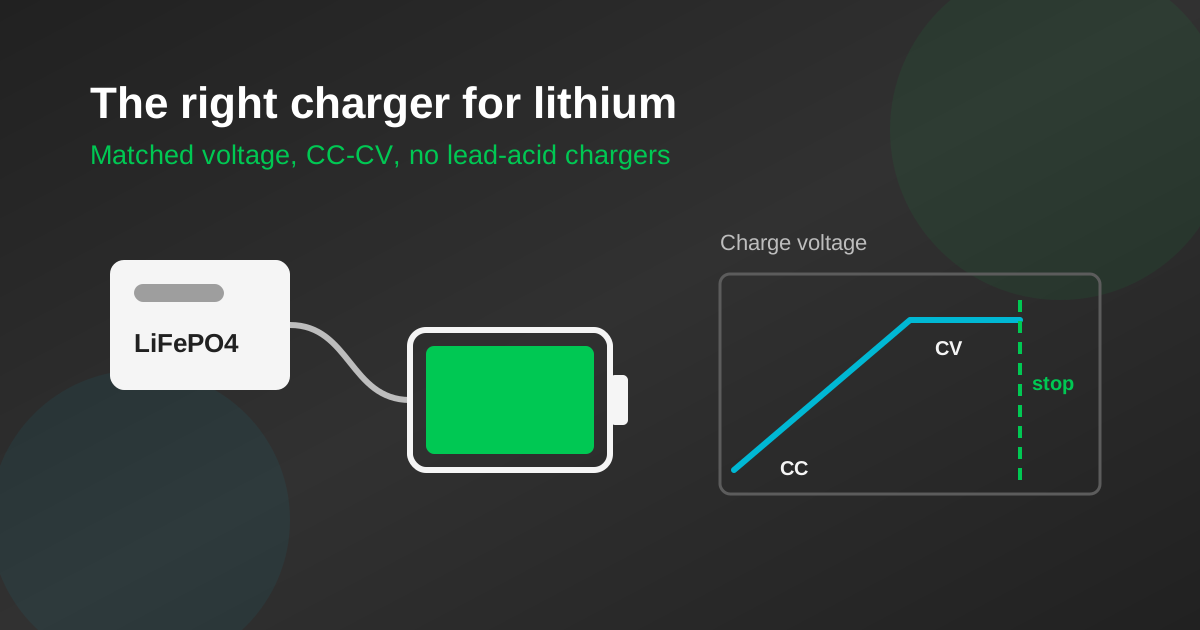
A lithium pack wants something simpler and stricter. The charger supplies a steady current until the pack reaches a set voltage, then holds that voltage while the current tapers off, and then stops. This is called CC-CV, for constant current then constant voltage. There is no float and no equalising, and the final voltage has to be right to within a fraction of a volt.
The numbers show the problem. A 48 V lead-acid set is typically charged to around 57–59 V, with equalising going higher still. An LFP pack is built from cells that should not go much above 3.6 V each, so its safe ceiling depends on how many cells it has — and for some 48 V-class lithium packs that ceiling sits below what a lead-acid charger delivers. Even where the top voltage happens to be close, the float and equalise stages keep pushing at a pack that is already full.
If you are moving from lead-acid, budget for the matching charger as part of the switch. Our comparison of lithium and lead-acid running costs only works out if the lithium pack lives its full life.
What “matched” actually means
A charger is matched to a battery when four things agree. Read them on the label of the charger and the label of the pack, and if anything is missing or unclear, ask the battery seller before you use it.
- •Chemistry. The charger should be made for LiFePO4 (LFP), not “lead-acid” or a switchable unit left on the wrong setting.
- •Final voltage. The charger’s output voltage must match the pack’s stated maximum charge voltage. A “48 V” label on both is not enough; the cut-off number is what counts.
- •Current. The charging amps should be within what the pack allows. A charger much stronger than the pack is rated for heats it; one much weaker just takes longer.
- •Connector and communication. The plug, the polarity and, on some packs, a signal wire that lets the charger and the BMS talk. A charger that fits only after the plug has been changed is not a matched charger.
Cheap chargers, copies and loose wires
The market is full of chargers that look identical and are not. Some are honest budget units. Others are copies of known brands with the right sticker and the wrong insides: a cut-off voltage that drifts, no proper stop at the end of charge, thin internal wiring, weak insulation between the mains side and the battery side, and a fan that is missing or does not run. A copy can work for months before its weaknesses show up in the pack.
Buy a replacement charger from the battery supplier or a dealer they name, keep the invoice, and if you are not sure about a unit, ask a technician to measure its full-charge voltage with a meter before trusting it with the pack.
Heat at the plug is the other common failure. A loose or worn connector has resistance, and resistance turns current into heat right at the contact. Over weeks the plastic browns, then melts, and the contact gets looser still. The same happens with thin extension leads, multi-plug boards shared with other appliances, and wall sockets that have been worked loose. A charging cable that is warm along its length, or a plug that is hot to the touch, is a warning, not a normal feature. Supply in many towns and villages also swings widely in the evening; a decent charger copes with that, a cheap one often does not. And a hooked line from an overhead wire is a fire risk as well as an offence.
The charger and your warranty
Almost every lithium battery warranty excludes damage from a charger that was not supplied or approved. That is not small print for its own sake: the charger is one of the most common causes of early pack failure, and a BMS log can often show a charge that went past the limit. Our guide to reading a battery warranty covers the exclusions in full. In practice, keep the original charger working, ask in writing which replacement models are approved, and keep the bill for any charger you buy later.
Where to charge, and signs the charger is failing
Charge where there is air, where people do not sleep and do not need to walk past to get out, and where nothing nearby can catch fire — no straw, fodder, cloth, fuel or stacked cartons. In a fleet yard, space vehicles out rather than packing them nose to tail, and keep chargers off the floor where rain or wash water collects. The charger needs ventilation as much as the battery does.
A charger on its way out usually gives warning:
- •Charging finishes much faster than it used to, and range falls short
- •Charging runs far longer than normal or never shows complete
- •The indicator lights behave differently, flicker or show an error
- •The fan has stopped, or a new buzzing or clicking sound appears
- •The case, cable or plug is hotter than before, or smells of burning plastic
- •The BMS cuts the charge off, or the pack shows a fault after charging
Stop using a charger that shows any of these and get it checked or replaced with an approved unit.
Charger checklist
- •Retire the lead-acid charger when you move to lithium.
- •Check the charger label says LiFePO4 or LFP, with a cut-off voltage matching the pack.
- •Buy replacements only through the battery supplier or a dealer they approve, and keep the bill.
- •Use an earthed wall socket — no shared multi-plugs or thin extension leads.
- •Feel the plug and cable after charging; heat or brown marks mean replace them.
- •Charge in an open, ventilated spot away from anything that burns and away from exits.
- •Watch charging time; a big change either way is worth a check.
- •Never change the plug or bypass the BMS to make a charger fit.
Terms in this article
Frequently asked questions
Can I use my old lead-acid charger on a lithium e-rickshaw battery?+
No. A lead-acid charger uses float and equalising stages and voltages that do not suit a lithium pack, which needs a constant-current, constant-voltage charge to an exact cut-off and then a full stop. Relying on the BMS to cut off a wrong charger every night wears the pack and its protection.
What should I check on a charger label?+
Four things: that it is made for LiFePO4 (LFP), that its output voltage matches the pack’s stated maximum charge voltage, that its current is within what the pack allows, and that the connector and any signal wire fit without modification.
Does using a different charger affect my battery warranty?+
Usually yes. Most lithium battery warranties exclude damage caused by a charger that was not supplied or approved by the seller. Ask in writing which replacement chargers are approved and keep the bill for any charger you buy.
Thinking about upgrading?
Talk to our team about the right pack for your vehicle, and about EMI options that keep the monthly outgo close to what you already spend.
Popular: Lithium e-rickshaw battery