Spain Creates a Capacity Market, and New Storage Can Bid for 15 Years
Order TED/966/2026 took effect on 18 September. New investment in Spain’s main capacity auctions is limited to renewables, storage and demand, with service periods of up to 15 years.
Published: 11 October 2026
Policy · 3 min read
What Spain has created
Written 11 October 2026, on Spain’s Order TED/966/2026 as reported by ESS News (17 September) and summarised by the law firms Garrigues (22 September) and Jones Day (30 September).
Spain now has a capacity market. Order TED/966/2026, dated 15 September, was published in the Official State Gazette on 17 September and came into force the next day, according to both Garrigues and Jones Day. It follows European Commission state-aid clearance in May. Jones Day puts the estimated budget at up to €9 billion over ten years.
A capacity market pays resources to be available when the grid is under strain, rather than paying only for the energy they deliver. The product Spain will buy is firm capacity in megawatts. Bids are made in euros per megawatt per year, auctions are sealed and pay-as-bid, and Red Eléctrica de España runs them under the supervision of the CNMC, the national regulator.
Why storage is the beneficiary
The rules are technology-neutral on paper, but one clause tilts the field. ESS News reports that for new investment, only renewable, storage and demand-side projects are eligible in the main auctions. Existing generation must also stay under an emissions limit of 550 g of CO2 per kWh.
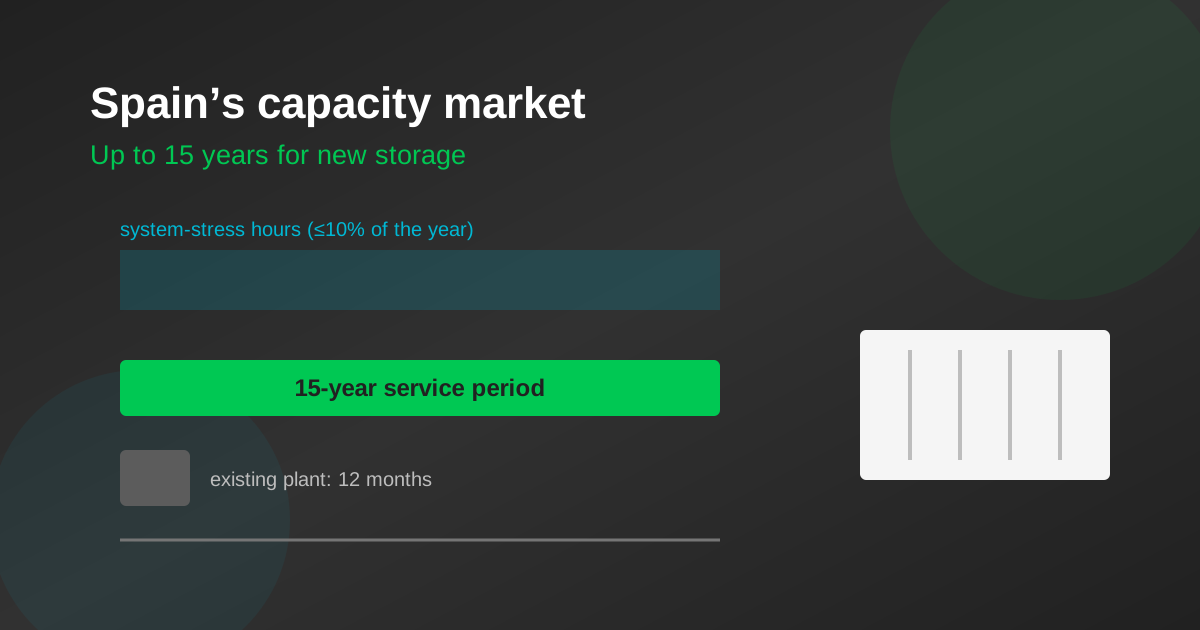
- •Main auctions: new storage can win a service period of up to half its useful life, capped at 15 years (Garrigues); existing generation and storage get 12 months
- •Adjustment auctions: annual, 12-month contracts, open only to plant already in service
- •Transitional auctions: one a year until the first main-auction delivery period begins; Jones Day says these are expected to start shortly after the order took effect
- •Payment: a fixed monthly sum, one-twelfth of awarded firm MW multiplied by the award price (Garrigues)
The obligation is to be available during system-stress hours set by the operator. Those hours may not exceed 10 per cent of the year, Garrigues notes. Miss them and the penalties run from lost payments to forfeited guarantees and exclusion from later auctions.
The number that matters is not yet published. Firm capacity is installed capacity multiplied by a firmness coefficient between 0 and 1, set before each auction. Jones Day gives no values. For a four-hour battery against a stress window of several hours, that coefficient decides how much of its nameplate it can sell, and so what the market is worth to it.
Why it matters for Spain
A contracted payment for availability, for up to 15 years, is the kind of income lenders can underwrite. It would sit alongside the less predictable earnings from shifting energy and selling grid services. In the same report, ESS News notes that the government raised planned transmission investment to 2030 by more than 30 per cent to over €17 billion, with storage accounting for 19 per cent of the proposals received in consultation.
What is still open is the auction calendar and the coefficients. Neither ESS News nor the two law-firm summaries give a date for the first auction.
What it means for this business
India does not have a capacity market, and nothing here suggests it will soon. Indian grid-scale storage is contracted instead through fixed monthly tariffs in tenders, as in the current wave of VGF-backed auctions. Two points still carry across.
- •Long, contracted revenue is what turns storage from a merchant bet into an asset that can be financed. Spain has reached by auction design what India reached through tender tariffs
- •Firmness coefficients reward duration and availability over nameplate. A factory sizing storage for backup or peak cover faces the same question: how many hours can it actually hold the load
For how storage earns its money in each of these structures, see our explainer on how grid-scale BESS makes money, and our commercial storage page for the on-site case.
Sources
Reporting this piece draws on. Figures were correct as published; scheme terms and commodity prices move.
- Spain launches capacity market via auctions, with key rules that support energy storageESS News · 17 September 2026
- Spain launches its new capacity market to strengthen the security of electricity supplyGarrigues · 22 September 2026
- Spain Creates an Electricity Capacity MarketJones Day · 30 September 2026
Frequently asked questions
What is Spain’s new capacity market?+
A mechanism created by Order TED/966/2026, in force from 18 September 2026, that pays resources for firm capacity available during system-stress hours. Red Eléctrica de España runs sealed, pay-as-bid auctions priced in euros per megawatt per year, supervised by the CNMC.
Can battery storage take part?+
Yes. Storage owners are eligible, and new investment in the main auctions is limited to renewables, storage and demand-side resources. New storage can win a service period of up to half its useful life, capped at 15 years; existing storage gets 12 months.
When is the first auction?+
No date had been published as of 11 October 2026. Jones Day says transitional auctions are expected to start shortly after the order took effect, and the firmness coefficients that decide how much capacity a battery can offer are set before each auction.
Want this applied to your own numbers?
Every solution page carries a calculator that shows its own arithmetic — storage savings, lithium against lead-acid, and home pack sizing.