Why Lithium Won, and Why Nothing Has Replaced It
Magnesium’s ion is smaller than lithium’s. Aluminium carries three electrons instead of one. Neither has replaced lithium, and the reason is a single number you can read off the periodic table — plus one fortunate accident in the electrolyte.
Published: 27 August 2026
Chemistry · 9 min read
Every few months, a headline
Magnesium. Aluminium. Sodium. Zinc. Each announcement is technically accurate about the advantage it claims, and each one quietly omits the thing that has kept lithium in place for thirty years.
It is worth understanding what that thing is, because it tells you which announcements to take seriously — and there is one you should.
Start with the position
Lithium is element number three. Only hydrogen and helium are lighter, and both are gases. It sits at the extreme top-left of the periodic table, and almost everything that matters about it follows from that one coordinate.
- •It is the lightest metal — 6.94 g/mol at a density of 0.534, so it floats on water and on cooking oil. Capacity per kilogram has molar mass in the denominator, so being light buys storage for free: lithium metal’s theoretical capacity is 3,862 mAh/g.
- •It is the most electropositive element there is, at −3.045 V. Cell voltage is cathode potential minus anode potential, so lithium extracts the highest possible voltage from whatever cathode you pair it with. The same cathode against zinc gives less than half the voltage, and therefore less than half the energy.
- •Its ion is small and carries only one charge. Li⁺ is 76 picometres across, and that combination — small and singly charged — is unique in the periodic table. It is the property nobody talks about, and the one that actually decides everything.
The counter-intuitive bit
Lithium has the highest first ionisation energy of all the alkali metals — 520 kJ/mol against caesium’s 376. It holds its outer electron more tightly than any of its group. By that measure it should be the worst reducing agent in the family, not the best.
It isn’t, because electrode potential is not ionisation energy. It is a three-step accounting: turn the solid into gas, strip off the electron, then surround the resulting ion with solvent. Lithium’s tiny ion pulls solvent molecules in so tightly that the energy released in the third step more than repays what the second cost. It loses the middle round and wins the match.
That is a nice piece of chemistry, and it is not why the alternatives have failed.
Why the alternatives fail
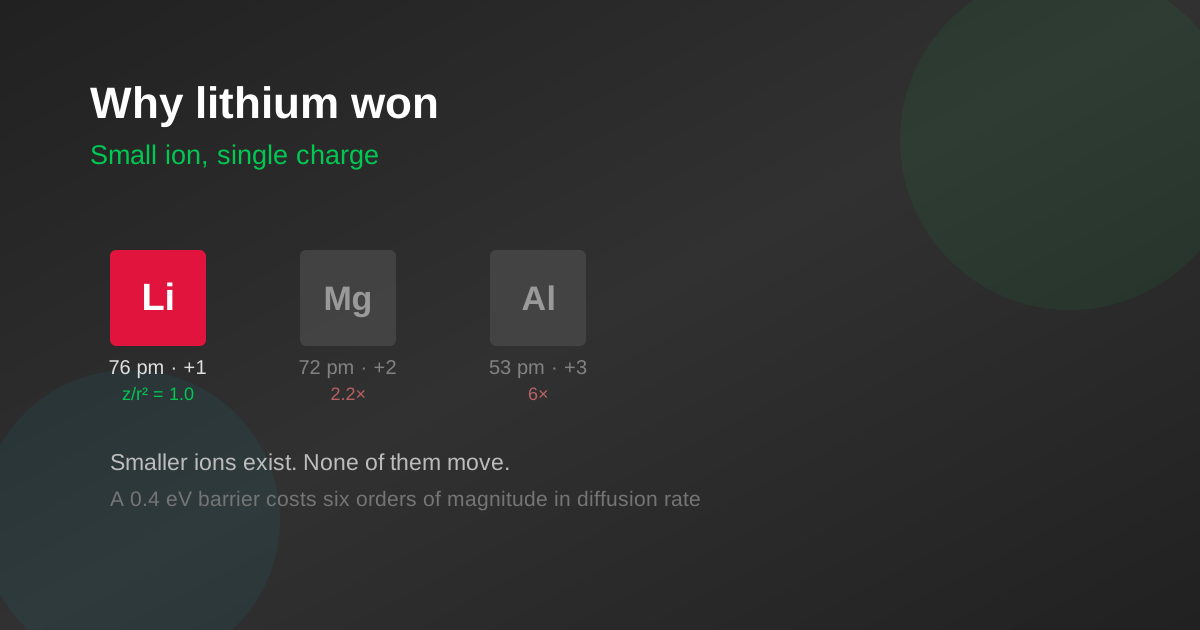
Here is the fact that catches most people out: magnesium’s ion is smaller than lithium’s. Mg²⁺ is 72 pm against Li⁺’s 76. Aluminium’s is smaller still at 53.5 pm. And magnesium carries two electrons per ion to lithium’s one, aluminium three.
On paper both should win. Aluminium has the highest volumetric capacity of any metal — better than lithium by a factor of four. It is the third most abundant element in the crust, and already an industrial commodity produced by the million tonnes.
So size is not the problem. Charge is.
A cation’s grip on its surroundings scales roughly as charge divided by radius squared. Run that for magnesium and it binds its neighbours about 2.2 times as hard as lithium does. For aluminium, six times as hard.
That grip has to be paid twice on every single hop — once to leave the site the ion is sitting in, once to squeeze through the gap to the next one. In a layered oxide a lithium ion faces a barrier of roughly 0.2 to 0.4 eV. Magnesium faces 0.6 to 1.2 eV.
That sounds like a factor of three. It is not. Diffusion rate falls exponentially with barrier height, so a 0.4 eV increase costs roughly six orders of magnitude in how fast the ion moves at room temperature. It is the difference between a cell that charges in an hour and one that would charge in a century.
There is no clever engineering around Coulomb’s law.
The second problem: magnesium poisons itself
Even if you solved the kinetics, magnesium has a separate difficulty that is arguably worse.
Lithium-ion cells work because of a fortunate accident. The electrolyte is not actually stable at lithium potentials — it decomposes on first charge. But its decomposition products happen to be ionically conductive and electronically insulating. Lithium ions can pass through the film; electrons cannot. So the decomposition stops itself after a few nanometres, and what is left is a protective layer the cell then runs on for years. That layer is the SEI, and it is the single most important accident in battery history.
Magnesium in the same electrolyte forms magnesium oxide and magnesium carbonate. Those films are insulating to electrons and blocking to magnesium ions. The electrode passivates against its own working ion, and the cell simply stops.
That — not capacity, not voltage — is why magnesium batteries have been four decades in the laboratory.
So what should you actually watch?
Sodium. It is the one credible successor, and it is credible precisely because it fails on none of the above. Same group as lithium, same chemistry family, −2.71 V, forms a working SEI, and a thousand times more abundant in the crust.
Its problems are ordinary engineering problems rather than physics walls. The sodium ion is 34 per cent larger and the atom is 3.3 times heavier, so capacity drops to 1,166 mAh/g. And sodium will not intercalate into graphite in any useful quantity, so sodium cells need a different anode — hard carbon — with a less convenient voltage curve.
That is a cost-versus-energy trade, not a dead end. Which is exactly why sodium-ion is now in commercial production and magnesium is not.
The rule of thumb: when you read about a new chemistry, look past the capacity number and ask two questions. How fast does the ion move, and does the electrolyte form a film the ion can get through? Almost every failed alternative fails on one of those two, and almost no press release mentions either.
The full argument — with the Born–Haber cycle behind the electrode potential, the Arrhenius arithmetic behind the migration barrier, and a candidate-by-candidate account of hydrogen, potassium, calcium, zinc and beryllium — is in The Periodic Table of the EV.
Frequently asked questions
If Mg²⁺ is smaller than Li⁺, why is magnesium not the better battery ion?+
Because size is not the binding variable — charge is. A cation’s grip on its surroundings scales roughly as charge divided by radius squared, and on that measure magnesium binds its neighbours about 2.2 times as hard as lithium and aluminium about six times. That grip is paid twice on every hop: once to leave the site, once to squeeze through the gap. Lithium faces a migration barrier of roughly 0.2 to 0.4 eV in a layered oxide; magnesium faces 0.6 to 1.2.
How much does a higher migration barrier actually cost?+
Far more than it looks. Diffusion rate falls exponentially with barrier height, so a 0.4 eV increase costs roughly six orders of magnitude in how fast the ion moves at room temperature. That is the difference between a cell that charges in an hour and one that would charge in a century. There is no engineering route around Coulomb’s law.
Why does magnesium fail even if the kinetics were solved?+
Because of the film it forms. Lithium-ion works on a fortunate accident: the electrolyte decomposes at lithium potentials, but its decomposition products are ionically conductive and electronically insulating, so the reaction self-limits after a few nanometres and leaves a protective SEI. Magnesium forms MgO and MgCO₃ in the same electrolyte, and those are blocking to magnesium ions as well as to electrons. The electrode passivates against its own working ion and the cell simply stops.
Why does lithium have the most negative electrode potential despite the highest ionisation energy of the alkali metals?+
Because electrode potential is a three-step accounting, not a single property: sublimation, ionisation, then solvation. Lithium’s first ionisation energy is 520 kJ/mol against caesium’s 376, so it loses that middle step. But its ion is tiny, so solvent molecules pack around it very tightly and the hydration enthalpy released more than repays the difference. It loses the middle round and wins the match.
Which alternative chemistry is actually worth watching?+
Sodium. It fails on none of the disqualifying tests — same group, −2.71 V, forms a working SEI, and is about a thousand times more abundant. Its problems are ordinary engineering trades: the ion is 34 per cent larger and the atom 3.3 times heavier so capacity drops to 1,166 mAh/g, and it will not intercalate graphite so hard carbon is required. That is a cost-versus-energy trade rather than a physics wall, which is why sodium-ion is in commercial production and magnesium is not.
Thinking about upgrading?
Talk to our team about the right pack for your vehicle, and about EMI options that keep the monthly outgo close to what you already spend.
Get in touch