Japan Makes Battery Projects Prove Their Land or Lose Their Grid Slot
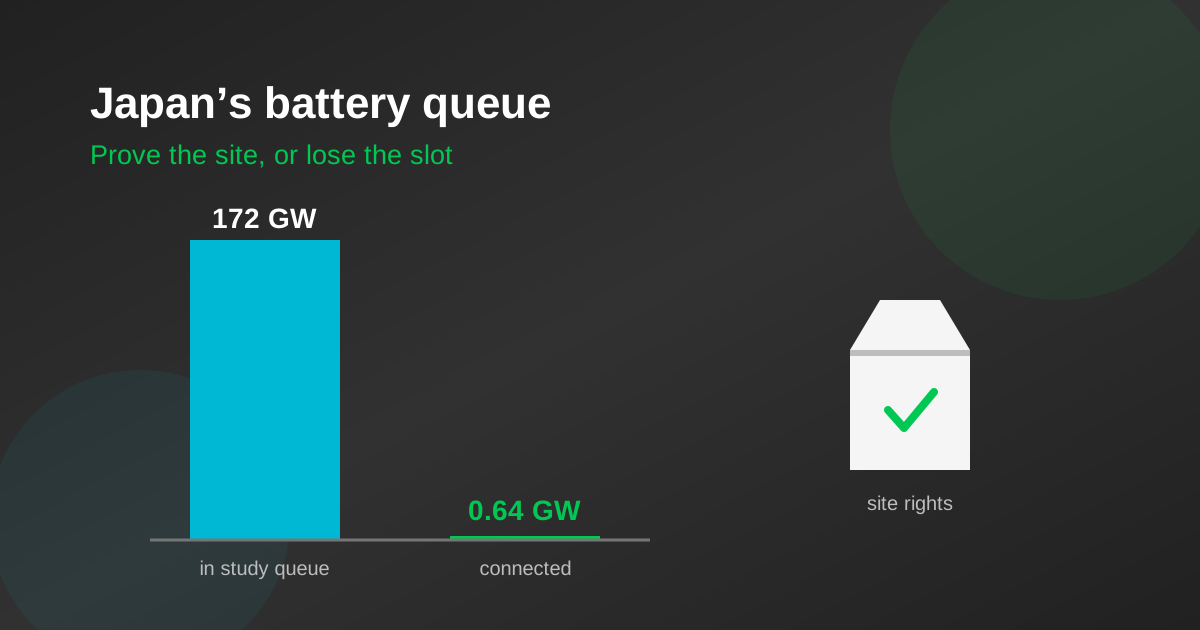
From 1 October, Japanese storage projects must show site rights within two months of grid approval. It is the third curb this year on a queue holding about 172 GW of grid batteries, against 0.64 GW connected.
Published: 11 October 2026
Grid storage · 3 min read
What happened
Written 11 October 2026, on a notice and quarterly grid-access statistics published by Japan’s Organization for Cross-regional Coordination of Transmission Operators (OCCTO) on 28 September, and reporting by ESS News on 2 October.
From 1 October, a generation or storage project in Japan that receives grid connection approval must submit documents proving its right to use the project site within two months, or lose its connection reservation. OCCTO’s notice of 28 September confirms that the land-use requirement took effect on 1 October.
ESS News reports that the rule applies to contract applications received from that date, covers all projects outside the feed-in tariff and feed-in premium schemes, and exempts upgrades at existing sites that do not raise output or otherwise affect the grid. Grid-scale batteries sit outside those schemes, so they are squarely in scope.
Why: a queue of batteries
Citing ministry figures, ESS News puts the queue at the end of December 2025 at about 172 GW of grid-scale battery capacity at the connection-study stage and about 30 GW at the contract-application stage. About 0.64 GW was actually connected. At the end of September 2024 the first two figures were about 88 GW and 6.2 GW.
OCCTO’s own statistics for April to June 2026 show the same pressure:
- •Connection-study applications rose to 6,796 from 5,657 a year earlier
- •Batteries accounted for 6,099 of them by generation type, 89 per cent
- •Contract applications rose to 1,627 from 1,037; batteries were 1,337, or 82 per cent, by type
- •Tokyo’s transmission company alone took 919 contract applications, against 247 a year earlier
172 GW in the study queue; 0.64 GW connected. On the ministry figures ESS News cites, capacity in the study queue was more than 250 times the grid-scale battery capacity actually connected. Much of it is unlikely to be built. The new rules exist to sort the projects that will from those holding a place in the queue.
The third measure this year
ESS News describes the site-rights rule as the third step in 2026 against low-certainty projects:
- •Since June, grid-scale battery projects must file their generation-side and demand-side contract applications at the same time
- •From 1 August, each transmission operator caps how many battery connection studies one company may request in its area: five in Hokkaido, Hokuriku, Chugoku and Shikoku, 11 in Tokyo and 12 in Kansai
- •From 1 October, proof of site rights within two months of approval
The caps followed a finding by a ministry working group, reported by ESS News, that several companies had filed more than 100 study requests with a single operator in a short period. Meanwhile, actual support is far smaller than the queue: Japan’s long-term decarbonisation auction awarded 1.25 GW of battery storage across 19 projects in May, down from 1.37 GW the year before.
What it means for this business
Japan is not our market, but the pattern is instructive. A storage project’s scarcest input is often not cells or capital but a confirmed grid connection, and regulators respond to speculative queues by asking for proof of land, sequencing and caps.
- •For a grid-scale developer in India, land and connectivity rights deserve the same diligence as the battery itself
- •A behind-the-meter commercial and industrial system sits on a site the owner already controls and usually works within the site’s existing connection, which keeps it out of this kind of queue
- •A large announced pipeline, in any country, says little about what will be commissioned
For how a factory system is sized within an existing connection, see sizing C&I storage in kW and kWh; for where Indian grid storage stands, see grid-scale battery storage in India and our battery storage page.
Sources
Reporting this piece draws on. Figures were correct as published; scheme terms and commodity prices move.
- Japan curbs grid capacity hoarding as battery queue hits 172 GWESS News · 2 October 2026
- 発電設備等に関する系統アクセスの流れの更新についてOrganization for Cross-regional Coordination of Transmission Operators (OCCTO) · 28 September 2026
- 発電設備等系統アクセス業務に係る情報の取りまとめ(2026年4月~2026年6月の受付・回答分)Organization for Cross-regional Coordination of Transmission Operators (OCCTO)
Frequently asked questions
What changed for battery projects in Japan on 1 October 2026?+
Projects that receive grid connection approval must submit documents proving their right to use the project site within two months, or lose their connection reservation. ESS News reports that it applies to contract applications received from 1 October and to all projects outside the feed-in tariff and feed-in premium schemes.
How big is Japan’s grid battery queue?+
Citing ministry figures, ESS News reports about 172 GW of grid-scale battery capacity at the connection-study stage and about 30 GW at the contract-application stage at the end of December 2025, against about 0.64 GW connected. OCCTO data show batteries made up 89 per cent of connection-study applications in April–June 2026.
Does this affect battery storage in India?+
Not directly. It shows that a confirmed grid connection, not cells or capital, is often the scarcest input for a grid-scale project. A behind-the-meter commercial and industrial system usually works within the site’s existing connection and stays out of such queues.
Is storage right for your site?
Send us a month of electricity bills and your load profile, and we will tell you what a battery would save — including when it would not pay.