Exide Commissions Its Bengaluru Cell Plant, and Three-Wheelers Come First
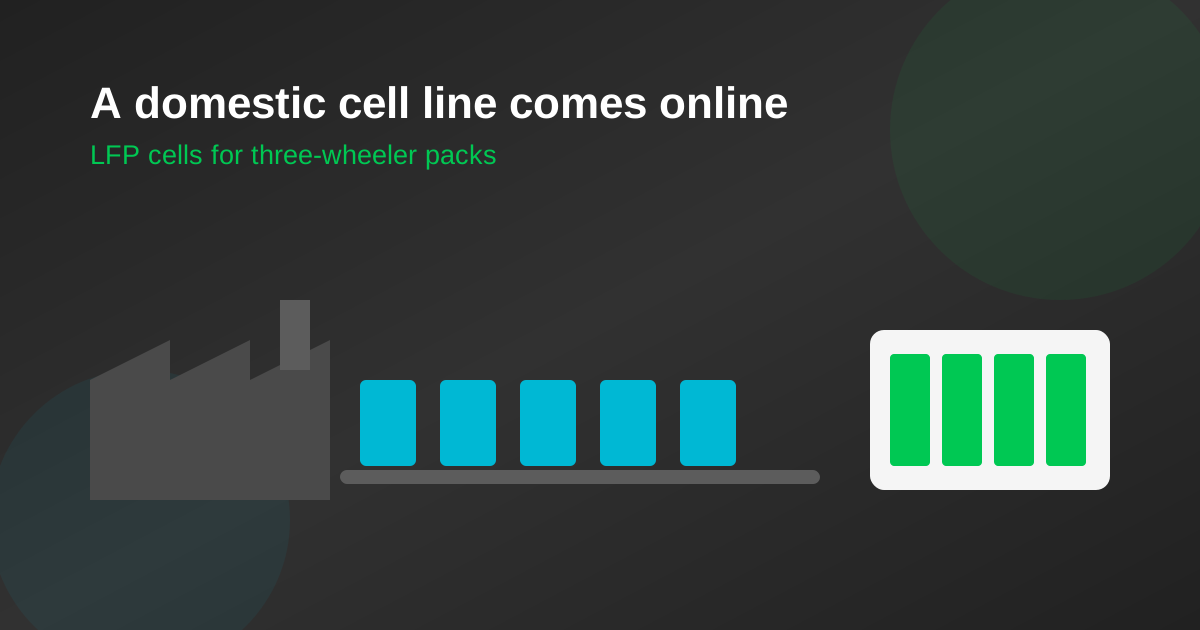
Exide Energy Solutions has commissioned the first phase of its lithium-ion cell plant near Bengaluru. Its first LFP cells go into electric three-wheeler packs in place of imported cells.
Published: 30 September 2026
Industry · 4 min read
What happened
Written 30 September 2026, on reporting by Mercom India, Upstox and Energetica India published 24–28 September 2026.
Exide Energy Solutions, a subsidiary of Exide Industries, has commissioned the first phase of its lithium-ion cell plant at Devanahalli near Bengaluru. Commissioning was reported on 23 September 2026. Mercom reports that Exide invested a further ₹1 billion in the subsidiary in July, bringing total investment to ₹49.02 billion.
The reports describe the capacity differently. Mercom calls it Phase I of a 6 GWh facility, and Energetica describes the 6 GWh as Phase I itself. How much of that 6 GWh is producing now, and how fast it ramps, has not been confirmed in anything we have read.
What the plant makes, and for whom
According to Energetica India, the plant makes both lithium iron phosphate (LFP) and nickel-manganese-cobalt (NMC) cells. The first LFP cells replace imported cells in the battery packs Exide assembles in Gujarat for electric three-wheelers. Two-wheeler packs are expected by the end of the financial year, and NMC cells are to be supplied to vehicle makers.
The detail that matters is the first customer. Much of the discussion of domestic cell capacity has been about cars and grid storage. This plant’s first LFP output goes into three-wheeler packs, a segment built almost entirely on imported cells.
Why it is only a start
India’s cell gap is large. As we reported in August, the cells in most packs sold here are imported, and locally made cells are expected to cost more than imports for some time. A plant that actually commissions matters for that reason: it shows the equipment, the process and the people can be put in place here.
Commissioning is not the same as competitive output. New cell lines take time to reach good yields, and early cells from a new plant typically cost more than those from mature Chinese lines running at scale. What matters is price and consistency a year from now, not the date on the ribbon.
What it means for this business
- •A domestic LFP cell for three-wheeler packs reduces exposure to import disruption, freight and currency swings
- •It is also a competitor: Exide assembles its own three-wheeler packs
- •Cell grading and consistency will decide whether it is a practical second source for independent pack makers
- •Still unconfirmed: current output, ramp schedule and whether the plant falls under the PLI scheme for advanced chemistry cells
For background on why the cell rather than the pack is the difficult part, see India’s battery manufacturing catch-up.
Sources
Reporting this piece draws on. Figures were correct as published; scheme terms and commodity prices move.
- Exide Commissions Phase I of 6 GWh Lithium-ion Cell PlantMercom India · 24 September 2026
- Exide Industries shares rise 2% as arm completes commissioning of Phase-I of lithium-ion cell mfg facilityUpstox · 24 September 2026
- Exide Commissions 6 GWh Phase-I Lithium-ion Cell Manufacturing FacilityEnergetica India · 28 September 2026
Terms in this article
Frequently asked questions
Where is the Exide lithium-ion cell plant?+
At Devanahalli, near Bengaluru in Karnataka. It is run by Exide Energy Solutions, a subsidiary of Exide Industries, and its first phase was reported commissioned on 23 September 2026.
What cells does it make?+
Both LFP and NMC chemistries, according to Energetica India. The first LFP cells replace imported cells in electric three-wheeler packs assembled at Exide’s Gujarat facility; two-wheeler packs are expected by the end of the financial year.
How large is the plant?+
Reports describe it around 6 GWh, but differ on whether that is the first phase or the whole facility. Current output and the ramp schedule have not been confirmed.
Want this applied to your own numbers?
Every solution page carries a calculator that shows its own arithmetic — storage savings, lithium against lead-acid, and home pack sizing.