China Exported a Record 606,000 NEVs in October, Ahead of Two Deadlines
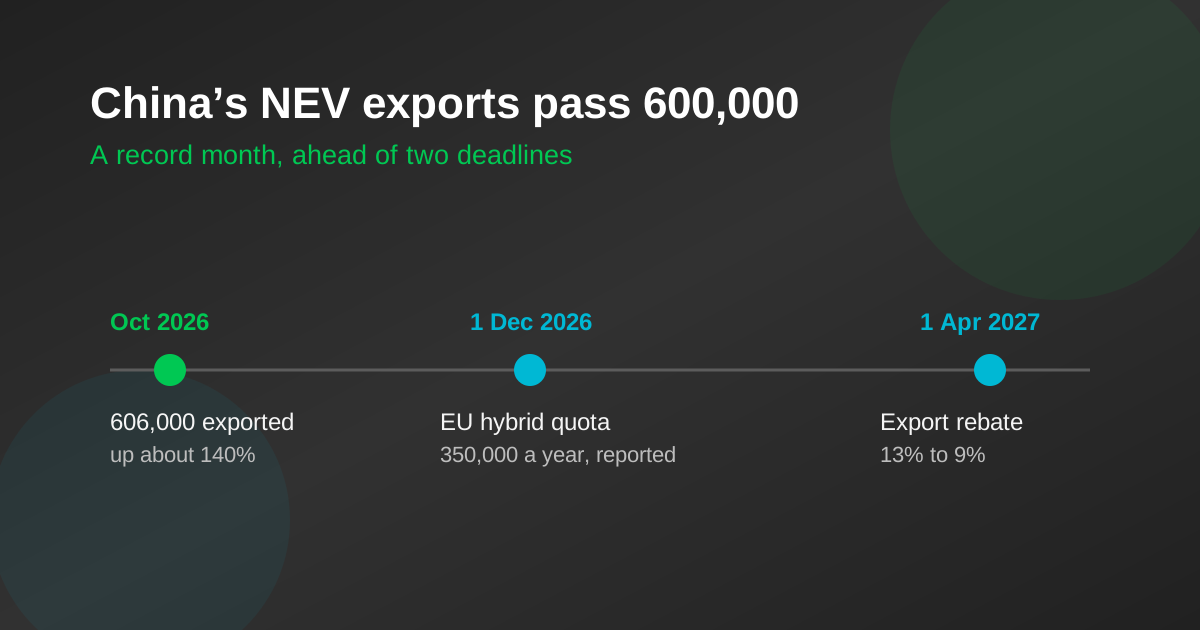
China’s NEV exports passed 600,000 in a month for the first time, up about 140 per cent. Carmakers say part of the rush was getting ahead of a cut in the export VAT rebate from 13 to 9 per cent in April 2027 and an EU quota on Chinese hybrids.
Published: 20 November 2026
Mobility · 3 min read
What happened
Written 20 November 2026, on CAAM and CPCA October data reported by CnEVPost on 9 and 11 November and Yicai Global on 11 November, CnEVPost and electrive reporting of the export rebate cut on 12 and 15 October, and electrive and CnEVPost reporting of the EU hybrid arrangement on 11 and 12 October.
China exported 606,000 new energy vehicles in October, according to the China Association of Automobile Manufacturers (CAAM), as reported by CnEVPost: up about 140 per cent on a year earlier and the first month above 600,000. Exports were about 31 per cent of all NEV sales. In the first ten months, NEV exports were 4.612 million, up 129 per cent, while domestic NEV sales fell 10.3 per cent.
The China Passenger Car Association (CPCA), which counts passenger cars only, puts October NEV exports at 582,000, up 144.7 per cent. On its numbers exports were 33 per cent of carmakers’ NEV wholesale, against 15 per cent a year earlier.
Two deadlines behind the surge
The CPCA says some export orders were delivered early “ahead of expected lower export tax rebates and overseas tariff changes,” and warns that this short-term support “should not be extrapolated into a sustained uptrend.” The two changes are:
- •A smaller export VAT rebate. On 12 October the Ministry of Finance and the State Taxation Administration said the rebate on NEV exports will fall from 13 per cent to 9 per cent from 1 April 2027, set by the export date on the customs declaration. It covers battery-electric and plug-in hybrid passenger cars, electric buses and electric truck tractors
- •An EU limit on Chinese hybrids. electrive, citing Bloomberg, reports a cap of 350,000 hybrid and plug-in hybrid cars a year from 1 December 2026, allowed to rise by up to 6 per cent a year, against about 800,000 the European Commission expects this year
The two sides describe the EU arrangement differently. EU trade commissioner Maroš Šefčovič said it would halve China’s hybrid exports to the bloc. China’s commerce ministry, reported by CnEVPost, said it allows growth from 2025 levels, when EU hybrid imports from China were 302,000, and did not disclose a quota.
What the rebate cut costs
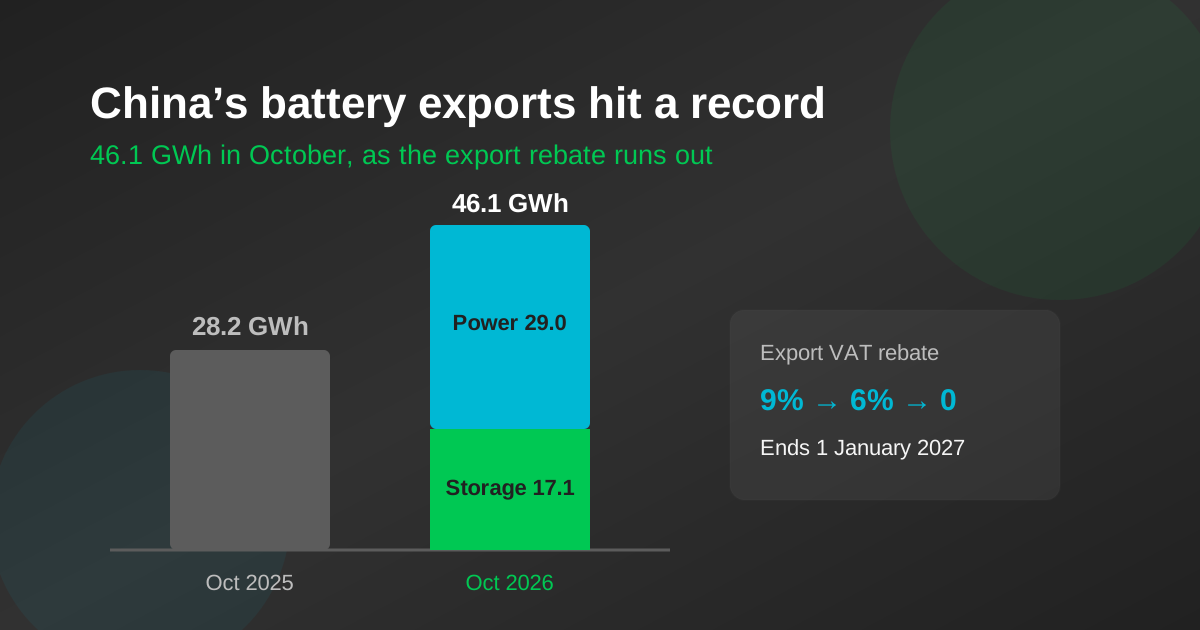
CnEVPost and electrive both report a Deutsche Bank estimate that the rebate cut will reduce BYD’s net profit by about ¥5,000 per exported vehicle from the second quarter of 2027. Neither government announcement gave a reason; economists quoted in the coverage link it to curbing price competition abroad. CnEVPost also notes that the rebate on battery exports was cut from 9 to 6 per cent and is due to be scrapped from 1 January 2027.
A third of China’s electric car shipments now go abroad. Part of October’s record was buyers and carmakers getting ahead of a tax change and a quota, so the trend line from here is likely to be flatter.
Yicai reports CPCA secretary-general Cui Dongshu as saying that total car exports have passed 10 million this year but that growth will probably slow to around 10 per cent next year.
What it means for this business
Wingzman does not import vehicles, so the car numbers themselves are background. The relevant points are narrower:
- •Beijing is now withdrawing export support across the battery chain, from solar modules to cells to finished cars; the end of the battery rebate in January 2027 bears directly on the landed cost of imported cells
- •With the EU capping hybrids, Chinese exporters will lean harder on markets without such limits, which is part of why “rest of world” EV sales are growing fastest
- •If export growth slows next year while the home market stays weak, more Chinese battery output could be looking for buyers; that is a possibility to watch, not a forecast
See the fastest-growing EV market in 2026, Chinese EV brands in Europe and what the strong yuan does to an Indian cell buyer.
Sources
Reporting this piece draws on. Figures were correct as published; scheme terms and commodity prices move.
- China NEV sales rise 13.1% to record 1.94 million in October, CAAM data showsCnEVPost · 11 November 2026
- China October NEV retail sales fall 13.7% as penetration hits record 67.5%, CPCA data showsCnEVPost · 9 November 2026
- China cuts NEV export tax rebates, testing profitability of automakers' overseas growthCnEVPost · 12 October 2026
- Chinese government cuts state subsidies for EV manufacturerselectrive · 15 October 2026
- China agrees to limit hybrid exports to the EUelectrive · 11 October 2026
- China says EU hybrid trade deal allows export growth from 2025 levelsCnEVPost · 12 October 2026
- China's Car Sales Fall for 13th Straight Month in October; NEV Adoption Hits New HighYicai Global · 11 November 2026
Frequently asked questions
How many NEVs did China export in October 2026?+
CAAM data, reported by CnEVPost, put NEV exports at 606,000, up about 140 per cent year on year and the first month above 600,000. The CPCA, which counts passenger cars only, put them at 582,000. In the first ten months NEV exports were 4.612 million, up 129 per cent.
What is changing in China’s NEV export tax rebate?+
The Ministry of Finance and the State Taxation Administration said on 12 October 2026 that the export VAT rebate on NEVs will fall from 13 to 9 per cent from 1 April 2027, set by the export date on the customs declaration. It covers battery-electric and plug-in hybrid passenger cars, electric buses and electric truck tractors.
What has the EU agreed with China on hybrid cars?+
electrive, citing Bloomberg, reports a cap of 350,000 Chinese hybrid and plug-in hybrid cars a year from 1 December 2026, rising by up to 6 per cent a year. The EU says it will halve China’s hybrid exports; China’s commerce ministry says it allows growth from 2025 levels and has not disclosed a quota.
Thinking about upgrading?
Talk to our team about the right pack for your vehicle, and about EMI options that keep the monthly outgo close to what you already spend.
Popular: Lithium e-rickshaw battery