Fourteen Per Cent: How Chinese EVs Grew Through a 45 Per Cent Tariff Wall
The EU imposed duties taking the burden to around 45 per cent, and Chinese brands took a record share of Europe’s battery-electric market anyway. Four routes around the wall, and why the real contest is the price of a small electric car.
Published: 24 August 2026
Industry · 12 min read
The tariff worked exactly as designed, and it did not work
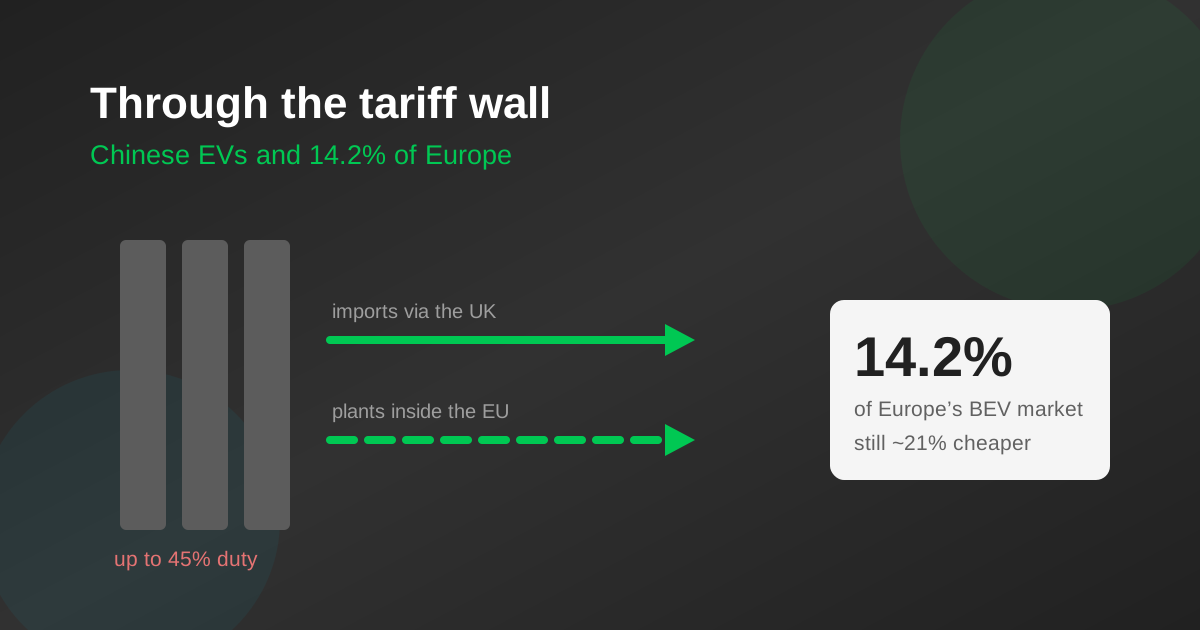
In October 2024 the European Union imposed definitive countervailing duties on battery-electric vehicles imported from China, on top of the standard 10 per cent car import duty. The rates were company-specific and steep: BYD came out lowest at around 17 per cent, with others considerably higher, and the top end of the range takes the total burden to something in the region of 45 per cent.
Two years on, Chinese brands are on track for a record share of roughly 14.2 per cent of Europe’s battery-electric market in 2026. BYD, Chery, SAIC and Xpeng sold around 171,800 vehicles across Western Europe in the first five months of the year alone. Chinese automakers have overtaken Japanese brands to become the second-largest group by market share in Europe. BYD, the manufacturer facing the lowest duty, more than doubled its BEV imports into the bloc.
Both of those things are true at once, and the interesting question is how. A 45 per cent wall is not a rounding error. What it ran into was a cost gap large enough to absorb it and a set of routes around it that the tariff was never designed to close.
The cost gap the tariff had to overcome
Even after duties, battery-electric vehicles from Chinese brands have been reported as around 21 per cent cheaper than those from European manufacturers. That is the whole story in one number. A tariff transfers margin; it does not create manufacturing cost parity.
The gap has three sources, and only one of them is subsidy. The first is the cell, where Chinese manufacturers hold a structural cost and scale advantage built over fifteen years — the subject of our piece on how that position was assembled. The second is vertical integration: BYD makes its own cells, semiconductors and much of its own drivetrain, so it captures margin at every stage instead of paying it to suppliers. The third is development speed — considerably shorter model cycles amortised over very high volume.
A tariff is a tax on the route, not on the cost base. It makes one path to the customer more expensive. Where the underlying cost advantage is larger than the duty, or where another path exists, the vehicles keep arriving.
Four routes around the wall
- •Sell where the wall is not. The United Kingdom applies no equivalent anti-subsidy duty, and it now accounts for roughly a quarter of Chinese EV sales across the eighteen biggest Western European markets — the single largest destination, ahead of Italy at about a fifth. A tariff imposed by a bloc redirects trade to the market outside it.
- •Change the product. The duties were levied on battery-electric vehicles. Plug-in hybrids and range-extended vehicles from the same manufacturers were not covered on the same terms, and shifting the mix toward them is the fastest available response — it requires no factory and no negotiation.
- •Take the lowest rate and scale it. Because the duties are company-specific, the firm assessed at around 17 per cent has a durable advantage over rivals at twice that. Concentrating exports through the least-penalised manufacturer is a rational market response to a differentiated tariff.
- •Build inside the wall. The permanent answer, and the one now underway.
Localisation is slower than announced, and it is still coming
BYD’s plant at Szeged in southern Hungary is the first Chinese-owned car factory in the European Union. It began trial production in early 2026, with assembly of the Dolphin Surf compact and mass production pushed to the fourth quarter of 2026 — roughly a year later than first indicated. Work on a planned Turkish plant has been paused while the company concentrates on European production and looks for a second EU site. Chery has similarly delayed the start of production at its Barcelona operation more than once.
The delays are real and they are being read too optimistically by European incumbents. Building a car plant in a new regulatory jurisdiction with a new supplier base and a new workforce is genuinely hard, and a year of slippage on a first attempt is unremarkable. It does not reverse anything. Once a vehicle is assembled inside the customs union, the anti-subsidy duty does not apply to it at all.
Analysis by Transport & Environment has made the awkward observation that the tariffs did shift production into the EU — including by Western carmakers repatriating models they had been building in China — while Chinese brands continued to grow their share regardless. Both effects were intended. Only one of them was the point.
What the incumbents are actually doing about it
The credible European response was never the tariff. It was the missing product: a small, genuinely affordable electric car, which the industry had spent a decade declining to build because the margins are thin and the segment had been ceded to imports.
| Model | Indicative entry price | Note |
|---|---|---|
| Citroën ë-C3 | from about €19,590 | The European sub-€20,000 electric car that arrived first; around 213 km WLTP from a 30 kWh pack |
| Renault Twingo E-Tech | from about €19,500 | Spring 2026; 27.5 kWh LFP pack, around 263 km WLTP, and materially cheaper again with French purchase support |
| VW ID. Polo | from about €25,000 | Volkswagen’s cheapest EV to date |
| VW ID. 1 | targeted under €20,000 | Expected 2027 — the segment where the competition is actually decided |
Note the pack sizes. A 27.5 kWh LFP battery is a deliberate decision to build a short-range, light, cheap city car rather than a compromised long-range one — the same insight that made the Chinese small-EV segment work, arrived at several years later. Renault and Volkswagen have also discussed collaborating on small EV development, which tells you how thin the economics are even for the largest players.
Reading the numbers carefully
A few cautions, because this topic attracts sloppy statistics in both directions.
- •14.2 per cent is a share of the battery-electric market, not of all cars. Chinese brands’ share of the total European car market is a considerably smaller figure — reported around 6.8 per cent. Both get quoted as "Chinese share of Europe" and they are not the same claim.
- •Brand nationality is not build location. A Chinese-brand car assembled in Hungary and a European-brand car imported from Shanghai both cut against the intuition the headline creates.
- •Western Europe is not the EU. The UK’s outsized role in these figures exists precisely because it is outside the tariff, so any EU-only comparison will look different.
- •Company-specific duties make averages misleading. There is no single Chinese EV tariff rate, and the spread between firms is wide enough to change competitive outcomes between them.
The lesson that travels
For anyone watching this from India, the European experiment is unusually informative, because it is a well-run natural test of whether tariffs alone can hold back a cost-advantaged competitor.
The answer so far is that they buy time and they change routes. They redirected trade to the UK, shifted product mix toward hybrids, advantaged the lowest-tariffed exporter, and accelerated exactly the localisation they were partly designed to encourage. What they did not do is reduce the share Chinese brands hold, because the cost gap that created the share was never about where the car was assembled.
The thing that will decide the European market is the product on the second table above, not the duty on the first. Protection creates the window; the window only matters if somebody builds a competitive small electric car inside it.
Frequently asked questions
What share of the European EV market do Chinese brands have?+
Chinese brands are on track for a record 14.2 per cent of Europe’s battery-electric market in 2026, with BYD, Chery, SAIC and Xpeng selling around 171,800 vehicles across Western Europe in the first five months alone. Chinese automakers have also overtaken Japanese brands to become the second-largest group by market share. Note that their share of the total European car market, including combustion vehicles, is a much smaller figure reported around 6.8 per cent — the two numbers are frequently confused.
How high are EU tariffs on Chinese electric cars?+
The countervailing duties are company-specific and sit on top of the standard 10 per cent car import duty. BYD received the lowest rate at around 17 per cent, while others including Geely and SAIC were assessed considerably higher, taking the total burden at the top end to roughly 45 per cent. Because the rates differ by firm, there is no single "Chinese EV tariff" and the spread is wide enough to shift competition between the Chinese manufacturers themselves.
Why did the tariffs not stop Chinese EV growth?+
Because the underlying cost advantage is larger than the duty and there were routes around it. Chinese-brand BEVs have been reported around 21 per cent cheaper than European equivalents even after tariffs, thanks to cell cost advantage, vertical integration and short development cycles. Beyond that, sales shifted to the UK, which applies no equivalent duty and now takes roughly a quarter of Chinese EV sales across the eighteen biggest Western European markets; product mix shifted toward plug-in hybrids not covered on the same terms; volume concentrated through the lowest-tariffed manufacturer; and localisation began.
Is BYD building cars in Europe?+
Yes. Its plant at Szeged in southern Hungary is the first Chinese-owned car factory in the EU. It began trial production in early 2026 and mass production of the Dolphin Surf compact was pushed to the fourth quarter of 2026, about a year later than first indicated. Work on a planned Turkish plant is paused while the company focuses on Europe and looks for a second EU site, and Chery has similarly delayed its Barcelona operation. Once a car is assembled inside the customs union the anti-subsidy duty does not apply to it.
How are European carmakers responding?+
With the small affordable electric car the industry had declined to build for a decade. The Citroën ë-C3 starts from about €19,590, the Renault Twingo E-Tech from about €19,500 with a 27.5 kWh LFP pack and around 263 km WLTP, Volkswagen’s ID. Polo from about €25,000, and an ID. 1 is targeted under €20,000 for 2027. Renault and Volkswagen have discussed collaborating on small EV development, which indicates how thin the margins are in this segment.
Thinking about upgrading?
Talk to our team about the right pack for your vehicle, and about EMI options that keep the monthly outgo close to what you already spend.
Get in touch