China’s E-Bike Market Shrank. Its Riders Moved Up to Electric Motorcycles.
China’s electric two-wheeler sales fell 4.8 per cent in the first nine months of 2026 after a tougher safety standard and the end of e-bike trade-in subsidies. Delivery riders and commuters moved to faster electric motorcycles, and makers’ profits fell.
Published: 20 November 2026
Mobility · 3 min read
What happened
Written 20 November 2026, on an analysis by 市值榜 (Shizhibang) published by 36Kr on 9 November citing AVC data and company results, Caixin Global’s report of 12 March, and SMM’s report of Yadea’s interim results on 26 August.
China’s electric two-wheeler market is shrinking this year. According to AVC data cited by 36Kr, domestic sales were 48.378 million in the first three quarters of 2026, down 4.8 per cent on a year earlier. The first half was down 12.6 per cent; the third quarter recovered, up 9 per cent.
The comparison is with a record. 36Kr reports that 2025 sales reached 58.767 million, helped by a national trade-in subsidy under which more than 12.5 million electric bicycles were replaced, and that electric bicycles are no longer in the national trade-in scheme in 2026. Some of this year’s demand was bought last year.
The new standard
The other cause is regulatory. Caixin reports that a revised national e-bike safety standard, aimed at reducing fires, took effect on 1 September 2025, and that sales of non-compliant models were banned from 1 December 2025. February 2026 sales fell 37.9 per cent to 2.99 million, which Caixin put down to the holidays and the transition.
36Kr lists what compliance changed:
- •Tighter rules on battery safety, fire resistance, charger protection and tampering
- •Certification test items up from 38 to 112
- •The compliant version of the same model typically ¥300–600 dearer
- •A 25 km/h cap on electric bicycles, enforced against tampering
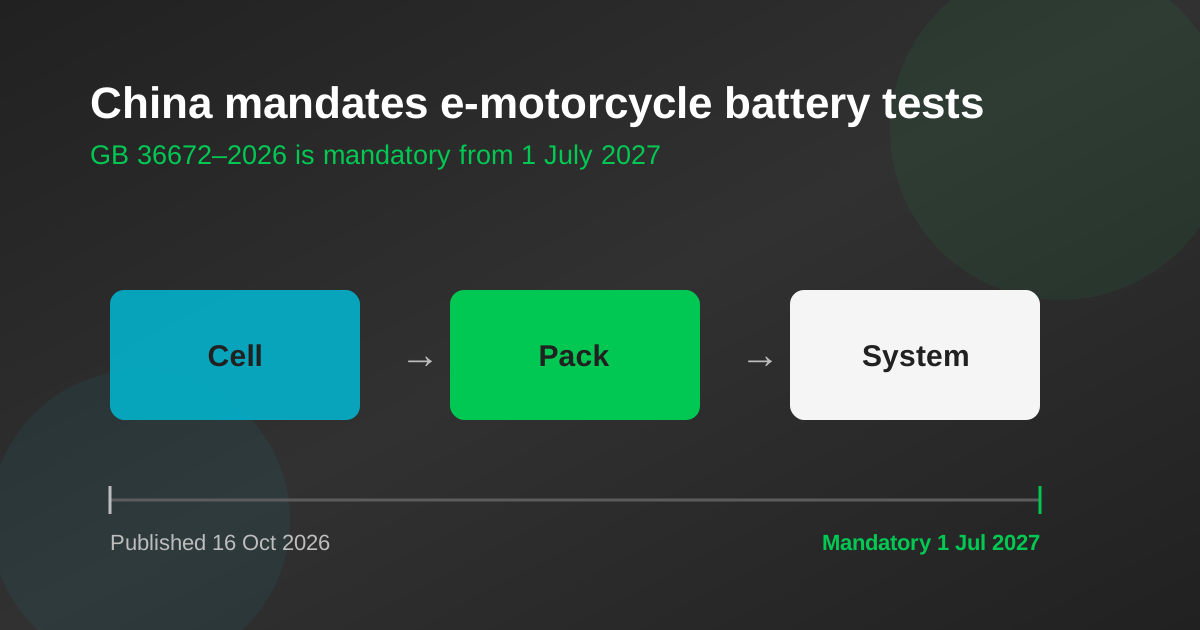
The motorcycles riders are moving to face their own battery rules next: China has made its e-motorcycle battery safety standard mandatory from July 2027.
Riders moved up a class
The speed cap hit the riders who use a two-wheeler for work. 36Kr reports that delivery riders and long-distance commuters moved to light electric motorcycles (25–50 km/h) and electric motorcycles, which it says offer more range, more load and compatibility with battery swapping. Entry-level electric motorcycles now sell for about ¥3,000, against more than ¥3,500 for many compliant e-bikes.
The makers’ first-half numbers, as 36Kr reports them:
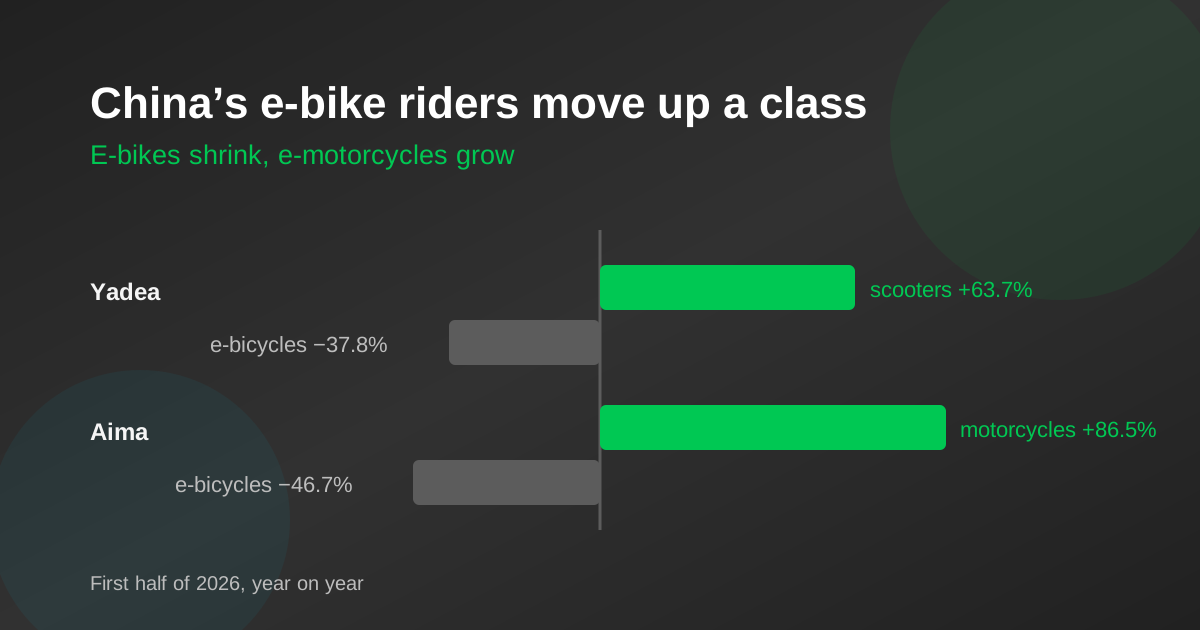
- •Yadea: electric scooter sales of 3.4842 million, up 63.7 per cent, while its electric bicycle business shrank 37.8 per cent
- •Aima: electric motorcycle sales of 2.125 million, up 86.5 per cent, electric bicycles down 46.7 per cent
- •Ninebot: electric motorcycles went from 51 per cent of its two-wheeler sales in the first half of 2025 to more than 90 per cent
Profits fell across the board. SMM reports Yadea’s first-half revenue down 5 per cent to ¥18.236 billion and net profit down 27.2 per cent to ¥1.201 billion, which the company attributed to the transition to the new standard. For the first three quarters, 36Kr reports Aima’s net profit down 42.1 per cent and Ninebot’s down 24.4 per cent, the latter despite revenue up 19.32 per cent.
A safety rule did not end the market; it moved it. Buyers who need speed, range and swappable batteries went up a vehicle class, and the makers who followed them kept volume but lost margin.
What it means for this business
China’s market is the nearest large precedent for what Wingzman sells into. The parallels are useful, with limits:
- •A tougher safety standard raised costs and briefly hit sales before volume recovered; India’s AIS-156 battery rules for scooters were the comparable step here
- •Commercial riders chose range, load and battery swapping over the cheapest compliant vehicle; Indian e-rickshaw and delivery operators weigh running cost the same way
- •A subsidy pulled demand forward and its removal left a gap; India’s PM E-DRIVE support has been extended, so that cliff is further off here
See AIS-156 in our glossary, the extension of India’s two-wheeler subsidy and fixed versus removable scooter batteries.
Sources
Reporting this piece draws on. Figures were correct as published; scheme terms and commodity prices move.
- Why are even small electric two-wheelers no longer selling well?36Kr (from 市值榜) · 9 November 2026
- China E-Bike Sales Plunge 38% as Holidays, Tougher Safety Rules Hit DemandCaixin Global · 12 March 2026
- Yadea Reports Decline in Revenue and Profit Amid New National Standards TransitionShanghai Metals Market (SMM) · 26 August 2026
Terms in this article
Frequently asked questions
Are electric two-wheeler sales falling in China?+
Yes, modestly. AVC data cited by 36Kr put domestic sales at 48.378 million in the first three quarters of 2026, down 4.8 per cent. The first half was down 12.6 per cent and the third quarter up 9 per cent. 2025 was a record 58.767 million, helped by trade-in subsidies.
What did China’s new e-bike standard change?+
Caixin reports that the revised safety standard took effect on 1 September 2025 and that non-compliant models could not be sold from 1 December 2025. 36Kr reports that it tightened battery safety, fire resistance, charger protection and anti-tampering rules, raised certification test items from 38 to 112 and added ¥300–600 to a typical model.
Where did the buyers go?+
To electric motorcycles, according to 36Kr. The 25 km/h cap on electric bicycles pushed delivery riders and long-distance commuters to faster light electric motorcycles and motorcycles, which offer more range and battery swapping. Aima’s electric motorcycle sales rose 86.5 per cent in the first half while its e-bicycle sales fell 46.7 per cent.
Thinking about upgrading?
Talk to our team about the right pack for your vehicle, and about EMI options that keep the monthly outgo close to what you already spend.
Popular: Lithium e-rickshaw battery