The Electric Two-Wheeler Subsidy Did Not End. It Was Extended to 2028.
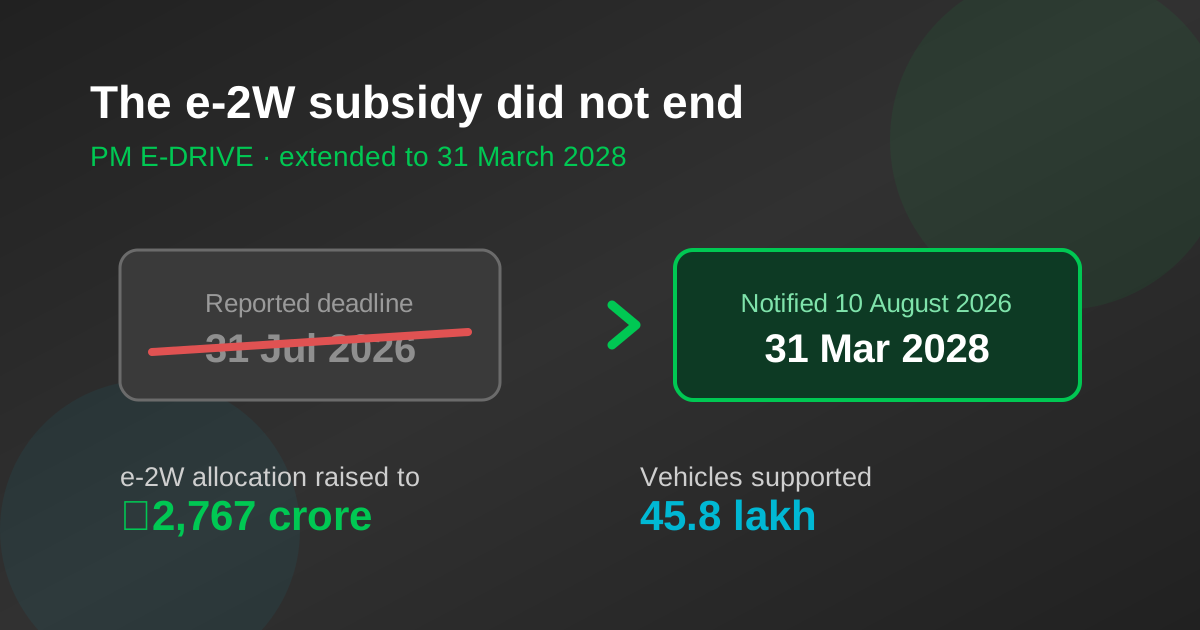
The PM E-DRIVE incentive for e-2Ws lapsed on 31 July 2026 and was reinstated ten days later, to March 2028, with a bigger budget. What it is worth now, why three-wheelers are a different story, and how to check what actually applies to you.
Published: 22 August 2026
Policy · 8 min read
What happened
Written 22 August 2026, from the Ministry of Heavy Industries amendment notified on 10 August 2026 and the Press Information Bureau release that followed. Scheme terms change; check the PM E-DRIVE portal before you rely on a number here.
Through July, a good deal of coverage told electric two-wheeler buyers that the central purchase subsidy was finished. That was accurate at the time. The demand incentive for e-2Ws under PM E-DRIVE had already been pushed once from 31 March 2026 to 31 July 2026, and on 1 August it duly lapsed. Several outlets ran the arithmetic on what that would add to a showroom price — somewhere between ₹5,000 and ₹10,000 depending on the model.
Ten days later the Ministry of Heavy Industries amended the scheme. The terminal date for the e-2W subsidy moved to 31 March 2028, the segment’s allocation rose by ₹1,000 crore to ₹2,767 crore, and the number of two-wheelers the scheme will support went from about 24.8 lakh to 45,79,120 — an increase of roughly 21 lakh vehicles, or 85 per cent. The overall PM E-DRIVE outlay was raised to ₹11,900 crore and the scheme itself extended by two years, to 31 March 2028.
If you were told in early August that the e-2W subsidy is gone, that information is now out of date. It is running again, to March 2028, with a larger budget behind it than it had before.
What the incentive is actually worth
The rate is not what it was at the start of the scheme, and the gap matters when you are reading older articles.
- •In the scheme’s first year the subsidy was ₹5,000 per kWh of battery capacity, capped at ₹10,000 per vehicle.
- •From April 2025 that halved to ₹2,500 per kWh, capped at ₹5,000 per vehicle.
- •The current terms also cap the benefit at 15 per cent of the ex-factory price, whichever of the three limits is lower.
For a typical 2.5 to 3 kWh commuter scooter, the per-kWh calculation lands above the per-vehicle cap, so the cap is what binds: ₹5,000. On a cheaper model the 15 per cent test can bite first — below roughly ₹33,000 ex-factory, 15 per cent is the smaller number. In practice most buyers of a mainstream electric scooter should expect ₹5,000, not a figure scaled to their battery size.
It is a meaningful discount and it is not a transformation. On a scooter selling around ₹1 lakh on-road it is roughly five per cent. Anyone deciding between petrol and electric on the strength of the subsidy alone is deciding on the wrong variable.
Three-wheelers are a different story
The e-2W extension does not mean everything under PM E-DRIVE was extended on the same terms. The demand subsidy for L5 category electric three-wheelers closed earlier, in December 2025, once the segment hit its sales target under the scheme. That closure has not been reversed.
What continues to 31 March 2028 is support for electric three-wheelers in the other covered categories, e-trucks, e-buses, e-ambulances and public charging infrastructure. For an e-rickshaw buyer specifically, the practical position is that the central demand incentive is not the lever it once was, and state-level policies plus the underlying cost per kilometre matter considerably more.
This is the recurring shape of Indian EV incentives: a segment is supported until it reaches a volume target, then support is withdrawn from that segment and redeployed. Building a purchase decision on a subsidy that is designed to expire is a way of being surprised.
How to check what applies to you
- •Confirm the model is registered under PM E-DRIVE. The incentive is claimed by the OEM against an e-voucher and shown as a deduction on your invoice — you do not apply for it separately, and you should be able to see it itemised.
- •Read the invoice, not the advertisement. If a dealer quotes an “after subsidy” price, ask which subsidy and at what rate — central, state, or a discount the dealer is funding themselves and calling a subsidy.
- •Check your state separately. State EV policies run on their own timelines and budgets, and several have their own road tax and registration waivers that are worth more than the central incentive.
- •Ask what happens if the scheme funds run out mid-order. The allocation is capped in vehicles as well as rupees; a booking is not a claim.
The number that actually decides it
A ₹5,000 incentive changes the purchase price. What changes the ownership cost is the battery: how long it lasts, what it costs to replace, and how much you pay per kilometre to charge it over the years you keep the vehicle. Those figures are larger than the subsidy by an order of magnitude, and unlike the subsidy they are not going to be amended by notification.
If you want to put your own numbers against that, the mobility savings calculator works out replacements, charging cost and cost per kilometre over a holding period you choose, and the EMI calculator will show you the APR behind any finance offer you are quoted.
Sources
Reporting this piece draws on. Figures were correct as published; scheme terms and commodity prices move.
- The Ministry of Heavy Industries extends the tenure of the PM E-DRIVE Scheme by 2 years from 31 March 2026 to 31 March 2028Press Information Bureau
- India extends e-2W incentives under PM E-DRIVE scheme, increases total outlayelectrive · 14 August 2026
- PM E-Drive subsidy for electric two-wheelers extended to March 2028Autocar India
Frequently asked questions
Is the electric two-wheeler subsidy still available in India?+
Yes. The demand incentive lapsed on 31 July 2026, but the Ministry of Heavy Industries amended the scheme on 10 August 2026 and extended the terminal date for electric two-wheelers to 31 March 2028. Reports published in the first ten days of August saying the subsidy had ended were accurate when written and are now out of date.
How much is the PM E-DRIVE subsidy on an electric scooter?+
₹2,500 per kWh of battery capacity, capped at ₹5,000 per vehicle or 15 per cent of the ex-factory price, whichever is lowest. For most mainstream scooters the ₹5,000 cap is what binds. The higher ₹5,000 per kWh rate with a ₹10,000 cap applied only in the scheme’s first year and was halved from April 2025.
Do electric three-wheelers still get the subsidy?+
The demand subsidy for L5 category electric three-wheelers closed in December 2025 once the segment met its sales target, and that has not been reversed. Support continues to 31 March 2028 for other covered categories including e-trucks, e-buses, e-ambulances and public charging infrastructure.
How do I claim the subsidy?+
You do not claim it separately. The manufacturer claims it against an e-voucher and it appears as a deduction on your invoice, so you should be able to see it itemised. If a dealer quotes an “after subsidy” price, ask which subsidy and at what rate — some dealer discounts are presented as government incentives.
Want this applied to your own numbers?
Every solution page carries a calculator that shows its own arithmetic — storage savings, lithium against lead-acid, and home pack sizing.
Get in touch