Brazil’s First Battery Auctions Are Weeks Away. Who Pays Is Still Open.
Brazil holds its first grid battery auctions on 2 and 4 December. Its regulator has only now opened a consultation on how the cost is shared, and a law placing it on generators alone is being challenged.
Published: 11 October 2026
Policy · 4 min read
Two auctions, eight weeks out
Written 11 October 2026, on reporting by Agência iNFRA and Times Brasil of a decision by Brazil’s electricity regulator ANEEL on 6 October 2026, by ESS News of a ministry ordinance published on 29 September, and by Canal Solar and the energy research agency EPE on the auction timetable. Portuguese sources are summarised in our own translation.
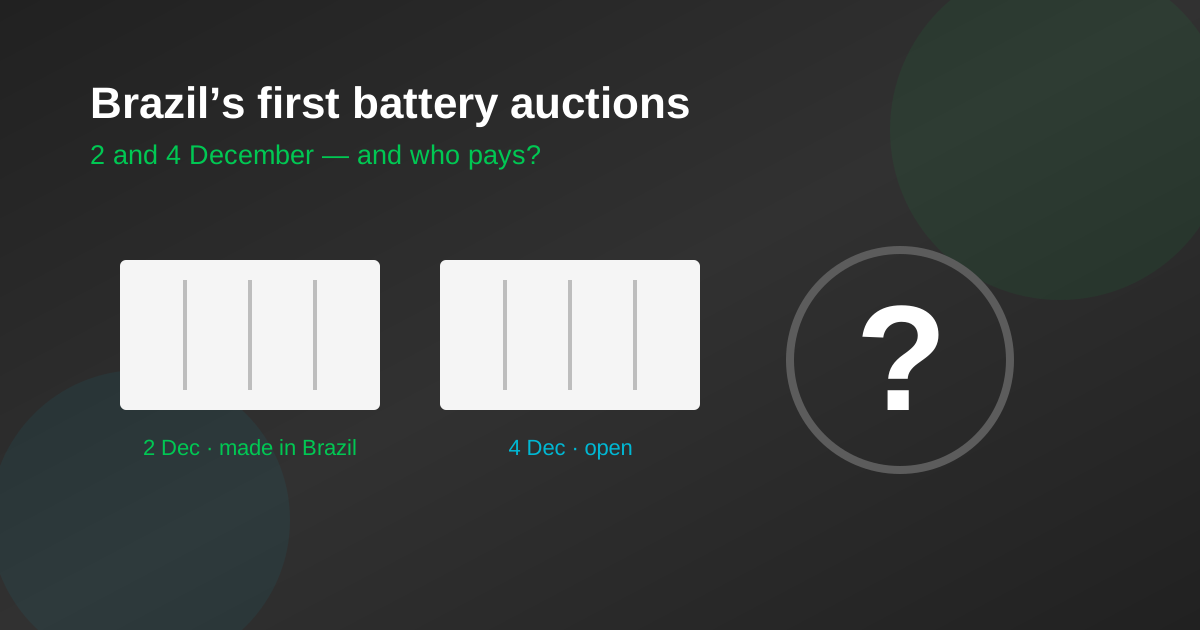
Brazil is due to hold its first auctions for grid batteries on 2 and 4 December 2026. Both buy capacity from standalone storage on 15-year contracts, with supply starting on 1 August 2028, as reported by Canal Solar. The first, “Armazenamento Nacional”, requires batteries made in Brazil. The second is open to imported equipment.
Interest is not the problem. EPE, the government’s energy planning agency, said in August that 6,091 projects totalling 296,807 MW had registered, a record for a Brazilian power auction. It cautioned that registration does not make a project eligible; that comes after technical qualification.
The open question: who pays
On 6 October ANEEL’s board opened a 30-day public consultation on how the cost of the contracted batteries should be recovered. Times Brasil reports contributions are open from 8 October to 9 November.
The starting point is the law. Times Brasil notes that Law 15.269/2025, which modernised the power sector, assigns the cost of battery contracts to generators alone, not to consumers. ANEEL’s technical staff propose spreading the charge across all generators according to how much flexibility each gives the system:
- •Intermittent plants, which do not provide firm power, would pay 100 per cent of the charge (Agência iNFRA)
- •More flexible plants would pay between 75 and 25 per cent; wind, solar and nuclear more, thermal less, hydro least (Agência iNFRA)
- •Small distributed generation would, in principle, be left out (Agência iNFRA)
- •The grid operator ONS has proposed a lower charge for plants that deliver more power at the evening peak (Agência iNFRA)
Why this matters to bidders. A battery’s revenue under these contracts is a fixed capacity payment. Who funds that payment, and whether the rule could change mid-contract, is a credit question for every lender looking at a bid.
A rule that may not survive
The allocation is contested. Times Brasil reports that bills in Congress aim to overturn it. ESS News reports that Absae, the storage industry association, wants the generator-only rule repealed through Bill 3716/26, arguing that it undermines technology neutrality because other capacity costs are shared with consumers. Absae cites a study it commissioned from Volt Robotics finding that batteries can meet the evening peak at fixed costs up to 60 per cent below thermal plants.
The timing is tight. The auction notice must be approved by the end of October to be published 30 days ahead, and ANEEL’s rapporteur, director Gentil Nogueira, said it could set its own cost rules for these contracts, according to Times Brasil. Agência iNFRA reports the consultation itself is expected to conclude after the first auction. A ministry ordinance published on 29 September also makes batteries eligible for a capacity auction in the second half of each year from 2027 to 2029, ESS News reports.
What it means for this business
Brazil is not a market Wingzman serves. The useful comparison is with India, where the same question, who carries the fixed cost of grid storage, is answered differently: through viability gap funding and capacity charges that distribution companies pass on in tariffs. Brazil’s split between a domestic-content auction and an open one is also worth watching, since India faces the same trade-off between building local cell supply and buying storage at the lowest price.
For a buyer of commercial storage the lesson is narrower. Policy decides who pays for grid batteries; it does not change what a battery on your own site saves. Our explainer on grid-scale storage in India sets out how the Indian framework works.
Sources
Reporting this piece draws on. Figures were correct as published; scheme terms and commodity prices move.
- ANEEL abre consulta sobre custeio de baterias a ser rateado entre geradoresAgência iNFRA · 6 October 2026
- Aneel propõe consulta de 30 dias sobre custos de sistemas de bateriasTimes Brasil · 6 October 2026
- Brazil includes batteries in capacity auction calendar through 2029ESS News · 1 October 2026
- ANEEL enfrenta impasse sobre encargos, mas mantém leilão de baterias para dezembroCanal Solar · 2 September 2026
- LRCAP Armazenamento 2026: EPE registra recorde de projetos cadastradosEPE · 3 August 2026
Terms in this article
Frequently asked questions
When are Brazil’s first battery auctions?+
On 2 and 4 December 2026. The first requires batteries made in Brazil and the second is open to imported equipment. Both offer 15-year capacity contracts with supply from 1 August 2028, as reported by Canal Solar.
Who pays for the batteries Brazil contracts?+
Law 15.269/2025 assigns the cost to generators, not consumers. ANEEL opened a consultation on 6 October 2026, running to 9 November, on a proposal to share the charge among generators according to how much flexibility each gives the system.
How much interest is there?+
EPE reported in August that 6,091 projects totalling 296,807 MW had registered, a record for a Brazilian power auction. Registration does not make a project eligible; only projects that pass EPE’s technical qualification can bid.
Want this applied to your own numbers?
Every solution page carries a calculator that shows its own arithmetic — storage savings, lithium against lead-acid, and home pack sizing.