What Happens to a Lithium Battery When It Wears Out
A retired e-rickshaw pack still holds most of its capacity and all of its materials. Second life, recycling, the path to avoid, and what India’s Battery Waste Management Rules make producers responsible for.
Published: 30 September 2026
Environment · 7 min read
Worn out is not the same as finished
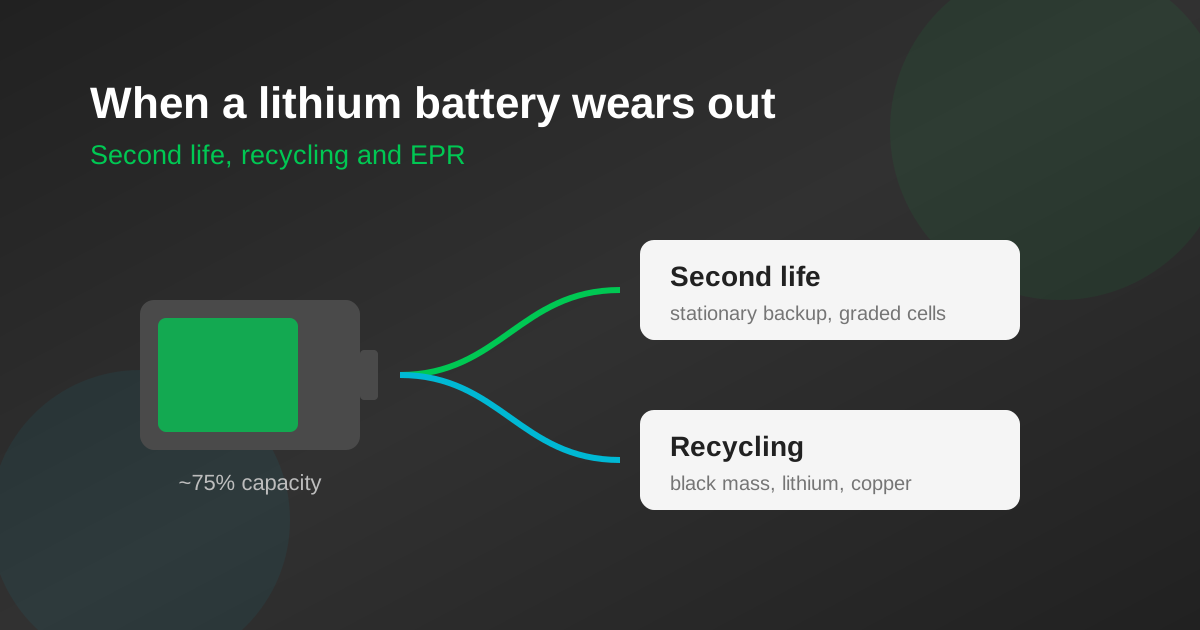
An e-rickshaw pack is usually retired when it can no longer carry the vehicle through a working day — somewhere around 70 to 80 per cent of its original capacity. For the driver, that battery is done. For the cells inside it, it often is not. Most of the chemistry is still there, most of the capacity is still there, and the materials in it are still worth recovering.
What happens next has three possible paths: a second life in a less demanding job, recycling into raw materials, or the path nobody should take — being broken open by hand for the copper and dumped. This post is about how each works, and what India’s rules say about who is responsible.
Path one: a second life
A vehicle is one of the hardest jobs a battery can do. It must deliver high current up hills, fit in a small space, and carry enough energy for a full shift. A stationary job — backing up a shop, a telecom tower or a small solar system — asks much less. Current is lower, space is less tight, and a pack with 75 per cent of its capacity simply means installing a little more of it.
Lithium iron phosphate (LFP) is well suited to this. It has a long cycle life and a gradual, predictable fade, so a pack that has lost a quarter of its capacity usually has a good deal of useful life left in a gentler role.
But repurposing is not simply plugging an old pack into a new use. Done properly, it means:
- •Testing every cell group for capacity and internal resistance, not only the pack as a whole
- •Removing groups that have degraded faster than the rest, which would otherwise limit the whole pack
- •Rebuilding with matched groups, so the pack does not spend its second life fighting imbalance
- •Fitting a battery management system configured for the new duty
- •Stating honestly what the repurposed pack is, and warranting it as such
Path two: recycling
Eventually every cell reaches the point where it is not worth using, and the value is in the materials. Modern lithium-ion recycling typically begins by discharging and shredding the cells into a mixed powder called black mass, with the copper, aluminium and steel separated out along the way. The black mass is then processed — most commonly by dissolving it chemically (hydrometallurgy) — to recover lithium and other metals in a form that can go back into new batteries.
The economics depend heavily on chemistry. Nickel- and cobalt-based cells contain expensive metals, and recovering them has historically paid for the process. LFP does not: iron and phosphate are cheap, so an LFP recycler relies on the lithium, the copper and aluminium, and on regulation to make the sums work. That is one reason policy matters more for LFP recycling than for other chemistries.
Path three: what should not happen
Lead-acid batteries in India have a long-established collection trade, formal and informal, and many buyers assume a spent lithium pack can go the same way. It should not. A lithium cell broken open with hand tools can short, heat and catch fire, and the electrolyte and its fumes are hazardous. Packs with physical damage or swelling are the most dangerous of all.
- •Do not sell a lithium pack to a scrap buyer who will break it open for the copper
- •Do not store a swollen, dented or leaking pack indoors or near anything flammable
- •Do not throw a pack, or loose cells, in household waste
- •Do ask the seller or the brand how they take packs back — they may be obliged to
Who is responsible: the Battery Waste Management Rules
India’s Battery Waste Management Rules, notified by the Ministry of Environment, Forest and Climate Change in 2022 and amended since, replaced the older lead-acid-focused rules and cover every battery chemistry, including the lithium packs in vehicles and home storage.
Their central idea is extended producer responsibility (EPR): the business that places a battery on the market — the manufacturer, importer or brand — is responsible for seeing that an equivalent quantity is collected and recycled or refurbished at the end of its life. In outline, the mechanism works like this:
- •Producers register on a central online portal run by the Central Pollution Control Board
- •They are set collection and recycling obligations linked to what they sell
- •Registered recyclers and refurbishers issue EPR certificates for what they process
- •Producers meet their obligations by acquiring those certificates
- •Recyclers must meet minimum material-recovery requirements, and new batteries are expected to contain a rising share of recycled material over time
- •Non-compliance can attract environmental compensation
The specific targets, percentages and timelines are set out in the rules and their amendments and have changed more than once, so we do not quote them here. The Ministry’s notification and the CPCB’s EPR portal are the places to check the current figures.
What this means for a battery owner
The practical upshot is simple. The seller of your battery, or the brand behind it, has a regulatory reason to want it back, and a registered recycler has a commercial one. You should not have to pay to dispose of a lithium pack responsibly, and in many cases a spent pack still has some value against a new one.
When you buy, ask the question you will need answered in five years: what happens to this pack when it is worn out? A seller with a real answer — a take-back route, a registered recycling partner, a buy-back value — is also telling you something about how seriously they take the years in between.
Terms in this article
Frequently asked questions
Can a worn-out e-rickshaw battery be reused?+
Often, yes. A pack retired at 70 to 80 per cent of its capacity can serve in a less demanding stationary role such as shop or telecom backup. Done properly, that means testing and grading each cell group, removing weak ones and rebuilding with matched groups under a suitably configured BMS.
Is LFP battery recycling profitable?+
Less so than for nickel- and cobalt-based chemistries, because iron and phosphate are cheap. An LFP recycler relies on the lithium, copper and aluminium, and on regulation, to make the economics work.
What do India’s Battery Waste Management Rules require?+
They place extended producer responsibility on the manufacturer, importer or brand that sells a battery: producers register with the Central Pollution Control Board and meet collection and recycling obligations, largely by acquiring EPR certificates from registered recyclers and refurbishers. Targets and timelines have been amended more than once, so check the current notification for figures.
Can I sell a dead lithium battery to a scrap dealer?+
You should not sell it to anyone who will break it open by hand. Lithium cells can short and catch fire when damaged. Ask the seller or brand about take-back, since producers carry recycling obligations under the rules.
Want this applied to your own numbers?
Every solution page carries a calculator that shows its own arithmetic — storage savings, lithium against lead-acid, and home pack sizing.