How Power Transmission Works: From the Generator to Your Charger
Electricity is the only commodity that must be produced the instant it is consumed. A comprehensive walk through generation, transmission, substations, distribution, grid frequency, and why renewables made storage essential.
Published: 16 August 2026
Industry · 12 min read
The problem the grid exists to solve
Electricity is the only major commodity that must be produced at the exact instant it is consumed. There is no warehouse. Every time someone in your city switches on a pump, a generator somewhere hundreds of kilometres away has to work fractionally harder, within seconds.
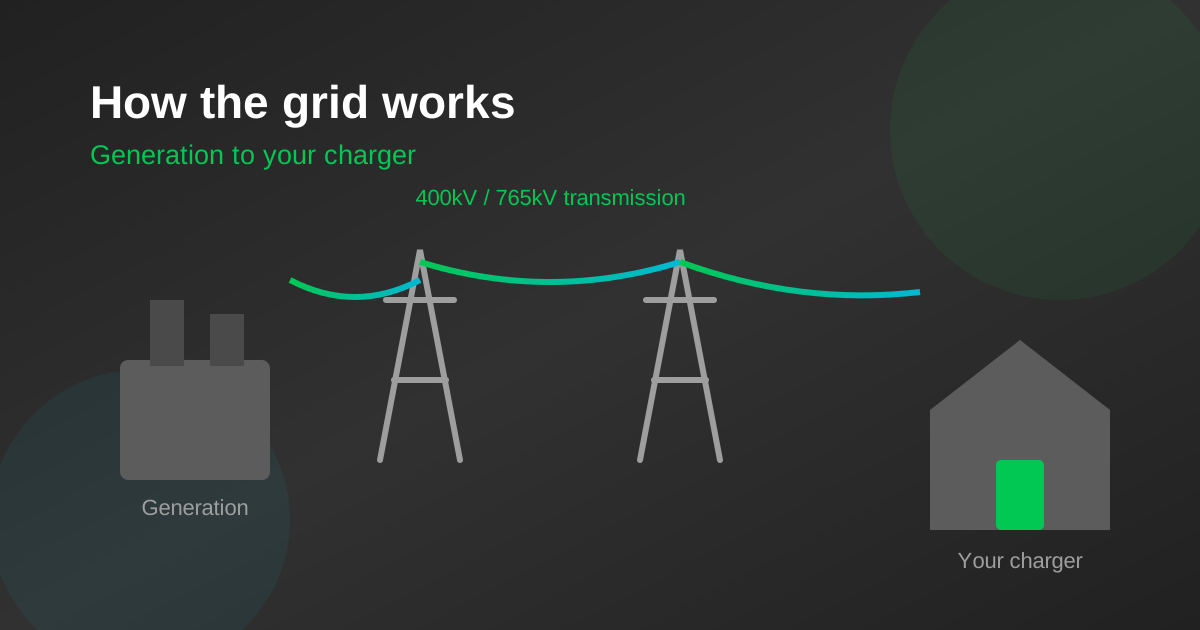
The grid is the machine that makes that continuous balancing act invisible. This article follows a unit of electricity from a generator to the socket your charger is plugged into, and explains why each step exists.
1. Generation
Power stations generate at relatively low voltage — typically in the range of 11kV to 25kV at the generator terminals. Coal, gas, nuclear and hydro plants spin large synchronous alternators. Solar and wind produce differently: solar generates DC which an inverter converts, and most modern wind turbines connect through power electronics rather than spinning in lockstep with the grid.
That distinction matters more than it sounds, and we return to it when we get to frequency.
2. Step-up: why transmission uses enormous voltages
The single most important idea in transmission is this: losses in a conductor are proportional to the square of the current, not the voltage.
To move the same power at ten times the voltage, you need one tenth the current — and the loss falls to one hundredth. That relationship is the entire reason high-voltage transmission exists.
So a transformer at the plant steps voltage up dramatically before the power travels anywhere. In India the main transmission voltages are 765kV, 400kV, 220kV and 132kV, with the higher levels used for the longest distances and largest transfers.
3. Transmission: moving bulk power across the country
Those familiar lattice pylons carry bulk power from generation centres to load centres, often across state boundaries. India’s coal is concentrated in the east, its best solar resource in the west and north-west, its hydro in the north and north-east — and its demand largely elsewhere. Transmission is what reconciles that geography.
AC and HVDC
Most of the network is alternating current, because AC is trivially easy to step up and down with transformers. But over very long distances AC has problems — reactive power, charging current, stability limits — and here high-voltage direct current takes over. HVDC links convert to DC at one end and back to AC at the other, which is expensive at the terminals and cheaper per kilometre in between.
HVDC also does something AC cannot: it allows controlled power transfer between two systems without requiring them to be synchronised with each other.
One nation, one grid
India’s regional grids — northern, western, southern, eastern and north-eastern — were progressively synchronised into a single national grid. The consequence is that surplus generation in one region can serve deficit in another, and that the whole interconnected system runs at one common frequency.
4. Substations: where voltage steps down
A substation is where transmission meets distribution. It does four jobs: transforms voltage between levels, switches circuits in and out, protects the network by isolating faults, and measures what is flowing.
The step-down is progressive rather than in one jump:
| Stage | Typical voltage | What it serves |
|---|---|---|
| Generation | 11kV – 25kV | Generator terminals |
| Transmission | 765kV / 400kV / 220kV | Bulk transfer between regions |
| Sub-transmission | 132kV / 66kV | Feeding into cities and large industry |
| Primary distribution | 33kV / 11kV | Distribution feeders and large consumers |
| Secondary distribution | 415V three-phase / 230V single-phase | Homes and small businesses |
5. Distribution: the last mile
Distribution is what most people actually see: the 11kV feeders along the road, the pole- or pad-mounted transformer serving a neighbourhood, and the low-voltage lines into buildings. It is operated by distribution companies, the DISCOMs, which are the entities that bill you.
This layer is where most reliability problems originate. Transmission networks are heavily redundant and closely monitored; distribution networks are vast, exposed, and where a single failed transformer takes out a locality.
It is also where losses concentrate. The industry term is AT&C losses — aggregate technical and commercial. Technical losses are physics: resistance in conductors and transformers. Commercial losses are billing and collection failures and theft. Reducing them has been a central objective of Indian power sector reform for decades.
6. Frequency: the heartbeat that reveals the balance
India’s grid runs at a nominal 50 Hz. That number is not merely a specification; it is the live indicator of whether generation matches demand.
- •If demand exceeds generation, the spinning machines are dragged fractionally slower and frequency falls below 50 Hz.
- •If generation exceeds demand, they speed up and frequency rises above 50 Hz.
Grid operators watch frequency continuously and instruct generators to raise or lower output to hold it inside a narrow band. Sustained deviation is dangerous: generators disconnect to protect themselves, which removes more generation, which drops frequency further. That is the cascade mechanism behind large blackouts.
7. Who operates all this
Dispatch is coordinated hierarchically. A national load dispatch centre oversees the interconnected system, regional centres manage inter-state flows, and state centres handle dispatch within their own boundaries. Together they decide, minute by minute, which generators run and how much power flows on which corridor.
Alongside them sits the regulatory structure: a central authority for technical standards, a central regulatory commission for inter-state matters and tariffs, and state commissions for intra-state distribution and retail tariffs. This is why electricity tariffs and policies differ so much between states — see our guide to state policies.
8. What renewables changed
A conventional grid was built around dispatchable generation: plants that produce when instructed. Solar and wind invert that assumption. They produce when the resource is available, and they are forecast rather than commanded.
Three consequences follow, and all three are why storage has become central.
- •The midday–evening mismatch. Solar peaks around noon; demand peaks after sunset. The larger the solar fleet, the wider that gap — the shape often called the duck curve.
- •Falling inertia. Fewer large spinning machines means frequency deviates faster, so response must be faster too.
- •Transmission congestion. The best solar and wind resources are often far from demand, so getting the power out becomes the binding constraint rather than generating it.
Batteries address all three: they shift midday surplus into the evening peak, they respond in milliseconds where a thermal plant takes minutes, and sited correctly they relieve congestion on a constrained corridor. Our grid-scale storage explainer covers what those systems do and how they earn.
9. What this means at your end of the wire
When you plug in a battery charger, you are the last link in a chain that started at a generator perhaps a thousand kilometres away, passed through several transformers, and was balanced in real time by operators watching a number hovering around 50.
Three practical implications follow for anyone charging batteries:
- •Voltage fluctuation is a distribution problem. It usually originates in the last few hundred metres — an overloaded local transformer or long thin conductors — not in the national grid. It matters, because chargers are sensitive to it.
- •Time-of-day tariffs reflect real scarcity. Evening electricity genuinely costs more to supply than midday electricity. Where such tariffs apply, shifting charging is not a gimmick.
- •Charging is a grid-scale question at scale. One scooter is negligible. A city’s worth of vehicles all charging at 7pm is a new evening peak — which is precisely why managed charging and storage are being taken seriously now rather than later.
Glossary
| Transmission | Bulk movement of power at high voltage over long distances |
| Distribution | Delivery of power at lower voltage to end consumers |
| Substation | Where voltage is transformed, circuits switched and faults isolated |
| HVDC | High-voltage direct current, used for very long links and asynchronous ties |
| Frequency | Cycles per second, nominally 50 Hz in India; the live indicator of supply-demand balance |
| Inertia | Resistance to frequency change from the rotating mass of synchronous generators |
| AT&C losses | Aggregate technical and commercial losses — physics plus billing and theft |
| DISCOM | Distribution company; the utility that supplies and bills end consumers |
| Load dispatch centre | The control room that instructs generators and manages flows |
Frequently asked questions
Why is electricity transmitted at high voltage?+
Because losses in a conductor are proportional to the square of the current, not the voltage. Power equals voltage times current, so moving the same power at ten times the voltage needs one tenth the current — and the loss falls to one hundredth. That single relationship is the entire reason high-voltage transmission exists.
What is the difference between transmission and distribution?+
Transmission moves bulk power at very high voltage (765kV, 400kV, 220kV, 132kV in India) over long distances between generation centres and load centres. Distribution delivers power at lower voltage (33kV, 11kV, then 415V three-phase or 230V single-phase) to end consumers, and is operated by DISCOMs. Most reliability problems and most losses occur in distribution.
Why does grid frequency matter?+
Frequency is the live indicator of whether generation matches demand. India's grid runs at a nominal 50 Hz. If demand exceeds generation the spinning machines are dragged slower and frequency falls; if generation exceeds demand it rises. Sustained deviation causes generators to disconnect to protect themselves, which is the cascade mechanism behind large blackouts.
What is grid inertia and why does it matter for renewables?+
Inertia is the resistance to frequency change provided by the rotating mass of large synchronous generators — they are physically heavy, so they resist sudden change and give operators time to react. Solar and battery inverters have no inherent rotating mass, so as their share grows the grid has less natural inertia and frequency moves faster after a disturbance.
Why does a renewable grid need battery storage?+
Three reasons. Solar peaks at midday while demand peaks after sunset, so energy must be shifted. Falling inertia means response must be faster, and batteries respond in milliseconds where a thermal plant takes minutes. And the best renewable resources are often far from demand, so storage sited correctly can relieve transmission congestion.
Thinking about upgrading?
Talk to our team about the right pack for your vehicle, and about EMI options that keep the monthly outgo close to what you already spend.
Get in touch