State EV Policies in India: How to Find What Actually Applies to You
The state layer is often worth more than the central one and is the most commonly missed. What every state policy contains, the four questions that decide whether it is real, and where to find the binding version.
Published: 15 August 2026
Policy · 7 min read

Why the state layer matters more than people expect
Central schemes get the headlines, but for a buyer the state layer is often worth more, and for a manufacturer it is usually where the negotiable money is. It is also the layer people most often fail to claim, because it is administered by several different departments rather than one portal.
What a state EV policy typically contains
Almost all of them cover the same six areas. Read your state’s policy looking for these:
- •Demand incentives. Purchase subsidy by vehicle category, often per kWh of battery capacity, usually capped and usually limited to a fixed number of vehicles.
- •Road tax and registration. Exemption or reduction, and for how long. The most durable benefit.
- •Charging and swapping infrastructure. Capital subsidy for stations, and the electricity tariff category applied to charging.
- •Manufacturing incentives. Capital subsidy, stamp duty and electricity duty exemption, SGST reimbursement, land at concessional rates.
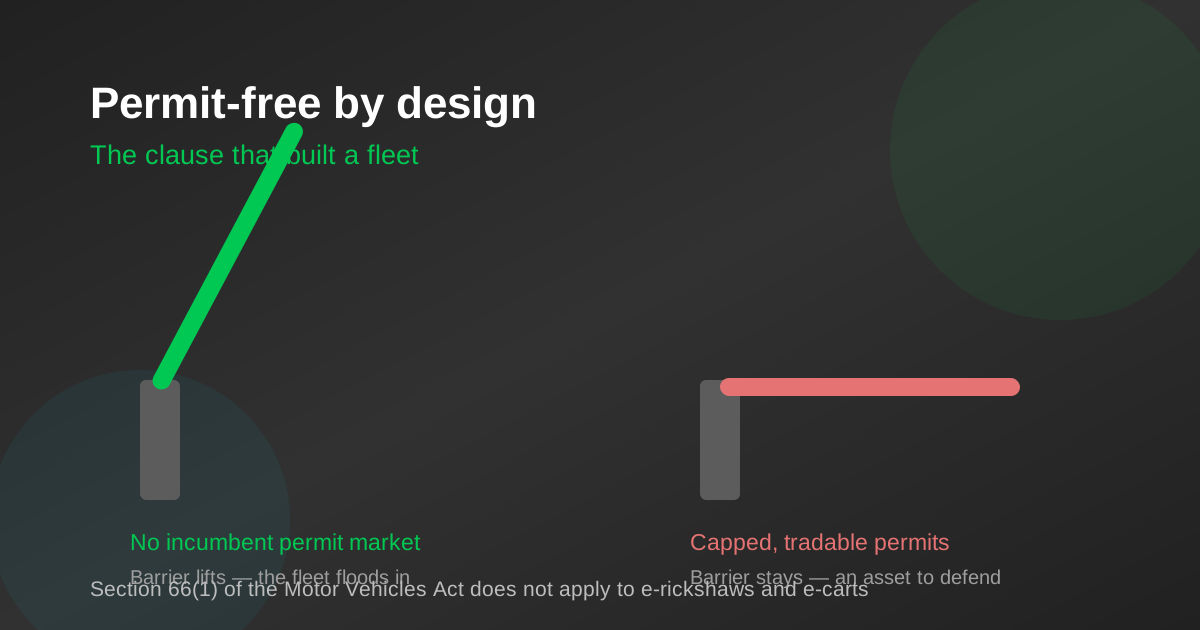
- •Fleet and commercial provisions. Permit relaxations for electric three-wheelers, aggregator obligations, city-level restrictions on new fossil-fuel commercial registrations.
- •Scrappage and retrofit. Incentives for converting or retiring older vehicles, which matter in the e-rickshaw segment specifically.
The four questions that decide whether it is real
A policy document announcing a subsidy is not the same as a subsidy you can actually receive. Before counting on it:
- •Is the policy currently in force? Many have an end date and are not always renewed on time. Check for an extension notification, not just the original policy.
- •Has the budget been exhausted? Demand incentives are usually capped at a number of vehicles. Once that is hit, the policy still exists and the money does not.
- •Is there an operating notification? A policy usually needs a follow-up government order specifying the claim process before anything can actually be disbursed.
- •Who disburses, and when? Upfront at the dealer is very different from reimbursement months later, especially for a driver buying on finance.
Where to find the authoritative version
- •The state industries or transport department website — look for the policy PDF and any amendment or extension orders
- •The state investment promotion agency, for manufacturing incentives
- •The state transport department or RTO, for road tax and registration treatment
- •The state EV portal, where one exists, for the claim process and current utilisation
- •Your RTO directly, which is the fastest way to confirm what is actually being applied at registration today
Treat dealer claims and news reports as leads to verify, never as the source. The government order is the only thing that binds.
If you operate across states
Fleet operators and dealers working across borders should expect genuine divergence: a vehicle economically sensible in one state may not be in the next, purely on tax treatment. Build the comparison per state rather than nationally, and rebuild it when policies renew.
Our state-level battery guides for Bihar, Uttar Pradesh, Madhya Pradesh and Jharkhand cover the operating conditions in each.
Frequently asked questions
Which state has the best EV policy in India?+
There is no stable answer, because policies are revised, extended and allowed to lapse on their own schedules and budgets get exhausted mid-year. Compare on the specific benefits that apply to your vehicle category and check whether the policy is currently in force and still funded, rather than relying on a ranking.
How do I check if a state subsidy is still available?+
Four checks: is the policy still in force or has it lapsed without extension; has the capped budget or vehicle count been exhausted; is there an operating government order specifying the claim process; and is it disbursed upfront at the dealer or reimbursed later. Your RTO is the fastest way to confirm what is actually being applied today.
Do EV benefits differ between states for the same vehicle?+
Substantially. Purchase subsidy, road tax treatment, registration fees and permit rules all vary, so a vehicle whose economics work in one state may not work across the border. Fleet operators should build the comparison per state and rebuild it when policies renew.
Thinking about upgrading?
Talk to our team about the right pack for your vehicle, and about EMI options that keep the monthly outgo close to what you already spend.
Get in touch