A History of the Electric Motor: Faraday to the Hub Motor
The motor in your e-rickshaw works on a principle patented in 1888. Here is how it got there — and why almost everything that has actually changed about electric vehicles happened somewhere other than the motor.
Published: 17 August 2026
History · 10 min read
The oldest technology in your e-rickshaw
The motor in a modern electric three-wheeler is, in its essential principle, older than the telephone, older than the light bulb, and very nearly older than the postage stamp. Almost everything that has changed about electric vehicles in the last thirty years is battery, electronics and software. The motor itself was largely solved in the nineteenth century.
That is worth understanding, because it tells you where the real engineering risk in a vehicle sits — and it is not usually in the motor.
1821: Faraday makes something spin
A year earlier, the Danish physicist Hans Christian Ørsted had noticed that a compass needle deflected when placed near a current-carrying wire. That was the discovery that electricity and magnetism were connected at all.
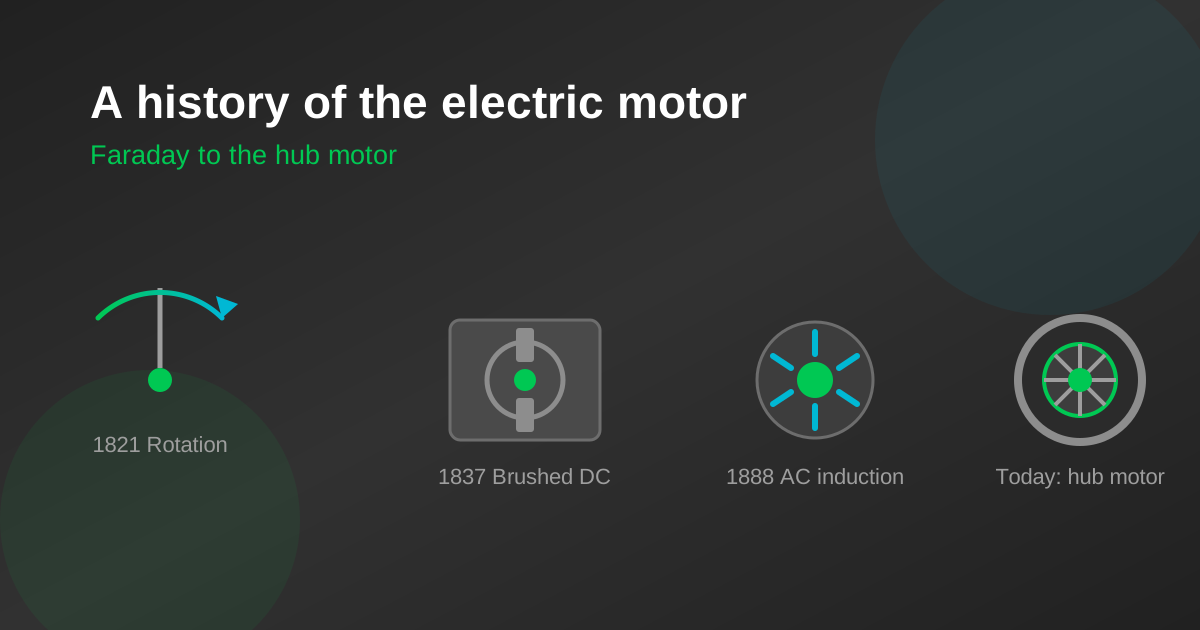
In 1821 Michael Faraday, then an assistant at the Royal Institution, worked out how to turn that force into continuous motion. He suspended a wire so that it hung into a pool of mercury with a magnet at the centre; when current flowed, the wire circled the magnet indefinitely.
It did no useful work and drove nothing. But it was the first demonstration that electrical energy could be converted into sustained mechanical motion — the entire premise of every motor that followed.
1832–1837: the commutator and the first real motors
Continuous rotation needs the current in the rotating part to reverse at the right moment, or the rotor simply swings to a position and stops. The commutator — a split ring with sliding contacts that flips the current direction twice per revolution — solved that, and it defines the brushed DC motor to this day.
- •William Sturgeon built a commutator-based DC motor in 1832 that could actually turn a load.
- •Moritz von Jacobi built a motor in 1834 powerful enough to drive a boat carrying passengers on the River Neva in 1839.
- •Thomas Davenport, a Vermont blacksmith, patented an electric motor in 1837 and used it to run a printing press and a small model railway.
Davenport’s business failed, and the reason is instructive. His motors worked fine. He was powering them from disposable Daniell cells, and the zinc they consumed cost far more than the coal an equivalent steam engine burned. The technology was sound; the energy source was uneconomic. Electric traction would keep hitting that same wall for the next 150 years.
1873: an accident that revealed something important
At the Vienna exhibition, a technician working with Zénobe Gramme’s dynamos reportedly connected two of them together by mistake. The first, being driven mechanically, generated current. The second, receiving that current, started spinning on its own.
The lesson was that a generator and a motor are the same machine running in opposite directions. That symmetry is not a curiosity — it is the basis of regenerative braking in every modern EV, where the traction motor is briefly operated as a generator to recover energy that would otherwise become brake heat.
1888: Tesla removes the brushes
Brushed DC motors have an inherent weakness: the brushes physically rub, so they wear, spark and need replacing. For an industrial motor expected to run continuously for years, that is a real maintenance burden.
Nikola Tesla’s AC induction motor, patented in 1888, dispensed with them entirely. Multiple AC windings arranged around the stator produce a magnetic field that rotates by itself; that rotating field induces current in the rotor, and the rotor is dragged along after it. No electrical connection to the rotating part is needed at all.
The induction motor is rugged, cheap, and needs almost no maintenance. It became the workhorse of twentieth-century industry, and it is a large part of why AC won the standards war of the 1890s — a fight we cover in how power transmission works. Mikhail Dolivo-Dobrovolsky’s three-phase designs from 1889 onwards made it practical at industrial scale.
The long quiet century
From roughly 1900 to 1960, motors did not change fundamentally. They got better materials, better insulation, better manufacturing and better efficiency, but a 1950s induction motor would be entirely recognisable to Tesla.
What they also did was disappear. Electric motors became invisible infrastructure — in pumps, fans, lifts, machine tools, trains and household appliances. Today, electric motors account for a very large share of all electricity consumed worldwide. Most people could not name a single one in their home, and would be wrong about the count by a factor of ten.
1960s onwards: the transistor changes what a motor can be
The real revolution was not in the motor. It was in what could be put in front of it.
The brushless DC motor replaces the mechanical commutator with electronic switching: sensors detect rotor position, and semiconductors energise each winding at the right instant. You get the ruggedness of having no brushes together with the fine speed control of a DC machine. This was impractical until power transistors became cheap and reliable.
The second shift was permanent magnets. Neodymium-iron-boron magnets, developed in the early 1980s, are dramatically stronger than the ferrite magnets available before, allowing a much smaller and lighter motor for the same torque.
Put those together and you get the motor actually fitted to an e-rickshaw: a brushless DC hub motor, built into the wheel itself, with no gearbox, no drive shaft, no brushes to replace, and a controller that shapes torque electronically. Every part of that description depends on semiconductor and magnet technology from the last forty years — wrapped around a working principle from 1888.
Where motor engineering is actually moving now
Three pressures are shaping current development, and none of them is about making motors more efficient in the abstract — a good modern traction motor is already well above 90% efficient across most of its operating range.
- •Reducing rare-earth dependence. Neodymium and dysprosium supply is concentrated in a small number of countries, which is a commercial and strategic risk. This is driving renewed interest in induction motors, switched-reluctance designs and ferrite-magnet motors that avoid rare earths entirely.
- •Integration. Motor, gearbox and inverter are increasingly designed and packaged as one unit rather than three, saving weight, cost and cabling.
- •Control sophistication. Most of the perceived difference between a smooth vehicle and a jerky one is the controller’s software, not the motor’s iron and copper.
What the history tells a buyer
If you are assessing an electric three-wheeler, the motor is rarely where the risk is. Brushless hub motors are a mature technology built by many competent suppliers, and a well-made one will usually outlast the vehicle around it.
The components that decide whether the vehicle is still working well in three years are the battery, the controller and the wiring and connectors — which is where our daily inspection routine spends its attention, and it is not an accident that the motor barely features in it.
Frequently asked questions
Who invented the electric motor?+
There is no single inventor. Michael Faraday demonstrated continuous electrically-driven rotation in 1821, though it drove no load. William Sturgeon built a commutator-based DC motor that could turn a load in 1832, Moritz von Jacobi built one powerful enough to drive a boat by 1839, and Thomas Davenport patented one in 1837. Nikola Tesla’s AC induction motor of 1888 was the design that scaled industrially.
What kind of motor does an e-rickshaw use?+
Almost always a brushless DC hub motor built directly into the wheel, with no gearbox, drive shaft or brushes to replace. It combines a working principle from the 1880s with two much more recent technologies: power semiconductors for electronic commutation, and neodymium magnets developed in the early 1980s.
What is the difference between a brushed and a brushless motor?+
A brushed motor reverses current in the rotor using a mechanical commutator with sliding contacts, which wear, spark and need periodic replacement. A brushless motor does the same switching electronically using semiconductors and rotor position sensing, so there is nothing rubbing. Brushless motors need a controller, which is why they only became practical once power transistors were cheap.
Why do electric motors use rare earth magnets?+
Neodymium-iron-boron magnets, developed in the early 1980s, are far stronger than the ferrite magnets available before, so a motor of the same torque can be much smaller and lighter. The drawback is that neodymium and dysprosium supply is concentrated in a small number of countries, which is driving renewed interest in induction, switched-reluctance and ferrite-magnet designs that avoid rare earths entirely.
Is the motor the part most likely to fail on an electric three-wheeler?+
Usually not. Brushless hub motors are a mature technology and a well-made one will often outlast the vehicle around it. The components that determine whether a vehicle is still working well after three years are typically the battery, the controller, and the wiring and connectors.
Thinking about upgrading?
Talk to our team about the right pack for your vehicle, and about EMI options that keep the monthly outgo close to what you already spend.
Get in touch