Buying Battery Storage for a Factory: Capex, Leasing or Storage-as-a-Service?
Outright purchase, leasing, build-own-operate and shared-savings contracts compared: who owns the battery, who carries the performance risk, which contract terms matter, and what happens at the end.
Published: 11 October 2026
Finance · 5 min read
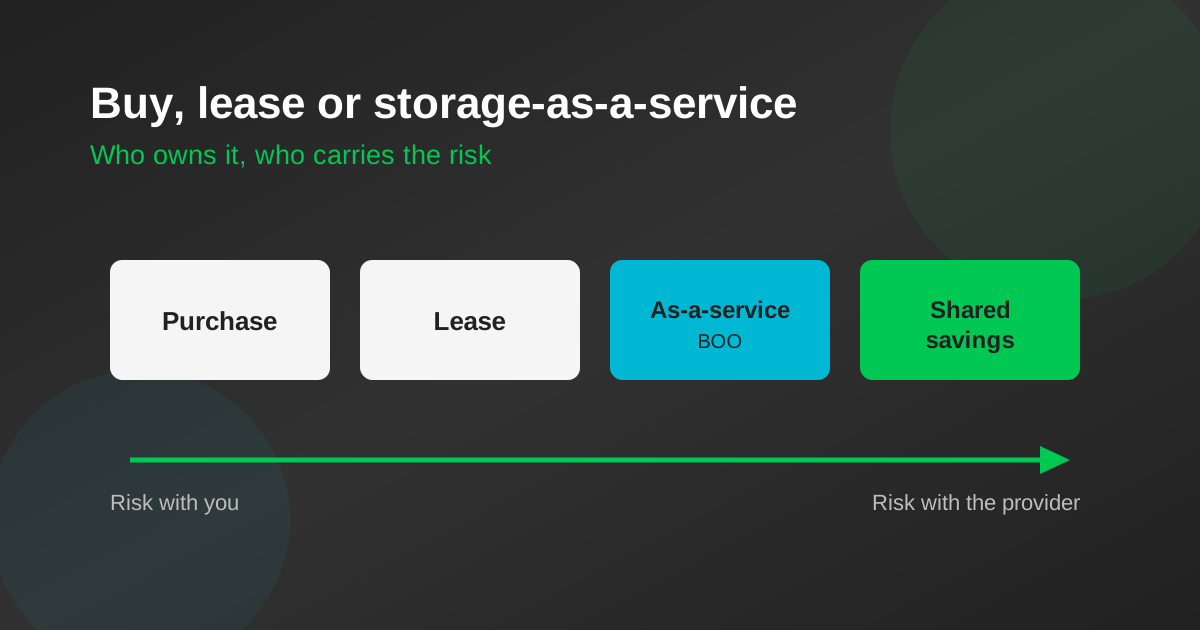
The same battery, four ways to pay for it
Once a factory has decided that battery storage makes sense, a second decision follows: how to pay for it. The hardware can be identical in every case. What changes is who owns it, who carries the risk if it underperforms, how it sits on your balance sheet, and what happens when the contract ends.
There are four broad models in the Indian C&I market. The names vary between suppliers, so judge each offer by its terms rather than its label.
The four models
- •Outright purchase (capex). You buy the system, own it from commissioning, and keep every rupee of saving. You also carry the performance risk beyond whatever the warranty covers.
- •Leasing. A lessor owns the system and you pay a fixed periodic rental for its use. The rental does not usually depend on how much the battery saves you, so the performance risk largely stays with you.
- •Storage-as-a-service or build-own-operate (BOO). A developer builds, owns and operates the system on your premises and charges a service fee, often tied to availability or energy delivered. The developer carries much of the technical risk.
- •Shared savings. The developer owns and operates the system, and you pay a share of the measured savings. If the battery saves less, you pay less, which puts the performance risk mostly on the developer.
Who carries the performance risk
The most important difference between these models is not the monthly figure. It is who absorbs the loss when reality falls short of the proposal — because the battery degrades faster, the tariff changes, the load profile shifts, or the system is unavailable.
A simple test: if the battery saved you nothing next month, what would you still owe? Under purchase or lease, the full instalment or rental. Under a service contract, the fee less any availability penalties. Under shared savings, little or nothing. The more risk the provider takes, the larger the share of the upside they will expect.
Tariff risk deserves special attention. If a regulator narrows the time-of-day spread or changes how demand is charged, the savings change. A fixed-fee contract leaves that risk with you; a shared-savings contract shares it. Read how each contract defines and measures savings before comparing the headline percentages.
Balance sheet and tax, at a high level
The accounting treatment differs between models, and it matters to companies that watch their borrowing ratios. Broadly, an owned asset sits on the balance sheet and is depreciated. Under current Indian accounting standards, many leases are also brought on to the balance sheet as a right-of-use asset with a matching liability. Service contracts may or may not be treated as leases, depending on who controls the asset and how the contract is drafted.
Tax treatment — depreciation on an owned asset versus a deductible service fee — also differs. These are questions for your auditor and tax adviser, with the draft contract in hand. Do not rely on a supplier’s description of how its model will be treated in your books.
If you buy the system with borrowed money, that is a separate arrangement with a bank or non-bank lender, on its own credit terms. The equipment supplier is not the lender, and the loan and the purchase contract should be read as two documents.
Contract terms to check
Whichever model you choose, these terms decide how it plays out:
- •Term length, and whether it is shorter than the battery’s expected life or the warranty
- •How savings or delivered energy are measured, by whose meter, and how disputes are settled
- •Guaranteed availability, and the penalty when the system is down
- •Capacity guarantees over time, and whether the provider must augment cells to maintain them
- •Escalation clauses on fees or rentals, and what they are indexed to
- •What happens if your tariff category, contract demand or premises change
- •Insurance, and who is liable if the system causes damage on your site
- •Access rights for the provider’s staff, and your obligations for space, cooling and safety
The capacity point links directly to the warranty. Our guide to reading a BESS warranty explains capacity retention, throughput caps and availability guarantees, and what each means for who carries the risk.
Exit and end of term
Contracts end, and companies relocate, expand or change processes before they do. Check what happens in each case:
- •Early termination: the fee, how it is calculated, and whether it falls over time
- •Purchase option: whether you can buy the system at the end, and at what price or formula
- •Renewal: whether the term can be extended, and on what fee basis given the battery has aged
- •Removal: who removes the system at the end and who pays, including site restoration
- •End-of-life cells: who is responsible for recycling or disposal under battery waste rules
A purchase option at a fair formula is valuable. A battery that still holds most of its capacity at the end of a ten-year term can keep saving money for years, and it is better for that value to come to you than to leave on a lorry.
Choosing between them
Outright purchase usually gives the best lifetime return if you have the capital, the technical confidence and an appetite for the risk. It also makes you responsible for operation and maintenance, so budget for it. Service and shared-savings models suit companies that would rather keep capital for their core business, or that are unsure how a battery will perform on their site and want the provider to prove it.
The starting point is the same in every case: an honest estimate of what the battery will save. Begin with where commercial storage savings come from, then run your own figures through the BESS savings calculator. Once you know the size of the saving, you can judge whether the fee or the share each model asks for is fair.
Frequently asked questions
What is storage-as-a-service?+
An arrangement in which a developer builds, owns and operates a battery on your premises and charges a service fee, often tied to availability or energy delivered. You avoid the upfront cost and much of the technical risk, in exchange for sharing part of the savings with the provider over the contract term.
Is it better to buy or lease a commercial battery?+
Buying usually gives the best lifetime return if you have the capital and are comfortable carrying the performance risk and maintenance. Leasing spreads the cost but typically leaves the performance risk with you, because the rental does not fall if savings do. The right choice depends on your capital, your risk appetite and the contract terms.
What should I check at the end of a battery service contract?+
Whether you have an option to buy the system and at what price or formula, whether the term can be renewed, who removes the equipment and restores the site, and who is responsible for recycling the cells. A fair purchase option matters because a battery often has useful life left at the end of a ten-year term.
Thinking about upgrading?
Talk to our team about the right pack for your vehicle, and about EMI options that keep the monthly outgo close to what you already spend.
Popular: Lithium e-rickshaw battery