Zero Per Cent, One Per Cent a Month, No-Cost EMI: What Festive Battery Offers Really Cost
Every term on a festive finance banner can be true and the loan still not be cheap. Three common offer shapes, worked through with real numbers, and the one question that cuts through all of them.
Published: 30 September 2026
Finance · 7 min read
Why the season matters
From Navratri through Diwali, battery and vehicle finance is advertised harder than at any other time of the year. The offers are real, and some of them are genuinely good. But the number on the banner — “0% interest”, “just 1% a month”, “no-cost EMI” — is chosen because it is attractive, not because it is the cost of the loan.
This post works through the three most common offer shapes with real arithmetic, so you can see where the cost goes. It builds on our guide to financing an e-rickshaw battery, which covers the Key Fact Statement and your protections in general.
Shape one: the flat rate
A flat rate charges interest on the full amount borrowed for the whole tenure, even though you repay part of it every month. A reducing-balance rate charges interest only on what you still owe. Home loans, and the APR on your Key Fact Statement, use the reducing basis. Shop-counter offers are often quoted flat.
Take ₹1,00,000 over 12 months at “12% flat”. The interest is ₹12,000, the total repaid ₹1,12,000, and the instalment ₹9,333. Because you are paying interest on money you have already returned, the equivalent reducing-balance rate is about 21.5 per cent a year.
“1% a month” is usually the same thing in disguise: 12% a year, flat. Ask whether a monthly rate is charged on the original amount or on the balance.
Shape two: zero per cent, plus fees
A true zero-interest loan exists when someone else pays the lender’s interest — typically the manufacturer or dealer, through what is called a subvention. That can be a real saving. But a lender still needs to be paid for the work of lending, and on a zero-interest scheme that payment has to come from somewhere else.
Usually it comes from a processing fee. On ₹1,00,000 at 0% over ten instalments of ₹10,000, a 3% processing fee deducted at the start means you receive ₹97,000 and repay ₹1,00,000. That is an effective rate of about 6.7 per cent a year — still cheap, but not zero.
Shape three: zero per cent, plus the discount you gave up
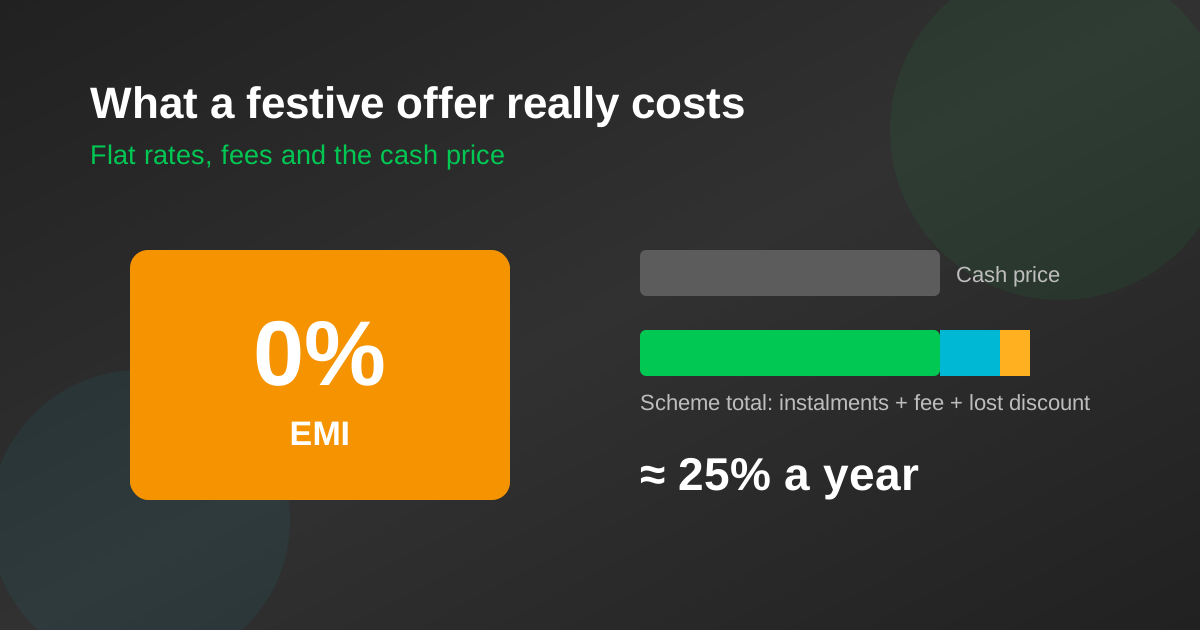
The cost that most often goes unnoticed is the one that never appears on a loan document: the cash price. If a battery is ₹1,00,000 on the scheme but ₹95,000 to a buyer paying in full, the ₹5,000 difference is interest, whatever the scheme is called.
Put the pieces together the way a festive offer often does. Ten instalments of ₹10,000 at “0%”, two of them collected in advance, and a ₹2,000 processing fee — against a cash price of ₹95,000.
- •You pay ₹22,000 on day one: two advance instalments and the fee
- •So the credit you actually receive is ₹95,000 − ₹22,000 = ₹73,000
- •You repay it with the remaining eight instalments: ₹80,000
- •That is ₹7,000 of cost on ₹73,000, repaid over eight months
The equivalent reducing-balance rate is about 25 per cent a year. Every individual term on the banner was true. The loan was still not free.
Advance instalments shorten the loan, not the cost
Paying one or two instalments upfront looks like a down payment, and in effect it is one. But the scheme is still described as “ten months”, so the cost is spread in your head over a longer period than you actually borrow for. In the example above the credit runs for eight months, not ten. Shorter borrowing for the same charge is a higher rate.
What to compare, and where to find it
The Key Fact Statement a regulated lender must give you before you sign shows the Annual Percentage Rate (APR), which is designed to fold interest and fees into a single comparable figure. It is the right place to start. Two things it cannot see: a cash discount you were not offered, and a price the dealer raised to fund the subvention. Those you have to ask about yourself.
- •The cash price, today, paid in full
- •The total of every payment on the scheme, including fees and advance instalments
- •The APR on the Key Fact Statement
- •How long you actually hold the credit, after advance instalments
- •Whether insurance or an extended warranty has been added to the loan amount
Our EMI calculator takes a flat or reducing rate, a down payment, subvention, a file charge and a security deposit, and shows the effective APR with all of them included — along with the reducing-balance equivalent of any flat rate you are quoted.
When a festive offer really is good
None of this means festive schemes are a trick. A genuine subvention on a price that has not been raised, with a modest fee and no advance instalments, can be cheaper than any ordinary loan you could get. The point is only that you cannot tell which kind of offer you are looking at from the banner. You can tell from the cash price and the total repaid.
And a reminder about our own position: Wingzman is a lending service provider, not a lender. When we arrange finance for a battery, the loan is granted by the regulated entity named on your Key Fact Statement, and the rate and charges are theirs.
Terms in this article
Frequently asked questions
How does a flat interest rate compare with a reducing-balance rate?+
A flat rate charges interest on the full amount borrowed for the whole tenure, even as you repay it. The equivalent reducing-balance rate is a little under double: ₹1,00,000 over 12 months at 12% flat works out to about 21.5% a year on a reducing basis.
Is a zero per cent EMI offer really free?+
Sometimes nearly, often not. A processing fee, advance instalments, or a cash discount that scheme buyers do not receive all add cost. Ten ₹10,000 instalments at “0%”, with two paid upfront and a ₹2,000 fee, against a ₹95,000 cash price, is equivalent to about 25% a year.
What is the best way to compare battery finance offers?+
Ask for the cash price paid in full today, add up every payment the scheme requires including fees and advance instalments, and compare the two. Then check the APR on the Key Fact Statement, which folds interest and fees into one figure.
Thinking about upgrading?
Talk to our team about the right pack for your vehicle, and about EMI options that keep the monthly outgo close to what you already spend.
Popular: Lithium e-rickshaw battery