Europe Lost the Cell Before It Lost the Car
Northvolt reached about 1 GWh of a planned 16 and went bankrupt, ACC halted two gigafactories, and the continent’s largest cell plant will be CATL’s in Hungary. Why cell manufacturing defeated well-funded newcomers — and what India should take from it.
Published: 24 August 2026
Industry · 13 min read
The car was never the hard part
Europe has spent three years arguing about Chinese electric cars. The more consequential contest was decided earlier and further upstream, in a business Europe entered late, funded generously, and largely lost: the manufacture of lithium-ion cells.
A car company that cannot buy competitive cells cannot build a competitive electric car, whatever its assembly costs are. Cells are the single largest cost in the vehicle, they set its range and charging behaviour, and they are the component with the longest and least forgiving industrial learning curve. Losing that layer is not one lost supplier. It is losing the ability to set the terms of everything built on top of it.
What happened to Europe’s champions
The European cell industry was supposed to be built by a handful of national and pan-European champions. The record since 2024 is bleak.
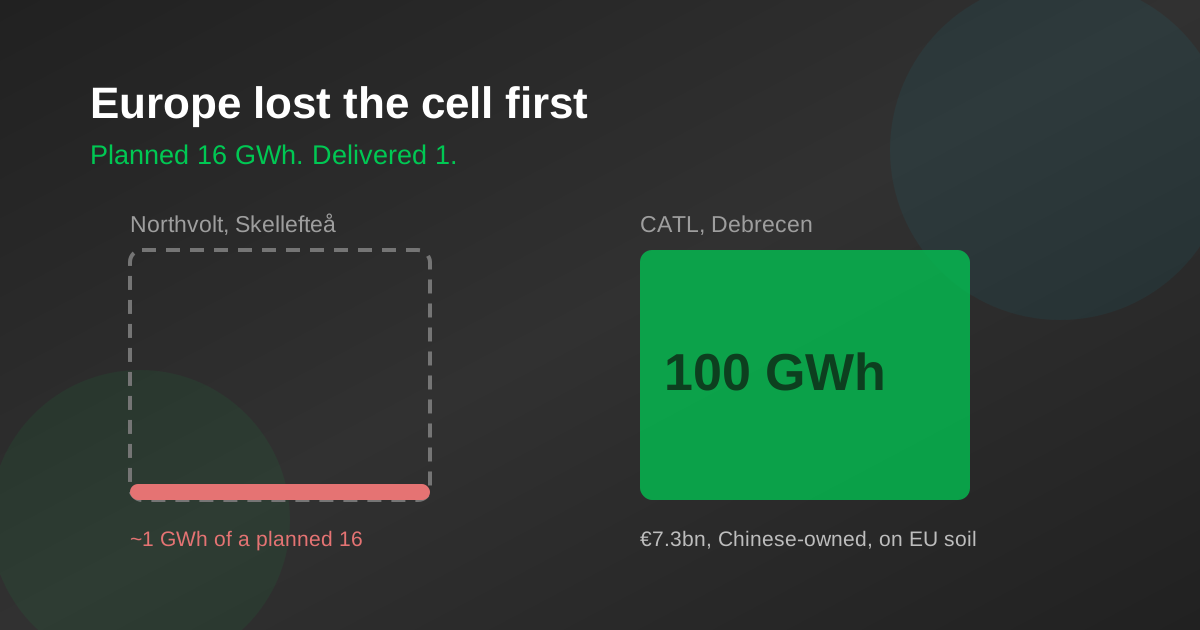
- •Northvolt, the Swedish company that carried most of the continent’s hopes, went bankrupt. Its factories were to have accounted for around 13 per cent of Europe’s planned 2030 battery production. Its Skellefteå gigafactory reached roughly 1 GWh of output against a planned 16 — a ratio that tells you the failure was in manufacturing execution, not in demand or in funding.
- •Automotive Cells Company, backed by Stellantis and Mercedes and the second-largest European effort, halted construction of gigafactories in Germany and Italy in June 2024, citing the need to move to lower-cost chemistry against slowing EV demand.
- •Cellforce, Porsche’s high-performance cell venture, also wound down.
- •Europe’s battery pipeline capacity out to 2030 fell by 176 GWh in 2024 alone, against an EU objective of covering 90 per cent of European demand from domestic production by 2030.
Meanwhile CATL began construction at Debrecen in Hungary of what may become Europe’s largest cell facility — a potential 100 GWh a year, with investment reported around €7.3 billion. Chinese manufacturers hold close to 70 per cent of global lithium battery installations, with CATL alone near 39 per cent.
The uncomfortable summary: Europe’s largest battery factories will substantially be Chinese-owned and built on European soil. That is better than importing finished cells — it brings jobs, tax and some process knowledge — but it is not the industrial sovereignty the policy was written to achieve.
Why building cells is harder than it looks
It is tempting to explain Northvolt by pointing at management, and there is evidence for that. The more useful explanation is that cell manufacturing is a fundamentally different discipline from anything European automotive engineering was good at, and the difference is not obvious from the outside.
- •It is a process industry, not an assembly industry. Output is governed by coating uniformity, drying, calendering, moisture control and contamination — closer to semiconductor fabrication or pharmaceuticals than to a body shop. The skills do not transfer from carmaking.
- •Yield is the whole business. A line running at 70 per cent yield and one running at 95 per cent have similar capital costs and completely different economics. Nobody publishes their yield curve, so a new entrant cannot know how far behind it is until it is running.
- •The learning curve is empirical and slow. Cost falls because thousands of small process problems get solved in sequence, each one requiring a failure to learn from. That takes calendar time that money cannot compress.
- •The equipment and materials supply chain is itself concentrated. Much of the machinery, and the refined cathode, anode and electrolyte inputs, come from the same region as the competition — see our note on the refining chokepoint.
- •Scale-up is not a bigger pilot. Processes that behave at 1 GWh routinely fail at 16, and the failure modes only appear at volume.
Northvolt’s 1 GWh against a planned 16 is precisely this pattern. The company could make cells. It could not make them at rate, at yield, and at a cost anyone would pay — which is the actual product.
The demand signal moved underneath them
There is a second cause, and it is policy rather than engineering. A gigafactory is a multi-billion-euro bet on a demand curve five to ten years out, and European EV demand grew more slowly than the plans assumed while the regulatory target that underwrote those plans was itself being renegotiated.
The softening of the 2035 combustion engine deadline into a 90 per cent fleet CO₂ reduction with technology neutrality — covered in our piece on what that revision actually does — is a rational response to industrial distress. It is also, from a cell investor’s point of view, the demand floor moving after the capital was committed. One analysis put the capacity implication of target rollback at the equivalent of dozens of Northvolt-sized factories.
This is the trap in industrial policy that uses a regulatory deadline as the demand guarantee. The deadline is only credible while the industry it disciplines is healthy enough to meet it, and it gets relaxed exactly when the factories most need it to hold.
What Europe still has
It would be wrong to write this as a collapse. Europe retains real assets: a large and wealthy vehicle market, deep engineering in power electronics, thermal systems, safety certification and manufacturing quality, strong recycling regulation that will matter more as fleets age, and a battery regulation framework that others are copying.
It also retains the ability to host production, which is what the CATL and BYD investments represent. Hosting is genuinely worth something — supplier ecosystems, trained process engineers and tacit knowledge do diffuse locally, which is roughly how Japan and Korea seeded parts of their own industries decades ago. It is simply a slower and more dependent path than the one that was planned.
What India should take from this
India is attempting the same thing Europe attempted, later, with less capital and a similarly concentrated upstream. The European experience is the most expensive available case study, and it argues against a few comfortable assumptions.
- •Announced capacity is not capacity. Europe’s pipeline shrank by 176 GWh in a single year and its flagship reached 6 per cent of its target output. Judge a cell programme by shipped, qualified, warrantied cells, not by memoranda of understanding.
- •Subsidy does not substitute for process capability. Northvolt was not short of money or of political support. It was short of yield, and no incentive scheme produces yield.
- •Partnering with the incumbent is not defeat. Hungary will host Europe’s largest cell plant because it accepted Chinese investment. The knowledge transfer argument for doing the same is stronger than the sovereignty argument against it — provided the terms actually require local engineering depth rather than a screwdriver plant.
- •A stable demand signal is worth more than a large one. Investors need a floor they can underwrite for a decade. Repeatedly revised targets and subsidy schemes that lapse and restart do more damage to a factory decision than a modest incentive would fix.
- •Pick the fights that are winnable. Cell chemistry leadership is a hard fight from behind. Pack engineering, BMS, thermal design, safety qualification, refurbishment and recycling are adjacent, less capital-hungry, and closer to where Indian firms already have people.
Our longer treatment of the Indian position is in what catching up would actually require, and the upstream constraint that binds everyone is in the refining chokepoint.
Europe’s mistake was not trying. It was assuming that a large market, serious money and a regulatory deadline would substitute for fifteen years of accumulated process learning. They do not, and the price of finding that out was paid in full.
Frequently asked questions
What happened to Europe’s battery manufacturing plans?+
They largely failed to deliver. Northvolt, which carried most of the continent’s hopes and whose factories were to account for around 13 per cent of Europe’s planned 2030 production, went bankrupt after reaching roughly 1 GWh of output at Skellefteå against a planned 16. Automotive Cells Company, backed by Stellantis and Mercedes, halted construction of gigafactories in Germany and Italy in June 2024. Porsche’s Cellforce venture wound down. Europe’s pipeline capacity out to 2030 fell by 176 GWh in 2024 alone, against an EU objective of meeting 90 per cent of demand domestically by 2030.
Why is making battery cells so difficult?+
Because it is a process industry rather than an assembly industry, closer to semiconductor fabrication than to carmaking. Output depends on coating uniformity, drying, calendering, moisture control and contamination. Yield is the whole business — lines at 70 and 95 per cent yield cost the same to build and have completely different economics. The learning curve is empirical and takes calendar time that capital cannot compress, the equipment and refined material supply chains are themselves concentrated, and processes that work at 1 GWh routinely fail at 16.
Who will build Europe’s batteries now?+
Substantially Chinese companies, on European soil. CATL began construction at Debrecen in Hungary of what may become Europe’s largest cell facility, with potential capacity around 100 GWh a year and investment reported near €7.3 billion. Chinese manufacturers hold close to 70 per cent of global lithium battery installations, with CATL alone near 39 per cent. Hosting production brings jobs, tax and some knowledge transfer, but it is not the industrial sovereignty the policy was written to achieve.
Did weakening the 2035 target hurt battery investment?+
It removed the demand guarantee those investments were underwritten against. A gigafactory is a multi-billion-euro bet on demand five to ten years out, and what makes that bet financeable is a legal requirement rather than a forecast of consumer preference. Softening the 2035 obligation into a 90 per cent fleet CO₂ target with technology neutrality moved the floor after capital had been committed; one analysis put the capacity implication at the equivalent of dozens of Northvolt-sized factories.
What should India learn from Europe’s battery failure?+
Five things. Announced capacity is not capacity — judge programmes by shipped, qualified, warrantied cells. Subsidy does not substitute for process capability, since Northvolt was short of yield rather than of money or political support. Partnering with the incumbent is not defeat, provided terms require real local engineering depth rather than a screwdriver plant. A stable demand signal matters more than a large one, because schemes that lapse and restart damage factory decisions more than a modest incentive would fix. And pick winnable fights: pack engineering, BMS, thermal design, safety qualification and recycling are adjacent, less capital-hungry and closer to where Indian firms already have people.
Thinking about upgrading?
Talk to our team about the right pack for your vehicle, and about EMI options that keep the monthly outgo close to what you already spend.
Get in touch