What You Are Actually Paying For in a Litre of Petrol
The board shows one number; underneath it there are four. How base price, central excise, dealer commission and state VAT stack — why states tax the Centre’s tax — and what the March 2026 excise cut did to all of it.
Published: 26 August 2026
Policy · 11 min read
Four numbers, not one
Written 26 August 2026. Tax rates on fuel changed more than once during 2026 and the specific figures below will date. The structure will not, and the structure is what this post is about — the last section shows how to look up current rates yourself.
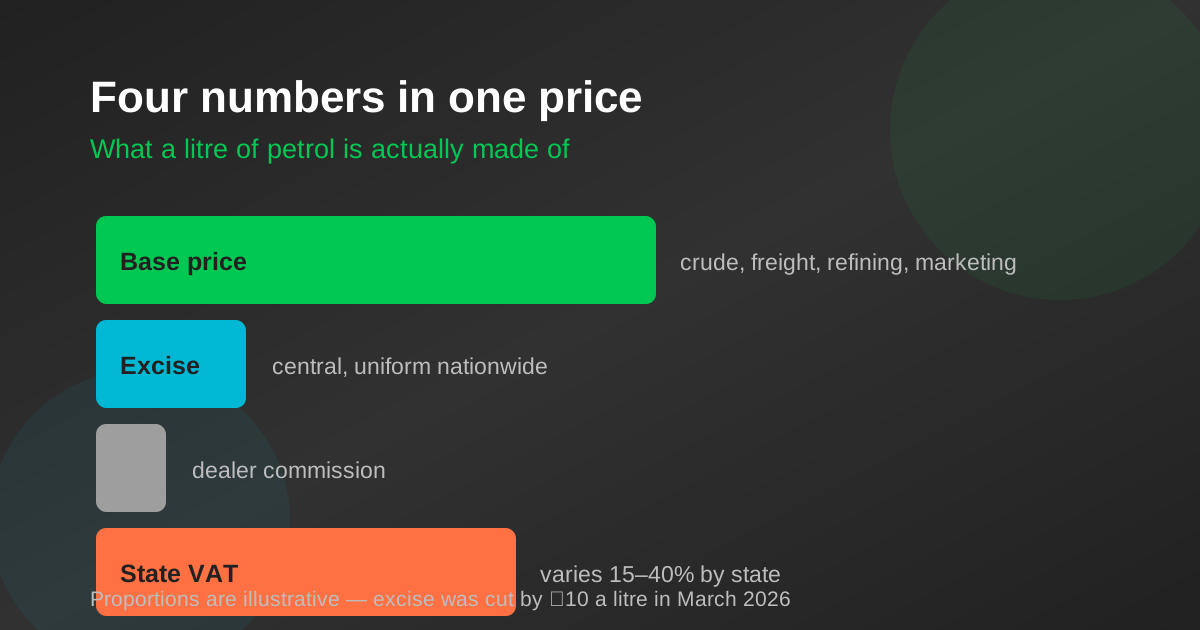
The board at the pump shows one number. Underneath it there are always four, and they behave in completely different ways:
- •The base price. What the oil marketing company charges the dealer: crude cost, freight, refining, marketing, distribution and the company’s own margin. This is the only part that tracks the oil market.
- •Central excise duty. A fixed amount per litre, uniform across the country, set by the Union government. Because it is fixed rather than proportional, it does not fall when crude falls.
- •Dealer commission. Broadly 3 to 4 per cent, in the region of a few rupees a litre.
- •State VAT or sales tax. A percentage, set by each state, ranging from roughly 15 to 40 per cent. This is why the same fuel costs materially different amounts across a state border.
The compounding nobody mentions
Central excise is a fixed rupee amount. State VAT is a percentage. And the percentage is applied to the base price plus the excise, not to the base price alone.
So the states charge tax on the Centre’s tax. Every rupee of excise adds more than a rupee to what you pay, because a state VAT of, say, 25 per cent turns that rupee into 1.25. It also means a central excise cut is amplified on its way to the pump rather than passed through one-for-one.
This is also why fuel sits outside GST. Bringing petrol and diesel into GST would cap the combined rate at 28 per cent plus cess and hand collection to a shared pool, and fuel taxes are one of the few large revenue sources states control directly. The obstacle is fiscal federalism, not administration.
What 2026 did to all of this
2026 was an unusual year for fuel taxation and it is worth recording what happened, because it inverted the structure most people carry in their heads.
On 27 March 2026, in the face of the West Asia crisis and the crude spike that came with it, the Union government cut central excise on both fuels by ₹10 a litre — taking petrol from around ₹13 to about ₹3, and diesel to effectively nil. Excise rates were revised again with effect from 16 July 2026.
At the same time the government moved in the opposite direction on exports, imposing and then raising a Special Additional Excise Duty on exported petrol and diesel — reported at ₹3.5 a litre for petrol and ₹24 a litre for diesel from 3 August 2026. The logic is straightforward: with international prices well above domestic ones, a refiner would rather export, and the export duty removes that incentive so domestic supply holds.
The third piece is the one that does not appear on any board. The public sector oil marketing companies raised retail prices only marginally against a sharp rise in crude, which means they absorbed the difference. That absorbed difference is called an under-recovery, and it is a subsidy paid by the balance sheets of state-owned companies rather than by a budget line.
Why the pump price is sticky in both directions
Since 2017 fuel prices have been revised daily, which was supposed to make them track international markets closely. In practice they are noticeably stickier than the underlying commodity, for four reasons that are all structural.
- •Physical lag. The crude in today’s diesel was bought weeks ago, shipped, refined and distributed. Today’s Brent price describes a barrel that has not reached a pump yet.
- •Fixed taxes do not scale. When roughly half of a price is a fixed rupee amount plus a percentage of it, a 20 per cent fall in the commodity cannot produce a 20 per cent fall at the pump. The arithmetic forbids it.
- •The rupee moves too. Crude is bought in dollars and sold in rupees. A falling oil price and a weakening rupee can cancel out entirely, and frequently do.
- •Marketing companies smooth. OMCs absorb increases and recover them slowly, which flattens the curve in both directions. Consumers notice the upside of this far less than the downside.
Where the money actually goes
It is worth being clear-eyed about this without being cynical. Fuel taxes in India fund a very large share of the road network, and the Road and Infrastructure Cess inside the excise structure is explicitly earmarked. Taxing fuel is also, in a rough way, taxing consumption and pollution — a household that burns more pays more.
The reasonable criticism is not that fuel is taxed. It is that a fixed per-litre levy is regressive: the same rupees fall on a driver covering 20,000 kilometres a year in a car and on a three-wheeler operator running the same distance to earn a living, and they represent very different fractions of income.
That regressivity is the real reason running-cost arithmetic matters so much for commercial vehicles. For an operator, fuel is not a household expense — it is the largest variable cost in the business, and it is taxed at a rate set for the household.
How to check the current numbers yourself
Given how much moved in 2026, the useful skill is not memorising rates but knowing where to find them.
- •The Petroleum Planning and Analysis Cell. PPAC publishes the official retail price build-up for the major metros, broken into exactly the four components above. This is the authoritative source and it is free.
- •Central Board of Indirect Taxes notifications. Excise changes take effect by notification, and the notification is the fact. News reports of a “₹10 cut” are usually accurate but rarely specify which of the three components — basic duty, Agriculture Infrastructure and Development Cess, Road and Infrastructure Cess — actually changed.
- •Your state’s VAT notification. The state share is the largest source of variation between cities and the one most likely to have changed without national coverage.
- •Do the subtraction. Take the pump price, subtract excise, dealer commission and VAT, and what remains is the base price. If that base price is falling while the pump price holds, you are looking at tax or margin, not at crude.
What this means if you are comparing with electricity
Two things follow for anyone weighing fuel against a battery.
The first is that the tax treatments are not comparable and the comparison is not neutral. Fuel carries central excise plus state VAT outside GST; electricity carries electricity duty at state rates, which is generally far lighter. A large part of the running-cost gap between petrol and electricity is a policy decision rather than a physical fact, and policy decisions can be reversed.
The second is that this cuts both ways over a vehicle’s life. Fuel tax could fall — it did, sharply, in March 2026. Electricity duty on charging could rise as EV volumes become worth taxing. If your case for an electric vehicle only works at today’s exact tax rates, it is a thinner case than it looks.
The version that survives is the one built on the physical difference rather than the fiscal one: a heat engine discards more than half its fuel as heat, and an electric drivetrain does not. That gap is not a policy setting. If you want to test how much of your own case rests on which, put both sets of numbers into our calculator and move the fuel price until the answer changes.
Frequently asked questions
What are the components of a petrol price in India?+
Four. The base price charged to the dealer, which covers crude, freight, refining, marketing and the oil company’s margin, and is the only part that tracks the oil market. Central excise duty, a fixed rupee amount per litre, uniform nationwide. Dealer commission, broadly 3 to 4 per cent. And state VAT or sales tax, a percentage set by each state and ranging from roughly 15 to 40 per cent.
Do states charge tax on the central tax?+
Yes. State VAT is applied to the base price plus central excise, not to the base price alone. So each rupee of excise adds more than a rupee at the pump — at 25 per cent VAT it becomes ₹1.25. It also means a central excise cut is amplified on the way down rather than passed through one-for-one.
What happened to fuel excise duty in 2026?+
On 27 March 2026 the Union government cut central excise on both fuels by ₹10 a litre in the face of the West Asia crisis and the crude spike with it, taking petrol from around ₹13 to about ₹3 and diesel to effectively nil. Rates were revised again with effect from 16 July 2026, and a Special Additional Excise Duty was imposed on exports — reported at ₹3.5 a litre for petrol and ₹24 for diesel from 3 August 2026 — to stop refiners diverting supply abroad. Rates change by notification, so check the current one rather than relying on any article, this one included.
Why are petrol and diesel not under GST?+
Fiscal federalism, not administration. Bringing fuel into GST would cap the combined rate at 28 per cent plus cess and move collection into a shared pool. Fuel taxes are one of the few large revenue sources states control directly, which makes the reform politically expensive in a way its technical merits do not address.
Crude prices fell, so why did the pump price not?+
Four structural reasons. The crude in today’s fuel was bought weeks ago and shipped, refined and distributed since. A fixed rupee excise plus a percentage on top of it cannot fall proportionally with a commodity. Crude is bought in dollars and sold in rupees, so a weakening rupee can cancel a falling oil price entirely. And oil marketing companies smooth increases and recover them slowly, which flattens the curve in both directions.
How do I check the current price build-up myself?+
The Petroleum Planning and Analysis Cell publishes the official retail price build-up for major metros, split into exactly those four components, and it is free. Excise changes take effect by CBIC notification, and your state’s VAT notification covers the largest source of city-to-city variation. Then subtract: pump price less excise, dealer commission and VAT leaves the base price, and if that is falling while the pump price holds, you are looking at tax or margin rather than crude.
Thinking about upgrading?
Talk to our team about the right pack for your vehicle, and about EMI options that keep the monthly outgo close to what you already spend.
Get in touch