The 2035 Ban That Became a 90 Per Cent Target
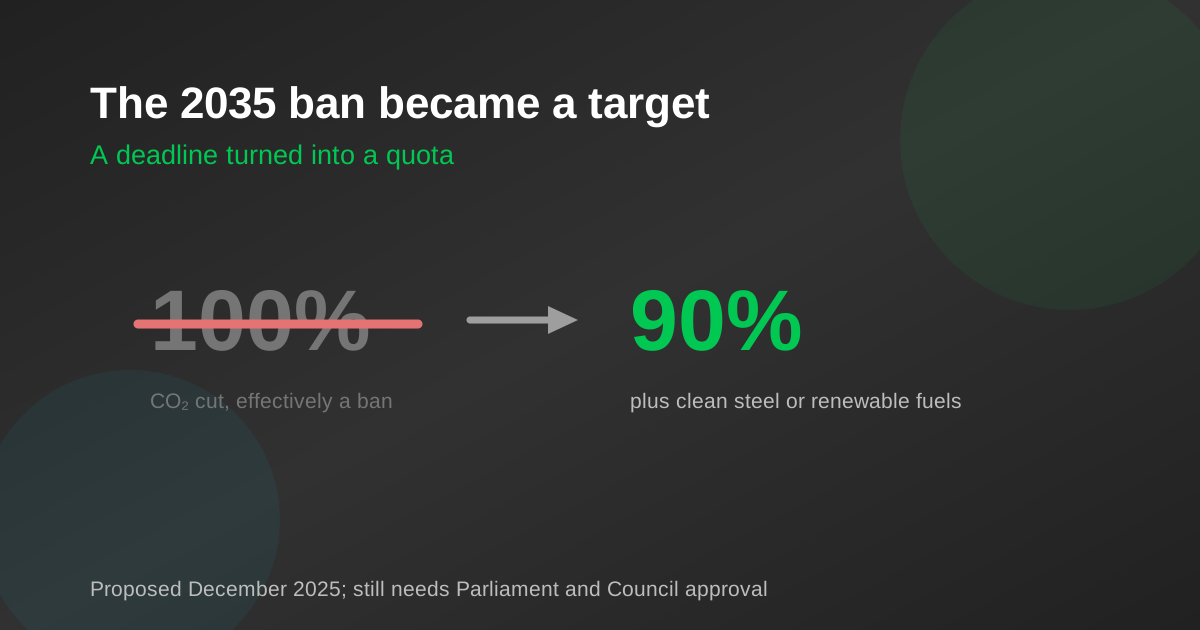
The Commission proposed replacing the 100 per cent CO₂ cut with 90 per cent plus clean steel or renewable fuels. Ten points sounds marginal; it converts a deadline into a quota — and quotas are things you plan around rather than reallocate capital for.
Published: 24 August 2026
Policy · 12 min read
What was actually decided
The rule everybody called “the 2035 petrol and diesel ban” was never phrased that way in law. It was a fleet-wide CO₂ target of a 100 per cent reduction for new cars and vans from 2035, which has the same practical effect while remaining, formally, an emissions standard rather than a technology prohibition.
In December 2025 the European Commission moved to soften it. The proposal replaces the 100 per cent requirement with a 90 per cent fleet-wide CO₂ reduction for 2035, explicitly invoking technology neutrality, with the remaining 10 per cent to be compensated through clean steel produced in the EU or through sustainable renewable fuels. Political negotiation between member states ran into 2026 under the Cypriot presidency, and the proposal still requires approval by both the European Parliament and the Council before it is law.
So: not yet final, and not a repeal. What it is, unambiguously, is a signal that technologies other than battery-electric vehicles may be sold after 2035.
Ten per cent sounds small. It is not.
The instinct is to read 90 versus 100 as a marginal loosening. The arithmetic says otherwise, because of what the target is a target of.
A fleet-average CO₂ obligation is met across everything a manufacturer sells. At 100 per cent reduction, every new vehicle must be zero-emission at the tailpipe; there is no room for anything else, which is why it functioned as a ban. At 90 per cent, a residual allowance exists — and because a combustion car emits far more than zero, a small percentage of allowance converts into a meaningful number of combustion vehicles.
The difference between 100 and 90 per cent is not ten per cent of the problem. It is the difference between a deadline and a quota — between a date on which one product line stops existing, and a permanent smaller business that can be planned around, lobbied over and extended again.
For a factory investment decision, that distinction is the whole thing. A deadline forces capital reallocation on a known date. A quota invites you to wait.
The compensation mechanisms are the strange part
Allowing the residual 10 per cent to be offset by EU-produced clean steel or by renewable fuels is an unusual piece of drafting, and it repays attention.
- •Clean steel is not a vehicle emissions measure. It shifts the accounting boundary from what comes out of the exhaust to what was emitted making the car. That is defensible as climate policy — lifecycle emissions are what matter — but it is a different regulation wearing the same name, and it hands an advantage to manufacturers who buy European steel, which is plainly part of the intent.
- •Renewable fuels revive the case for combustion engines. E-fuels and advanced biofuels let an internal combustion vehicle count as low-carbon. The physics problem is unchanged: making an e-fuel from electricity and using it in a heat engine wastes most of the energy compared with putting the electricity in a battery, which is why e-fuels make sense for aviation and shipping and struggle to make sense for cars.
- •Both mechanisms create accounting questions that will take years to settle. How compensation is verified, how it is allocated between manufacturers, and how it is priced are unresolved — and every year spent resolving them is a year in which the 2035 requirement is uncertain.
Why it happened
The honest account is that the European car industry is under simultaneous pressure from three directions and asked for relief from the one that was politically available.
- •A cost-advantaged competitor gaining share. Chinese brands are on track for a record 14.2 per cent of Europe’s battery-electric market in 2026 and have passed Japanese brands to become the second-largest group overall — while their BEVs remain around a fifth cheaper than European equivalents even after tariffs.
- •A domestic cell industry that did not materialise. Northvolt’s bankruptcy, ACC halting two gigafactories and a European pipeline shrinking by 176 GWh in a single year left carmakers dependent on the same suppliers as their competitors.
- •EV demand growing more slowly than the compliance path assumed, leaving manufacturers facing penalties for missing targets they had been building toward in good faith.
Given that, softening the target is a comprehensible decision. The question is whether it treats the disease or the symptom.
The case that this was a mistake
The strongest argument against the revision does not come from climate advocacy. It comes from industrial policy.
The 2035 target was doing a job beyond emissions: it was the demand guarantee underwriting every European battery factory, charging network and supply agreement. An investor putting several billion euros into a cell plant is not betting on consumer preference — consumer preference in 2035 is unknowable. They are betting that the law will require the product. Move the law and you remove the guarantee, retroactively, from capital that has already been committed. One analysis put the capacity implication of the rollback at the equivalent of dozens of Northvolt-sized factories.
There is also a competitive dimension. The relief goes to the manufacturers slowest to transition, and the cost falls on those who moved early and priced their plans around the rule holding. And it does nothing whatever about the actual competitive problem, which is that Chinese electric cars are cheaper to make. Relaxing an emissions target does not close a manufacturing cost gap; it just permits a temporary retreat into the segment where the gap has not yet arrived.
The case that it was sensible
The counter-argument deserves a fair hearing, because it is not merely industry lobbying.
- •A target that destroys the industry meant to meet it achieves nothing. Regulation that pushes European manufacturers into losses, plant closures and market exit does not produce European electric cars; it produces imported ones and fewer European jobs.
- •Technology neutrality is defensible on its own terms. Regulators have a poor record of picking technologies, and specifying an outcome rather than a mechanism is usually better policy.
- •Lifecycle accounting is more honest than tailpipe accounting. Bringing steel emissions into the frame is directionally correct, even if the mechanism is awkward.
- •Ninety per cent by 2035 remains a serious obligation. It is an enormous reduction against today, and treating it as a surrender misreads the number.
What actually decides this
Both arguments above are about the regulation, and the regulation is probably not the binding constraint. The market is being decided by the price of a small electric car.
The response that matters is on the showroom floor: the Citroën ë-C3 from around €19,590, the Renault Twingo E-Tech from about €19,500 with a 27.5 kWh LFP pack, Volkswagen’s ID. Polo from around €25,000, and an ID. 1 targeted under €20,000 for 2027. Renault and Volkswagen have even discussed collaborating on small EV development, which tells you how thin these economics are.
If those cars sell profitably, the 2035 target is irrelevant, because the transition happens on price and the regulation merely records it. If they do not, no target achievable by political negotiation will save the industry, because the competitor will still be cheaper. The regulatory argument is loud and the product argument is decisive, and they are being conducted by different people.
What this means from outside Europe
Two things are worth carrying away, particularly for a market like India that is writing its own EV timetables.
The first is about policy credibility. A regulatory deadline is only a demand guarantee for as long as investors believe it will hold, and its credibility is tested precisely when the industry is struggling — which is exactly when factories need it most. A target revised under pressure teaches every future investor to discount the next one. That lesson is more expensive than it looks, and it applies directly to subsidy schemes that lapse and restart, as India’s have.
The second is about sequencing. Europe set an ambitious demand-side deadline and assumed the supply side would follow. It did not, so the deadline had to move. India’s fastest electrification — the three-wheeler segment — happened with almost no demand mandate at all, because the electric option was simply cheaper to buy and cheaper to run. Where that condition holds, policy has to do very little. Where it does not, policy has to do more than any deadline can.
Frequently asked questions
Has the EU cancelled the 2035 petrol and diesel ban?+
Not cancelled, and not yet final. The rule was never a ban in law — it was a fleet-wide requirement for a 100 per cent CO₂ reduction for new cars and vans from 2035, which had the same practical effect. In December 2025 the Commission proposed replacing that with a 90 per cent reduction invoking technology neutrality, with the remaining 10 per cent compensated through EU-produced clean steel or sustainable renewable fuels. Political negotiation ran into 2026 and the proposal still requires approval from both the European Parliament and the Council.
Why does the difference between 100 and 90 per cent matter so much?+
Because it changes the kind of rule it is. At 100 per cent reduction every new vehicle must be zero-emission at the tailpipe, leaving no room for anything else, which is why it functioned as a ban. At 90 per cent a residual allowance exists, and since a combustion car emits far more than zero, a small percentage converts into a meaningful number of combustion vehicles. The practical effect is the difference between a deadline, which forces capital reallocation on a known date, and a quota, which can be planned around, lobbied over and extended again.
What are the clean steel and renewable fuel compensation mechanisms?+
They let the residual 10 per cent be offset either by using EU-produced low-carbon steel or by sustainable renewable fuels. Clean steel shifts the accounting boundary from tailpipe emissions to manufacturing emissions, which is defensible as climate policy but is effectively a different regulation, and it advantages manufacturers buying European steel. Renewable fuels allow combustion vehicles to count as low-carbon, though the physics is unchanged: making an e-fuel from electricity and burning it in a heat engine wastes most of the energy compared with putting that electricity into a battery.
Why did the EU soften the target?+
Because the European car industry is under pressure from three directions at once and asked for relief from the one politically available. Chinese brands are taking a record 14.2 per cent of Europe’s battery-electric market while remaining around a fifth cheaper even after tariffs; the domestic cell industry did not materialise, with Northvolt bankrupt, ACC halting two gigafactories and the pipeline shrinking 176 GWh in a year; and EV demand grew more slowly than the compliance path assumed, leaving manufacturers facing penalties.
Will weakening the target change who wins the European market?+
Probably not, because the regulation is not the binding constraint — the price of a small electric car is. Relaxing an emissions target does not close a manufacturing cost gap; it permits a temporary retreat into segments where the gap has not yet arrived. If the Citroën ë-C3, Renault Twingo, VW ID. Polo and ID. 1 sell profitably, the transition happens on price and the target merely records it. If they do not, no politically achievable target saves the industry, because the competitor is still cheaper.
Thinking about upgrading?
Talk to our team about the right pack for your vehicle, and about EMI options that keep the monthly outgo close to what you already spend.
Get in touch