Hormuz and the Cost of a Container: What the Iran War Did to Global Freight
Freight rates repriced on lanes nowhere near the Gulf, and contract rates followed spot. A look at the three mechanisms behind it, India’s unusually direct exposure, and an honest calculation of how much of it actually lands on a battery pack.
Published: 20 August 2026
Industry · 11 min read
Where things stand
Written 20 August 2026. This is an active conflict and the situation described below has already reversed twice; treat every figure as a snapshot rather than a forecast.
On 28 February 2026, coordinated US and Israeli airstrikes on Iran triggered the closure of the Strait of Hormuz and the suspension of Suez transits. In normal times roughly 20 million barrels a day — about a fifth of global petroleum liquids — pass through a channel whose navigable width is a couple of nautical miles.
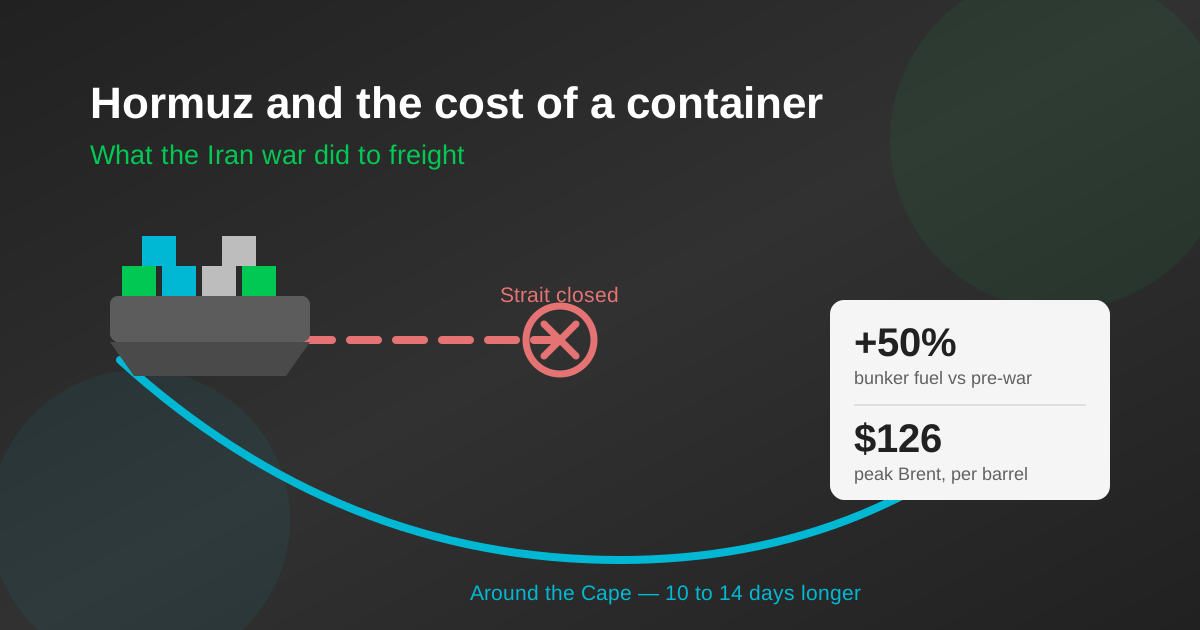
Within days the container market felt it directly. Alphaliner counted 138 container ships representing around 470,000 TEU trapped inside the Persian Gulf in early March. Vessels that could reroute went the long way round the Cape of Good Hope, adding 10 to 14 days to Asia– Europe and Asia–US East Coast voyages.
A US–Iran memorandum signed on 17 June lifted both blockades and traffic surged back through the strait on 19 June. That truce collapsed on 8 July. Iran declared a fourth closure on 12 July, the US reinstated its naval blockade on 14 July, and the strait has been effectively shut since. On 16 August a single vessel transited, against a normal rate of around 73 a day.
Why an oil chokepoint changed the price of a container of batteries
The connection is not obvious. Almost no lithium cells travel through Hormuz — they come out of China, Korea and Japan on the eastbound and westbound trades. Yet freight quotes for those lanes moved sharply. Three separate mechanisms did it.
- •Fuel. Ships burn oil, and the oil price is set globally. Singapore VLSFO rose more than 35 per cent within a fortnight of the closure; Brent peaked around $126 a barrel. Bunker fuel remains roughly 50 per cent above pre-war levels. Bunker adjustment factors pass this straight through to the shipper, on every lane, whether or not that lane goes anywhere near Iran.
- •Capacity. A voyage that takes two extra weeks ties up the same ship for longer, so the same fleet delivers fewer sailings a year. Rerouting does not merely delay cargo; it destroys effective capacity, and a capacity shortage raises the price of every slot in the market. This is why lanes with no geographic exposure to the conflict repriced anyway.
- •Risk. War risk insurance premiums for the region rose steeply, and carriers layered on emergency conflict surcharges that ran between $2,000 and $4,000 per container in March, alongside war risk surcharges of up to $1,500 per TEU. As one analyst put it bluntly, carriers would apply as many and as high surcharges as humanly possible.
Fuel and risk surcharges are the visible part. The capacity effect is the one that persists after the shooting stops, because vessels take months to redeploy and schedules take longer still to stabilise. It is also the reason a resolution does not produce an immediate return to old rates.
What rates actually did
Long-term contract rates from the Far East to the US West and East Coasts were reported up around 41 and 40 per cent respectively against their end-February levels — and the significant word there is contract. Spot markets reprice on rumour; when a disruption works its way into annual contract rates, the market has concluded it is structural rather than episodic.
More recently the direction has softened. Asia to North Europe has come off roughly 14 per cent since early July to around $5,000 per forty-foot container, and Mediterranean rates about 16 per cent to roughly $6,000. That is easing, not normalising: both remain far above where they started the year, war-risk premiums are still elevated, equipment is out of position and available tonnage is tight. Air freight, which absorbed some of the urgent cargo, tightened alongside it.
India’s exposure is unusually direct
India imports close to 90 per cent of the crude it consumes, and something in the range of 40 to 50 per cent of that import flow is exposed to the Hormuz corridor. Bilateral trade with the Gulf states exceeds $180 billion, so pharmaceuticals, engineering goods, rice, textiles and chemicals all face delay and cost on the export side as well.
For a battery buyer, the exposure that matters most is not the freight invoice. It runs through two other channels.
- •The rupee. A sustained oil price shock widens the current account deficit of a large net oil importer, which pressures the currency. Since cells are bought in dollars, a few per cent of rupee depreciation raises the landed cost of an imported cell by more than the entire freight increase does.
- •Diesel and logistics inside India. Higher crude feeds into diesel, which feeds into road freight, which feeds into the delivered cost of everything — including the pack that finally reaches a dealer in Indore.
How much of this actually lands on a battery pack?
It is worth doing the arithmetic rather than assuming, because the intuitive answer is wrong by a wide margin.
Lithium cells are dense and heavy, so a container of them hits its weight limit long before its volume limit. At roughly 22 tonnes of payload and around 160 Wh per kilogram at cell level, a forty-foot container holds on the order of 3,000 kWh of LFP cells once packaging is accounted for.
Spread a $3,000 surcharge across 3,000 kWh and you get about $1 per kWh, or roughly ₹85. On an LFP cell landed at something like ₹6,000 per kWh, that is on the order of one and a half per cent. For a typical 8 kWh e-rickshaw pack it is a few hundred rupees.
Freight is a real but second-order input to battery cost. A three per cent move in the rupee does more damage to the landed price of an imported cell than a tripling of container freight, because the exchange rate applies to the whole cell cost and freight applies to a thin slice of it.
The first-order effects on your battery bill are, in order: cell prices themselves, the exchange rate, duty treatment, and working capital cost — the last of which rises when transit times stretch, because inventory sits on water for two extra weeks and somebody is financing it. That last point is quietly significant for importers running on thin margins.
The offsetting force nobody mentions
An oil shock is not uniformly bad news for electrification. It is unambiguously bad for costs, and unambiguously good for the comparison against the alternative.
Every calculation on this site that pits electric running cost against diesel — the three-year cost per kilometre of an e-rickshaw, the case for replacing a diesel generator with battery storage — improves when crude sits above $100. A battery pack that costs one and a half per cent more in freight, competing against a fuel that costs thirty per cent more, has gained ground, not lost it.
This is a recurring pattern in energy history. Oil shocks have repeatedly accelerated the adoption of whatever was next, not because the alternative got cheaper but because the incumbent got dearer.
If you are buying batteries or equipment this year
- •Check whether freight is inside the quoted price. A CIF or DDP quote from six weeks ago carries risk the supplier has now repriced. An ex-works quote never included it and you will meet the surcharge separately.
- •Ask for the incoterm explicitly and get quote validity in writing. Validity windows have shortened across the market; a price good for thirty days is worth materially more than the same price good for seven.
- •Add two to three weeks to every imported lead time and plan inventory against the new number, not the old one. The delay is more likely to hurt you than the cost.
- •Watch for surcharges appearing after the fact. Emergency conflict and war risk surcharges are frequently levied at shipment rather than at quotation. Ask which surcharges are excluded from the price you were given.
- •Do not panic-buy on a spot spike. Rates have already fallen 14 to 16 per cent from July highs on the Europe trades. Filling a warehouse at the top of a surcharge cycle ties up working capital you may need if the rupee moves.
- •If you buy on credit, look at the total financed cost rather than the sticker. Longer transit and tighter validity push people into faster decisions and worse terms.
The structural lesson
The Hormuz closure is a reminder that the energy transition has not removed geopolitical chokepoints; it has moved them. India’s oil dependence runs through a strait in the Gulf. Its battery dependence runs through cell manufacturing and, further upstream, through refining capacity concentrated in a single country — a concentration we examine in the refining chokepoint and in why China dominates battery cells.
Both are single points of failure. The difference is that one of them can be built out of domestically, which is precisely the argument behind India’s cell manufacturing push — and the case for it looks a great deal stronger from where we sit in August 2026 than it did in January.
Frequently asked questions
What happened at the Strait of Hormuz in 2026?+
Coordinated US and Israeli airstrikes on Iran on 28 February 2026 triggered the closure of the strait and the suspension of Suez transits. A US–Iran memorandum on 17 June briefly reopened it and traffic surged back on 19 June, but the truce collapsed on 8 July, Iran declared a fourth closure on 12 July and the US reinstated its naval blockade on 14 July. As of mid-August the strait remains effectively shut — one vessel transited on 16 August against a normal rate of around 73 a day.
Why did freight rates rise on routes that do not pass through Hormuz?+
Three mechanisms. Fuel, because ships burn oil priced globally and bunker prices remain around 50 per cent above pre-war levels, passed straight through as bunker adjustment factors on every lane. Capacity, because rerouting around the Cape adds 10 to 14 days per voyage, so the same fleet delivers fewer sailings a year and every slot in the market reprices. And risk, through war risk insurance, emergency conflict surcharges of $2,000 to $4,000 per container and war risk surcharges of up to $1,500 per TEU.
Where are container freight rates now?+
Long-term contract rates from the Far East to the US West and East Coasts were reported up around 41 and 40 per cent against end-February levels, which matters because disruption reaching annual contracts signals the market treats it as structural. Asia to North Europe has since eased roughly 14 per cent from early-July highs to around $5,000 per forty-foot container, and Mediterranean rates about 16 per cent to roughly $6,000 — easing, but far above where the year started.
How much does higher freight actually add to a battery pack?+
Less than most people assume. Cells are weight-limited in shipping, so a forty-foot container holds on the order of 3,000 kWh of LFP cells. A $3,000 surcharge across that is about $1 per kWh, roughly ₹85, against a landed cell cost around ₹6,000 per kWh — on the order of one and a half per cent, or a few hundred rupees on an 8 kWh e-rickshaw pack. A three per cent move in the rupee costs considerably more, because the exchange rate applies to the whole cell cost.
Is the oil shock bad for electric vehicle adoption?+
It raises costs modestly and improves the comparison substantially. Every calculation pitting electric running cost against diesel — cost per kilometre for a three-wheeler, battery storage against a diesel generator — gets better when crude sits above $100. A pack that costs one and a half per cent more in freight while competing against a fuel that costs thirty per cent more has gained ground. Oil shocks have historically accelerated the adoption of whatever came next.
Thinking about upgrading?
Talk to our team about the right pack for your vehicle, and about EMI options that keep the monthly outgo close to what you already spend.
Get in touch