India’s Public Charging Problem Is Not the Number of Chargers
The count went from 5,000 stations to over 29,000 and drivers trust the network less than before. What actually breaks — grid connections, connector standards, twenty separate apps — and why two- and three-wheelers barely notice.
Published: 20 August 2026
Industry · 10 min read
The count went up. The experience did not.
India’s public charging network has grown quickly by the only measure anyone reports: the number of installed points. From roughly 5,000 public stations in 2022, the count passed 29,000 by late 2025 and has kept climbing since. Press releases follow the same template every quarter.
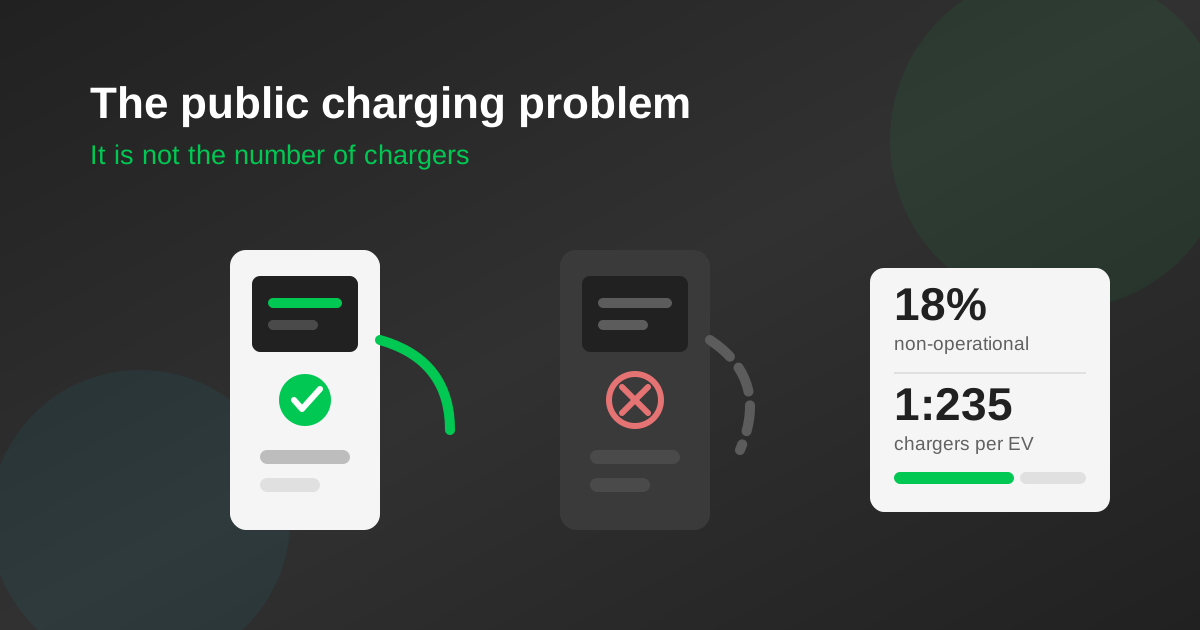
Ask anyone who actually drives an electric car outside a metro and you get a different account. Surveys through 2026 have found around 18 per cent of installed public stations non-operational at any given time, with some public-sector networks reporting far worse; roughly a quarter of stations suffer frequent downtime from technical faults, weak grid connectivity or maintenance that never arrives. Meanwhile the ratio stands at about one public charger per 235 electric vehicles on the road.
These two accounts are not in conflict. Installing a charger is a capital event that happens once and gets photographed. Keeping it working is an operating commitment that happens every day and gets photographed by nobody.
Why uptime compounds against you
The single most under-appreciated point about charging reliability is that individual charger uptime and useful network availability are not the same number, and the gap between them is brutal.
Suppose every charger in a network is independently up 85 per cent of the time — which sounds tolerable. A driver arriving at a two-gun site finds nothing working about 2 per cent of the time, which is fine. But a driver planning a 400-kilometre route with three possible stops, each of which must work when they arrive, is looking at compounded probability. Add a queue at the working unit, add a payment app that will not authenticate, and the practical failure rate climbs into territory where people stop trusting the network at all.
That loss of trust shows up in the survey data as something quite alarming: a large majority of Indian EV owners name finding a working charger as their main anxiety, and a substantial minority say they are considering going back to a petrol or diesel vehicle. The charger that was installed and photographed is doing real damage when it does not work.
Five things that actually break
It is worth naming the failure modes specifically, because “chargers are unreliable” is not actionable and each of these has a different owner.
- •The grid connection. A fast charger needs a sanctioned load that the local distribution network often cannot supply without a transformer upgrade. Approvals stall, interconnection terms are opaque, and sites sit commissioned-but-not-energised. Where supply exists but is weak, voltage excursions trip the charger repeatedly and the unit is recorded as faulty when the fault is upstream.
- •Connector fragmentation. A meaningful share of installed capacity is on Bharat DC-001 or CHAdeMO, while almost every vehicle sold now uses CCS2 on DC and Type 2 on AC. A working charger with the wrong gun is, to that driver, a broken charger.
- •Payments and apps. Drivers report navigating between 17 and 20 different mobile applications to find and start a session. Each is a separate account, wallet and failure point. Interoperability and roaming exist in policy documents and rarely at the kerb.
- •Physical neglect and vandalism. Cables cut, guns damaged, screens dead, units used as informal parking bollards. Unattended sites with no local host who is accountable for the asset degrade fast, particularly overnight.
- •The missing service contract. Most of the above is survivable with a maintenance SLA, spares held locally and a technician who can reach the site in hours. That costs money every month, which brings us to the reason it is so often absent.
The vicious circle
Almost every failure above is ultimately funded out of the same place, and that is where the system feeds on itself.
Private charge point operators report average utilisation well under 25 per cent, and in many locations under 10 per cent. A site running at 8 per cent utilisation does not generate enough gross margin to pay for a technician on call, a spares inventory and a reliable connectivity plan. So maintenance is deferred. The site becomes unreliable. Drivers who get burned once route around it permanently. Utilisation falls further.
This is the core of it. India does not primarily have a charger count problem. It has a charger economics problem that presents as a reliability problem. We work through the arithmetic in the charging station money problem.
Why two- and three-wheelers barely feel this
A point that gets lost in the public charging debate: the overwhelming majority of electric vehicles on Indian roads are two- and three-wheelers, and most of them never touch a public DC charger.
- •The energy is small enough to handle at home. An e-rickshaw pack of 5 to 8 kWh refills overnight from an ordinary 15 A socket. A scooter needs less. There is no engineering need for a 100 kW connection to move that much energy in the hours a vehicle is parked anyway.
- •The duty cycle has a natural charging window. Commercial three-wheelers run a day shift and park at night. Charging is not an interruption to the trip, it is what happens when the trip is over.
- •Fleets charge at a depot. One site, one owner, one connection, high utilisation, and someone whose job it is to notice a broken charger. Every problem in the section above is easier when the asset has an owner standing next to it.
- •Swapping side-steps it entirely. Where the duty cycle genuinely will not tolerate downtime, a swap network moves the charging off the vehicle’s critical path — at the cost of a larger battery inventory.
The practical implication is that public fast charging is largely a four-wheeler and intercity-highway problem. That is a real problem worth solving, but it should not be confused with the state of electrification generally. The segment that has actually electrified in India did it without the public network.
If you depend on public charging, check these
Concrete, in advance, before the trip rather than at 40 per cent state of charge on a highway.
- •The connector, not the kilowatts. Confirm the site has CCS2 if that is what your vehicle takes. A 60 kW Bharat DC-001 unit is 0 kW to you.
- •The real power per gun. A "120 kW" site with two guns sharing one 120 kW module gives you 60 kW each when both are occupied. Published ratings are often per site, not per vehicle.
- •Recent session history in the app, not the listing. A station listed as available with no successful session in a fortnight is telling you something.
- •Whether the host is open when you need it. Chargers inside malls, offices and hotels inherit the host’s opening hours and barrier gates.
- •A second option within range. Treat any single charger as unavailable until proven otherwise and plan the reserve accordingly.
What would actually fix it
The policy instruments now in place are aimed, encouragingly, at the right target. PM E-DRIVE support for fast-charger capital cost is conditional on uptime commitments around 95 per cent and on OCPP compliance — that is, on the charger being open to standard management software rather than a black box only its vendor can talk to. Tying money to uptime rather than to installation is the single most important design choice in the whole programme.
Beyond that, the fixes are unexciting and well understood: enforce one connector standard for new installations, mandate roaming so one account works across networks, publish per-charger uptime as open data so an operator’s reliability is visible before you drive to it, and put buffer storage behind sites where the grid connection is the binding constraint — which, for a great many locations, it is.
A battery between the grid and the charger lets a site deliver high peak power from a modest connection, which is both a reliability fix and a cost fix. It is the same logic as peak shaving for a factory, applied to a charging forecourt.
Frequently asked questions
How many public EV chargers does India have, and is it enough?+
The network passed 29,000 public stations by late 2025, up from around 5,000 in 2022, which works out at roughly one public charger per 235 electric vehicles. But the raw count overstates capability: surveys through 2026 have found around 18 per cent of installed stations non-operational at any time, with some networks far worse, and about a quarter suffering frequent downtime.
Why are so many public chargers in India non-functional?+
Five recurring causes. Grid connections that are unavailable, delayed or too weak to hold voltage; connector fragmentation, where installed Bharat DC-001 and CHAdeMO units cannot serve the CCS2 vehicles now being sold; payment and app fragmentation across 17 to 20 separate applications; physical damage and vandalism at unattended sites; and the absence of a maintenance contract, because low utilisation does not generate the margin to pay for one.
What utilisation do Indian charging stations actually see?+
Private operators report averages well under 25 per cent, and many individual sites under 10 per cent. That is the root of the reliability problem rather than a separate issue — a site at 8 per cent utilisation cannot fund a technician on call, a spares inventory and reliable connectivity, so maintenance is deferred and the site degrades until drivers route around it permanently.
Do e-rickshaws and electric scooters need public charging stations?+
Largely not. A 5 to 8 kWh e-rickshaw pack refills overnight from an ordinary 15 A socket, the duty cycle has a natural charging window while the vehicle is parked anyway, and fleets charge at a depot where somebody is accountable for the equipment. Public fast charging is mainly a four-wheeler and intercity-highway problem; the segment that has actually electrified in India did it without the public network.
What would genuinely improve charger reliability?+
Tying money to uptime rather than to installation, which PM E-DRIVE now does by conditioning fast-charger support on roughly 95 per cent availability and OCPP compliance. Beyond that: one connector standard for new installations, mandated roaming so a single account works across networks, published per-charger uptime as open data, and buffer battery storage at sites where the grid connection is the binding constraint.
Thinking about upgrading?
Talk to our team about the right pack for your vehicle, and about EMI options that keep the monthly outgo close to what you already spend.
Get in touch