The South Didn’t Skip Electrification, It Skipped the E-Rickshaw
India sold a record 830,000 electric three-wheelers in FY2026, led by Mahindra, Bajaj and TVS — organised firms selling into the South and West. The dividing line is the vehicle category, not the powertrain, and the two are now converging.
Published: 22 August 2026
Industry · 12 min read
The question is usually asked backwards
“Why has the South not adopted e-rickshaws?” assumes the e-rickshaw is the destination and that southern states are running late. Look at what actually sells there and the assumption falls apart.
Electric three-wheeler demand in India reached a record of roughly 830,000 units in FY2026, up about 19 per cent. Mahindra’s last-mile business sold over 100,000 of them and leads the L5 passenger category with something near 40 per cent share. Bajaj is the largest three-wheeler manufacturer overall and has been converting a rising share of its own output to electric. TVS reported electric penetration above half of its three-wheeler passenger sales in March 2026; Piaggio was around 17 per cent.
Those are organised-sector companies headquartered in Pune, Hosur and Chennai, selling through dealer networks that are strongest in the South and West. The southern three-wheeler market is electrifying quickly. It is simply not electrifying with the vehicle that dominates Uttar Pradesh.
L3 and L5 are not two versions of the same thing
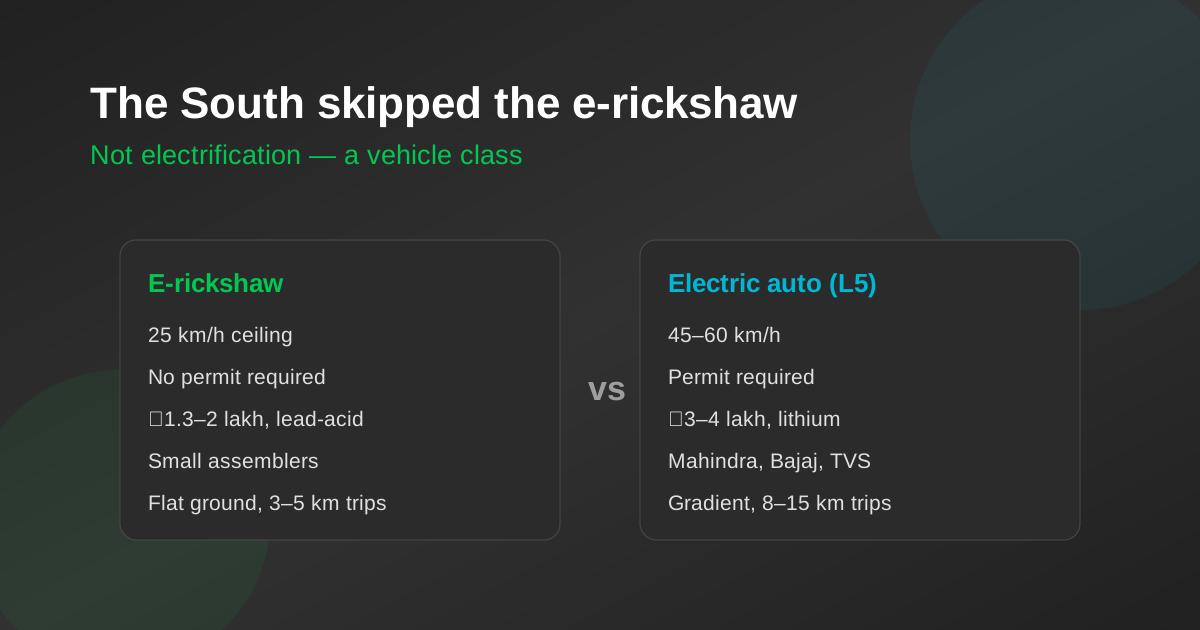
Indian vehicle regulation puts the e-rickshaw and the electric auto in genuinely different categories, with different rules, different economics and different customers. Most of the confusion about the adoption map dissolves once the two are separated.
| E-rickshaw (special category) | Electric auto (L5M) | |
|---|---|---|
| Top speed | Capped at 25 km/h by definition | Typically 45 to 60 km/h |
| Motor and drivetrain | Small BLDC motor, chain drive, often no true differential | Larger motor, proper transaxle, designed for gradient and load |
| Permit | Exempt from the commercial passenger permit requirement | Contract carriage permit required, and in many cities capped in number |
| Typical price | Roughly ₹1.3 to ₹2 lakh, historically with a lead-acid pack | Roughly ₹3 to ₹4 lakh, lithium pack standard |
| Battery | Commonly lead-acid, replaced every 9 to 18 months | Lithium, warrantied, expected to last most of the vehicle’s useful life |
| Who builds it | Hundreds of small assemblers, largely unbranded | Mahindra, Bajaj, Piaggio, TVS and other organised OEMs |
| Service and warranty | Local mechanic; warranty often nominal | Dealer network, parts supply, financeable and insurable |
| Natural habitat | Dense, flat, low-speed streets; 3 to 5 km feeder trips | Mixed arterial traffic, gradient, 8 to 15 km trips |
These are not competing products in one market. They are two vehicles that happen to have three wheels, aimed at customers who want different things and can raise different amounts of money.
Why the South could skip a rung
The interesting question is not why the South refused the cheap vehicle. It is why the South could afford to go straight to the expensive one.
- •The buyer already owned a productive asset. A southern auto driver replacing a CNG or LPG auto is trading up from a vehicle with resale value and a permit attached, so the financing conversation starts from a trade-in rather than from zero. A cycle-rickshaw puller in Bihar has nothing to trade.
- •The lender was already there. NBFC lending against a permitted, insurable, branded three-wheeler with a known resale market is ordinary business, and has been for decades against petrol autos. Swapping the powertrain changes the risk model far less than moving to an unbranded vehicle would.
- •The route economics justified the price. On a 12 km average trip at 45 km/h, an electric auto does roughly twice the daily revenue kilometres of an e-rickshaw. Paying twice as much for a vehicle that earns twice as much and lasts several times longer is not a stretch.
- •The vehicle had to survive gradient and arterial speed. Across much of the South and West a 25 km/h vehicle is not the cheaper option — it is not an option at all, because it cannot do the job.
The e-rickshaw is best understood as a capital-constrained answer to electrification and the electric auto as a duty-cycle-constrained one. Where drivers had almost no capital and very short trips, the cheap vehicle won. Where they had access to finance and long trips, the capable one did.
The evidence that the South is electrifying anyway
If southern reluctance were really about electricity, batteries or range anxiety, it would show up across every vehicle category. It does the opposite.
In the first five months of 2026, Kerala led the country on electric two-wheeler penetration at over 19 per cent of new registrations, with Karnataka close behind at nearly 19 per cent on around 99,000 units, and Goa at almost the same rate. On electric cars in FY2025–26, Maharashtra took the largest volume share at about 15.5 per cent of national sales, Karnataka around 11 per cent and Kerala roughly 9 per cent, with Kerala’s own electric car penetration approaching 8 per cent. Karnataka has also built the largest public charging network of any state, at roughly 6,100 stations.
A consumer base buying electric scooters and electric cars at the highest rates in India is not suffering from an aversion to batteries. It is declining one particular vehicle, for reasons specific to that vehicle.
What each route bought, and what it cost
Neither path is obviously superior, and it is worth being even-handed about the trade.
| North and East: the e-rickshaw route | South and West: the electric auto route | |
|---|---|---|
| Speed of adoption | Extremely fast — a whole category electrified inside a decade | Gradual, tracking OEM product cycles |
| Cost to the driver | Low entry price, high and recurring battery replacement cost | High entry price, low running and replacement cost |
| Who got included | The poorest transport workers in the country | Existing permit-holding auto drivers |
| Safety and standards | Weak — informal builds, poor braking, unregulated packs and chargers | Regulated construction and battery safety standards apply |
| Grid and charging | Informal domestic charging, frequently unmetered | Depot and home charging on commercial supply |
| Durability | Short vehicle and pack life, frequent replacement | Long vehicle life, warrantied pack |
| Headline EV share | Spectacular — up to 8 points of a state’s EV share from one category | Modest, but spread across two, three and four wheelers |
The northern route delivered inclusion and volume at the cost of safety and durability. The southern route delivered standards and durability at the cost of excluding anyone without access to three lakh rupees of credit. Both costs are real, and most commentary picks one and ignores the other.
The two are converging, from both directions
The gap that made these separate markets is closing, and mostly because of the battery.
The e-rickshaw’s low sticker price was always financed by a lead-acid pack that has to be replaced roughly every year to eighteen months. Over three years that replacement cycle can cost about as much as the vehicle did, which is why the lithium-versus-lead-acid comparison increasingly favours lithium even at the bottom of the market. As lithium becomes the default, the e-rickshaw’s cost advantage over an entry-level electric auto narrows from below.
From the other direction, organised manufacturers are pushing entry-level electric three-wheelers toward price points that overlap the top of the e-rickshaw market, while formalisation in the North — registration enforcement, fitness certificates, licensing — raises the effective cost of the informal option. The regulatory side of that story is the third article in this series.
The most plausible endpoint is not the e-rickshaw finally arriving in Chennai. It is a branded, lithium-powered, standards-compliant vehicle sitting between the two categories becoming the default across both halves of the country — cheap enough for a Patna driver, capable enough for a Pune one.
For anyone selling into this market
The practical reading, if you build, finance or supply parts into three-wheelers, is that “India’s electric three-wheeler market” is not one market, and treating it as one produces bad decisions.
- •Two customers, not one. The northern buyer is price-led, credit-constrained, and replaces the battery more often than the vehicle. The southern buyer is duty-cycle-led, financed formally, and is buying a warranty as much as a product.
- •The battery is the pivot in the North. Because packs turn over every year or two, the replacement market there is larger in unit terms than the new vehicle market. That is the entry point, not new vehicles.
- •The vehicle is the pivot in the South. Packs are warrantied and integrated, so the aftermarket opportunity arrives years later and comes through the OEM channel rather than around it.
- •Terrain belongs in the spec sheet. A pack sized for flat Gangetic duty will disappoint on the Deccan. Continuous discharge capability and thermal headroom matter far more where gradients are routine — see our guide on reading a spec sheet properly.
- •Watch the formalisation timetable, not the subsidy. Registration, fitness and licensing enforcement in the northern states will reshape that market over the next few years more than any purchase incentive will.
The simplest point is the last one. There is nothing culturally different about how the two halves of the country think about electric vehicles. There is a difference in terrain, trip length, incumbent vehicle, permit regime and access to credit — and those five things between them explain a map that otherwise looks inexplicable.
Frequently asked questions
What is the difference between an e-rickshaw and an electric auto?+
They are separate regulatory categories, not two versions of one vehicle. An e-rickshaw is capped at 25 km/h by its statutory definition, uses a small motor and chain drive, is exempt from the commercial passenger permit requirement, and costs roughly ₹1.3 to ₹2 lakh, historically with a lead-acid pack. An electric auto in the L5M category runs at 45 to 60 km/h, has a proper drivetrain built for gradient and load, needs a contract carriage permit, and costs roughly ₹3 to ₹4 lakh with a warrantied lithium pack from an organised manufacturer.
Is the Indian electric three-wheeler market actually growing?+
Strongly. Demand reached a record of roughly 830,000 units in FY2026, up about 19 per cent. Mahindra’s last-mile business sold over 100,000 units and leads the L5 passenger category with close to 40 per cent share, Bajaj remains the largest three-wheeler manufacturer overall, TVS reported electric penetration above half of its three-wheeler passenger sales in March 2026, and Piaggio was around 17 per cent.
Why do southern drivers buy the more expensive vehicle?+
Because it earns more and they can finance it. A southern auto driver is usually trading up from a permitted vehicle with resale value, so the finance conversation starts from a trade-in rather than zero, and NBFC lending against a branded, insurable three-wheeler is routine business. On a 12 km average trip at 45 km/h an electric auto covers roughly twice the daily revenue kilometres of an e-rickshaw and lasts several times longer. On gradient and arterial roads a 25 km/h vehicle is not the cheaper choice — it cannot do the job at all.
Which route to electrification worked better?+
Each bought something and paid for it. The e-rickshaw route delivered enormous volume very fast and included the poorest transport workers in the country, at the cost of weak safety standards, informal charging and short vehicle and pack life. The electric auto route delivered regulated construction, warranties and durability, at the cost of excluding anyone without access to around three lakh rupees of credit. Most commentary picks one of those costs and ignores the other.
What should battery and component suppliers take from this?+
That it is two markets. The northern buyer is price-led and credit-constrained and replaces the battery more often than the vehicle, so the replacement pack market there is larger in unit terms than the new vehicle market and is the natural entry point. The southern buyer is duty-cycle-led, formally financed, and buying a warranty, so packs are integrated and the aftermarket arrives years later through the OEM channel. Terrain also belongs in the spec: continuous discharge capability and thermal headroom matter far more where gradients are routine than on the Gangetic plain.
Thinking about upgrading?
Talk to our team about the right pack for your vehicle, and about EMI options that keep the monthly outgo close to what you already spend.
Get in touch