Why E-Rickshaws Conquered the North and East and Stopped at the Border
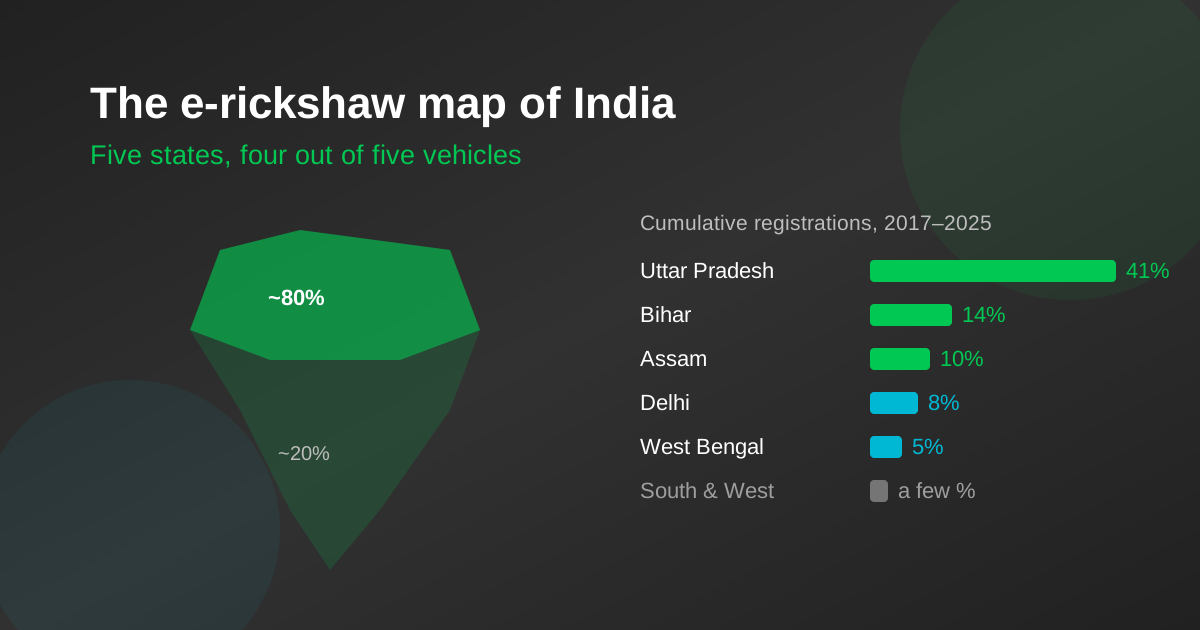
Five states hold roughly four out of every five e-rickshaws in India. The reasons are terrain, trip length, the vehicle it replaced, the permit rule and the credit market — not enthusiasm for electric vehicles, which the South has more of.
Published: 22 August 2026
Industry · 13 min read
Five states, four out of every five vehicles
India has an electric vehicle success story that nobody planned, and it has a postcode. Between 2017 and 2025, Uttar Pradesh alone accounted for around 41 per cent of all cumulative e-rickshaw registrations in the country. Bihar added roughly 14 per cent, Assam about 10, Delhi close to 8 and West Bengal a little over 5. Five states, and something near four-fifths of the national fleet.
The single-year picture is the same shape. Across 2025–26, Uttar Pradesh registered more than 200,000 e-rickshaws, West Bengal about 90,000, Bihar over 60,000, Assam over 50,000 and Delhi over 30,000 — again about 80 per cent of the national total from five states.
Now look at the other half of the map. Tamil Nadu, Karnataka, Kerala, Telangana, Andhra Pradesh, Maharashtra and Gujarat between them hold something like a third of India’s population and a considerably larger share of its urban vehicle demand. Their combined contribution to that fleet is small enough that removing e-rickshaws from the statistics barely moves their numbers at all.
The subtraction test
There is a neat way to see how load-bearing this one vehicle is. Take each state’s overall EV share of new registrations, then take e-rickshaws out and look at what remains.
| State | EV share of registrations | Excluding e-rickshaws | Change |
|---|---|---|---|
| Assam | 16% | 8% | −8 points |
| West Bengal | 10% | 3% | −7 points |
| Uttar Pradesh | 10% | 5% | −5 points |
| Delhi | 13% | 9% | −4 points |
| Bihar | 8% | 4% | −4 points |
| India | 8% | 7% | −1 point |
West Bengal’s electric transition is roughly two-thirds one vehicle. Assam’s is half. Kerala, Karnataka and Goa barely notice the subtraction, because almost none of their EV share was ever e-rickshaws in the first place.
That is the fact to explain. Not “why is the South behind” — it isn’t — but why one specific vehicle class saturated one half of the country and never crossed into the other.
Reason one: it replaced different things
This is the explanation that does most of the work, and it is the one least often mentioned. The e-rickshaw did not win a competition against petrol autos. In the places it conquered, it won a competition against a man pedalling.
Across the Gangetic plain and the East, the cycle rickshaw remained the dominant form of short-distance paid transport well into the 2010s. For someone pulling one, an e-rickshaw is not a marginal upgrade. It converts a job that yields perhaps 25 to 30 kilometres a day of brutal physical labour into one that yields 80 to 100 kilometres of sitting down. Daily earnings roughly double or better, the work stops destroying the body, and the capital required — well under two lakh — is within reach of informal credit.
In most of the South and West, the cycle rickshaw had already been extinct for decades. The incumbent was the petrol, LPG or CNG auto-rickshaw: faster, weatherproof, highway-legal, permitted, and organised. Against that incumbent an e-rickshaw is not an upgrade at all. It is slower, carries less, cannot climb, and cannot take the trip types that make an auto driver’s day profitable.
The e-rickshaw’s adoption map is really a map of where the cycle rickshaw survived into the 2010s. Overlay the two and they are close to identical. Everything else in this article is a second-order effect on top of that.
Reason two: the vehicle is built for flat ground
The statutory e-rickshaw is a deliberately limited machine: three wheels, not more than four passengers plus the driver, 40 kilograms of luggage, and a top speed capped at 25 kilometres per hour with motor power limited to a small fraction of what an auto-rickshaw uses. Cheap examples typically run a single low-power BLDC motor, a chain drive to one or both rear wheels, no differential worth the name, drum brakes and a lead-acid pack.
On the Indo-Gangetic plain that specification is fine. It is one of the flattest large inhabited surfaces on earth — the gradient from Delhi to Kolkata is measured in centimetres per kilometre. A vehicle with almost no hill-climbing reserve never meets a hill.
The Deccan plateau is not flat. Neither is the Konkan, the Nilgiris, the ghat sections around Pune, the ridges through Thiruvananthapuram, or the rolling terrain much of Bengaluru is built on. Gradient is where a low-power three-wheeler with a loaded pack fails: current draw spikes, a lead-acid pack sags under the load, range collapses, and the motor and controller overheat on the way back up. The margin that a 25 km/h vehicle has in reserve is close to zero to begin with.
Reason three: 25 km/h is a different vehicle on a different road
Speed limits sound like a detail. They decide which roads a vehicle can legally and safely use, and therefore which trips it can serve.
A 25 km/h vehicle is well matched to a dense, congested, low-speed street network where nothing moves faster anyway — the older cores of Varanasi, Patna, Kanpur, Agra, Guwahati, or the endless small-town main roads of eastern UP and north Bihar. It is a hazard on a six-lane signal-free arterial where traffic runs at 60. Southern and western metros built exactly that kind of arterial network, plus flyovers and ring roads on which a slow three-wheeler is either banned outright or lethal.
Trip length compounds it. The e-rickshaw’s economic sweet spot is a three-to-five kilometre feeder run — station to market, bus stop to colony, block road to village. Bengaluru, Hyderabad and Chennai sprawl, and the average paid trip in them is considerably longer. At twelve kilometres the difference between 25 and 50 km/h is the difference between four trips a day and eight.
Reason four: the industry that built them was northern
The e-rickshaw was never an organised-sector product. It grew out of hundreds of small assemblers — Delhi’s industrial clusters, Kanpur, Meerut, parts of West Bengal — importing controllers, motors and differentials as kits, welding a chassis, bolting on a locally made lead-acid pack, and selling within a district or two.
That model scales beautifully in density and terribly across distance. There was no national dealer network to extend, no service standard to export, and no working capital for either. An industry of small assemblers grows outward from where it already is. It reached Assam and Bihar because they are next door to the cluster and the demand was identical. It never reached Coimbatore, because the distribution reach did not exist and nobody in Coimbatore was asking.
Meanwhile the South and West already hosted the organised three-wheeler industry — Bajaj and Piaggio around Pune, TVS at Hosur, Mahindra’s last-mile business. When those firms electrified, they did not build e-rickshaws. They built proper electric auto-rickshaws, which is a different vehicle class serving different customers. That is the subject of the second article in this series.
Reason five: the money and the electricity were informal
Two enabling systems sit underneath the northern fleet, and both are informal.
- •Credit. A cycle-rickshaw puller has no credit file, no income proof and no collateral. The purchase gets financed by the dealer, a local financier or a chit arrangement, at rates a bank would not print, secured mostly by the fact that everyone knows where the borrower parks. This lending network exists densely in UP, Bihar and Bengal because it has funded small commercial assets there for generations.
- •Electricity. A 5 to 8 kWh pack refills overnight from an ordinary domestic socket. In much of the fleet that socket is on a residential connection, a shared informal charging shed, or a supply arrangement the distribution utility would not endorse. Cheap or unmetered power turns a marginal vehicle into a profitable one, and states with weak distribution enforcement effectively subsidised the fleet without deciding to.
Neither system transplants. Southern distribution utilities are, on the whole, better at collecting for what they supply, and the southern financing market for a commercial three-wheeler is already served by NBFCs lending against a permitted, insurable asset with a resale value. A formal lender can underwrite an electric auto. It struggles to underwrite an unbranded vehicle from an assembler that may not exist in three years, which is why battery and vehicle finance for this segment has developed the way it has — see our note on financing an e-rickshaw battery.
Reason six: the rules landed on different ground
E-rickshaws were given a legal category of their own and, critically, an exemption from the permit requirement that governs every other commercial passenger vehicle. In a state where nobody held a valuable permit for short-distance transport, a permit-free vehicle class simply filled a vacuum.
In a state where auto permits are capped, tradable and politically defended, the same exemption is not a vacuum — it is an attack on an existing asset, and it meets organised resistance. That mechanism deserves its own treatment, and gets it in the third article in this series.
What the map does not mean
It is worth stating the counter-case plainly, because the headline numbers invite a wrong conclusion.
Kerala recorded the highest electric two-wheeler penetration in the country in early 2026, at over 19 per cent of new two-wheeler registrations, with Karnataka just behind at nearly 19 and Goa at almost the same. Karnataka has led the country on public charging infrastructure. Maharashtra sells the largest volume of electric cars of any state. Kerala, Goa and Karnataka sit near the top of overall EV penetration tables.
So the South and West are not resisting electrification. They are electrifying a different set of vehicles, through the organised sector, on formal credit, with a slower ramp and a much broader base. The North and East got to a high EV share fast by electrifying one category almost completely; the South is getting there gradually by electrifying everything a little.
Two roads to the same place. The northern route is fast, narrow and informal — enormous volume in one cheap category, weak on safety and standards. The southern route is slower, broader and formal — regulated vehicles, real warranties, and no single number that looks impressive on a chart.
Where this goes next
Three things are likely to reshape the map over the next few years.
- •Formalisation in the North. Registration enforcement, fitness testing and licensing are tightening across UP, Delhi and Bihar. That raises costs, kills the weakest assemblers and pushes buyers toward branded vehicles — narrowing the gap between an e-rickshaw and a low-end electric auto.
- •Lithium replacing lead-acid. The economics of the northern fleet were built on a cheap pack that dies in a year. As lithium replacement costs fall, the total cost per kilometre changes shape, and a vehicle that can actually hold its performance over three years becomes viable in places lead-acid never worked.
- •The electric auto moving down. Organised OEMs are pushing entry-level electric three-wheelers toward price points that overlap the top of the e-rickshaw market. The likely long-run outcome is not the e-rickshaw spreading south, but the electric auto spreading north.
The e-rickshaw was the right vehicle for a specific place at a specific moment: flat ground, short trips, no incumbent, no permit, cheap power and cheap credit. Every one of those conditions is geographic or institutional rather than technical, which is exactly why the map looks the way it does — and why simply promoting the vehicle harder in Chennai was never going to change it.
Frequently asked questions
Which Indian states have the most e-rickshaws?+
Adoption is extraordinarily concentrated. Between 2017 and 2025, Uttar Pradesh alone accounted for around 41 per cent of cumulative e-rickshaw registrations, followed by Bihar at about 14 per cent, Assam around 10, Delhi close to 8 and West Bengal a little over 5 — roughly four-fifths of the national fleet from five states. The single-year picture matches: in 2025–26 Uttar Pradesh registered more than 200,000, West Bengal about 90,000, Bihar over 60,000, Assam over 50,000 and Delhi over 30,000.
Why are e-rickshaws so rare in south and west India?+
Six reinforcing reasons. The cycle rickshaw, which the e-rickshaw directly replaced, had already disappeared there decades earlier, so the incumbent was the faster and more capable petrol or CNG auto. The terrain is not flat, and a 25 km/h vehicle with minimal power reserve fails on gradient. Southern and western cities have fast arterial roads and longer average trips that a slow vehicle cannot serve profitably. The manufacturing and dealer ecosystem was northern and never extended south. Informal credit and informal charging, both of which underwrote the northern fleet, are weaker there. And the permit exemption that opened the category landed very differently in states with capped, valuable auto permits.
Does that mean south India is behind on electric vehicles?+
No — the opposite, on most measures. Kerala led the country on electric two-wheeler penetration in early 2026 at over 19 per cent of new registrations, with Karnataka at nearly 19 per cent and Goa close behind. Maharashtra sells the largest volume of electric cars of any state, Karnataka has built the largest public charging network, and Kerala, Goa and Karnataka sit near the top of overall EV penetration tables. The South is electrifying broadly across categories rather than saturating one cheap category.
How much of northern EV adoption is just e-rickshaws?+
A great deal of it. Removing e-rickshaws from the statistics cuts Assam’s EV share of new registrations from about 16 per cent to 8, West Bengal’s from 10 to 3, Uttar Pradesh’s from 10 to 5, Delhi’s from 13 to 9 and Bihar’s from 8 to 4. Nationally the share only slips from about 8 per cent to 7, which shows how geographically concentrated the effect is.
Will e-rickshaws eventually spread to south India?+
Probably not in their current form. The likelier convergence runs the other way: formalisation in the North — registration drives, fitness testing, licensing and battery compliance — is raising the cost of the cheap informal vehicle, while organised manufacturers push entry-level electric autos down toward overlapping price points. The plausible endpoint is a branded, lithium-powered, standards-compliant vehicle between the two categories becoming the default in both halves of the country.
Thinking about upgrading?
Talk to our team about the right pack for your vehicle, and about EMI options that keep the monthly outgo close to what you already spend.
Get in touch