Permit-Free by Design: The Clause That Built India’s Largest EV Fleet
The e-rickshaw got no meaningful subsidy, no charging programme and no manufacturing incentive. It got an exemption from Section 66(1) of the Motor Vehicles Act — and that landed very differently in states where auto permits are scarce and valuable.
Published: 22 August 2026
Policy · 12 min read
A vehicle class created by an amendment
The e-rickshaw did not arrive as a product. It arrived as a legal definition, and almost everything about its geography follows from how that definition interacted with rules the states already had.
Battery rickshaws were on Indian roads for years with no legal status at all. In 2014 the Delhi High Court effectively halted them for want of a category, and the response was to amend the Motor Vehicles Act to create one. Section 2A defined an e-rickshaw as a three-wheeled battery-operated vehicle carrying not more than four passengers excluding the driver plus 40 kilograms of luggage, with tightly limited motor power and a maximum speed of 25 kilometres per hour.
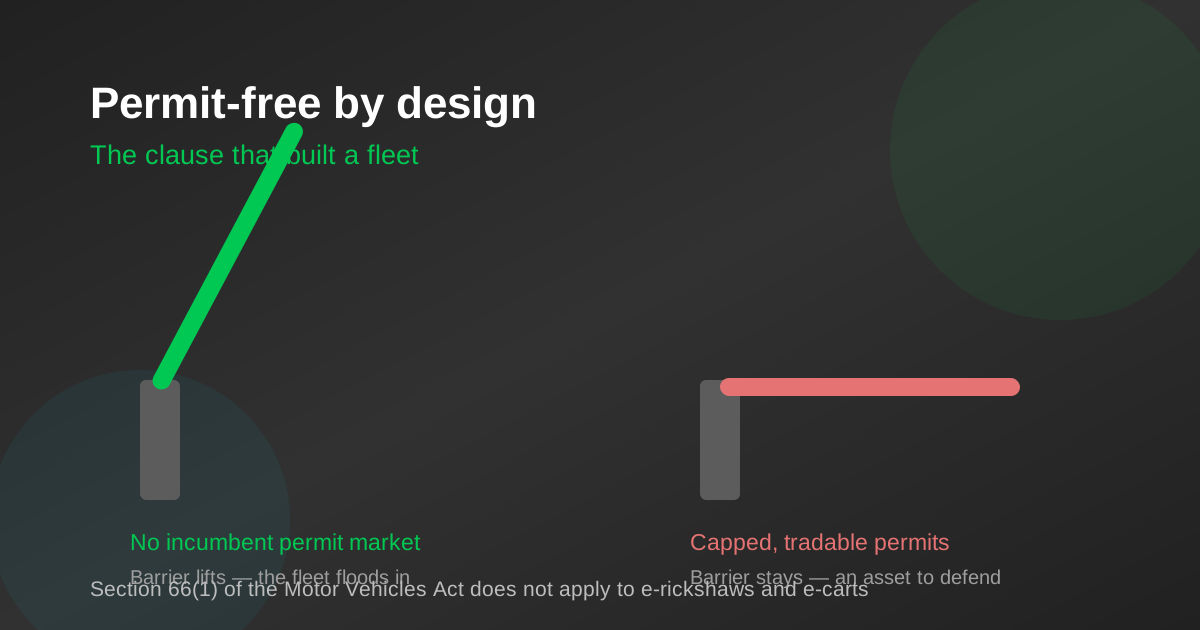
Then came the provision that mattered more than any subsidy ever has: sub-section (1) of Section 66 — the requirement that a vehicle carrying passengers for hire hold a permit — was made not to apply to e-rickshaws and e-carts. Driving licence and periodic fitness requirements were attached, but the permit was gone.
Why a permit exemption is worth more than a subsidy
To see why that single clause did more for adoption than any purchase incentive, you have to look at what a permit is in a city where they are capped.
A contract carriage permit for an auto-rickshaw is a licence to earn. Where the number issued is limited — as it has been at various times in Mumbai, Pune, Bengaluru, Chennai and elsewhere — that scarcity gives the permit a market value quite separate from the vehicle. Permits get transferred, rented, inherited and traded. For a great many auto drivers the permit is the single most valuable thing they own.
Now introduce a vehicle that carries paying passengers on the same streets, needs no permit, and can be bought by anyone with a lakh and a half. You have not merely added competition. You have created an unlimited supply of a good the state deliberately kept scarce, and every existing permit is worth less the moment you do it.
The permit exemption is the most consequential EV policy India has passed, and it was never framed as EV policy. It works by removing a barrier to entry rather than by paying anyone — which is also precisely why it met organised opposition wherever that barrier was valuable.
The same rule, two very different receptions
Central law created the category. What happened next was decided locally, because the amendment left states free to restrict where these vehicles may ply under ordinary traffic powers — specific roads, specific areas, specific hours.
That is a wide power, and it is the lever every state has actually used. Nobody had to ban the e-rickshaw to keep it out. Barring it from arterial roads, restricting it to a radius around a subdivision headquarters, or declining to build any registration process for it achieves the same result while remaining a routine traffic decision.
| Local condition | How the permit exemption landed |
|---|---|
| No incumbent permit market (much of UP, Bihar, Assam, small-town Bengal) | Filled a vacuum. Short-distance transport was cycle rickshaws and shared jeeps, nobody held a valuable permit, and there was no organised constituency with anything to lose. Registration followed adoption rather than preceding it. |
| Capped, tradable auto permits and organised unions (Mumbai, Pune, Bengaluru, Chennai and other large metros) | Read as a threat to an existing asset. Unions that can mobilise thousands of drivers and vote as a bloc have consistently opposed uncapped new categories of paid transport, and state governments have generally moved slowly, restricted routes, or regulated the category into a narrow feeder role. |
| Strong road-safety and traffic enforcement priorities | A 25 km/h vehicle mixing with 60 km/h arterial traffic is a defensible thing to restrict on safety grounds alone, quite apart from any politics. Restrictions on major roads have been imposed in cities across both halves of the country, including in the North. |
| Weak registration and enforcement capacity | Large unregistered fleets. Several northern cities have had e-rickshaw populations that transport authorities could not reliably count, which is a genuine problem and one now being corrected through mandatory registration drives. |
It is worth being careful here. The politics is real, but it is not the whole story, and treating southern states as simply captured by unions would be lazy. Restrictions on slow vehicles on fast roads are defensible on their own terms, and a state that already has a functioning permitted auto sector has less need for an unregulated parallel one. Both motives point the same way, which makes them hard to separate from the outside.
The organised counterweight
Auto-rickshaw drivers in the southern and western metros are among the most effectively organised informal workers in India. Bengaluru’s auto drivers are represented by a federation of more than twenty unions; comparable structures exist in Chennai, Kerala, Mumbai and Pune, many with long-standing political affiliations.
Their consistent demand across two decades has been control over the number of permits issued, on the straightforward argument that unlimited entry drives everyone’s earnings to subsistence. The same federations have opposed bike taxis, app aggregator expansion and other uncapped categories, and have won often enough that the pattern is well established.
In the North and East the equivalent workforce — cycle-rickshaw pullers, largely migrant, with no licensed asset to defend — had no comparable organisation and nothing to protect. When a vehicle appeared that doubled their income, there was no institution positioned to object, and the constituency for the e-rickshaw was the same people who would have been the constituency against it elsewhere.
What states actually control
If you are trying to read whether a given state will support this vehicle class, the purchase subsidy in its EV policy is close to the least informative thing in it. The levers that decide the outcome are these.
- •Road access. Which roads and areas the vehicle may use, and at what hours. This is the decisive lever, it is exercised by traffic police and transport departments rather than by legislation, and it can be changed without announcement.
- •Registration process. Whether the RTO has a functioning route to register the vehicle at all, and what it demands — type approval, battery compliance, chassis documentation. Non-compliant packs are a common ground for rejection, and enforcement of that varies enormously by state.
- •Radius and route conditions. Restricting operation to a fixed radius around a town, or to feeder routes off a main corridor, keeps the vehicle out of competition with permitted autos while still permitting it.
- •Fitness and licensing enforcement. Licence and periodic fitness requirements exist centrally. Whether they are checked is local, and it is the single biggest cost difference between a formalised and an unformalised fleet.
- •Charging and electricity policy. Whether commercial charging is metered and billed, whether dedicated tariffs exist, and how hard the distribution utility works on unmetered draw. Cheap informal power has quietly underwritten a large share of the northern fleet.
- •Scrappage and battery rules. Requirements on pack certification and end-of-life handling raise the floor on vehicle cost and squeeze the informal assembler out first.
Our guide to checking state EV policies covers where to find the documents. The point to carry into them is that the operative rules are usually not in the EV policy at all — they are in transport department circulars and traffic notifications that no press release covers.
Formalisation is the live story now
The direction of travel has changed. Having grown for a decade in a regulatory gap, the e-rickshaw fleet is now being pulled into the system: mandatory registration drives across states, licence and fitness enforcement, restrictions on entry to major roads in city after city, and rising attention to battery and charger compliance after fire incidents.
The effects are predictable and mostly good. Vehicles get safer and countable. The cheapest assemblers, whose margin came from skipping compliance, are squeezed out. Costs rise, which hurts the marginal driver in the short term and pushes buyers toward branded vehicles and certified packs in the medium term.
It also narrows the gap that made this a two-market country. A registered, licensed, fitness-tested e-rickshaw with a compliant lithium pack is a substantially more expensive proposition than the vehicle that conquered Uttar Pradesh — and it is much closer to the entry-level electric auto that the South chose instead. That convergence is the subject of the second article in this series.
The lesson worth generalising
The e-rickshaw is the closest thing India has to a natural experiment in EV policy, and it says something uncomfortable about how adoption actually happens.
Nobody targeted it. It received no meaningful purchase subsidy for most of its growth, no charging infrastructure programme, no manufacturing incentive, and very little official enthusiasm. What it got was a legal category, an exemption from a barrier to entry, a price low enough for informal credit, and a duty cycle that needed no public charging. On the back of that it put several million electric vehicles on Indian roads and lifted whole states into double-digit EV share.
Meanwhile the categories that received the most policy attention and money have grown far more slowly, and the public charging network built to support them remains underutilised.
The reproducible lesson is not “build e-rickshaws everywhere.” It is that electrification moves fastest where the electric option is cheaper to buy, cheaper to run, legal to operate and not blocked by an incumbent with something to lose. Where a policy can deliver those four conditions, adoption follows without being paid for. Where it cannot, no subsidy has yet proved large enough to substitute.
Frequently asked questions
Do e-rickshaws need a permit in India?+
No. When the Motor Vehicles Act was amended to create the category after the 2014 court intervention, sub-section (1) of Section 66 — the requirement that a vehicle carrying passengers for hire hold a permit — was made not to apply to e-rickshaws and e-carts. A driving licence and periodic fitness certification are required, but the permit is not. States retain the power to restrict where these vehicles may ply under ordinary traffic powers, and that power is the lever most actually used.
Why did the permit exemption matter more than subsidies?+
Because in cities where permits are capped, the permit itself has market value quite separate from the vehicle, and is often the most valuable asset an auto driver owns. Introducing a vehicle that carries paying passengers on the same streets, needs no permit and costs a lakh and a half does not merely add competition — it creates unlimited supply of a good the state deliberately kept scarce. Where no such incumbent market existed, the exemption simply filled a vacuum and the fleet grew without anyone paying for it.
How do states restrict e-rickshaws without banning them?+
Mostly through road access and process. Barring the vehicle from arterial roads on safety grounds, restricting operation to a radius around a subdivision headquarters or to feeder routes, declining to build a workable registration route at the RTO, and enforcing battery and type-approval compliance strictly all achieve the same outcome while remaining routine administrative decisions. None of this requires legislation or an announcement.
Are auto-rickshaw unions the reason e-rickshaws did not spread south?+
They are part of it, not the whole of it. Auto drivers in the southern and western metros are among the most effectively organised informal workers in India — Bengaluru’s drivers alone are represented by a federation of more than twenty unions — and their consistent demand has been control over the number of permits issued, a position they have also taken against bike taxis and aggregator expansion. But restricting a 25 km/h vehicle on 60 km/h arterial roads is defensible on road-safety grounds by itself, and a state with a functioning permitted auto sector has less need for an unregulated parallel one. Both motives point the same way.
What is changing now?+
Formalisation. Mandatory registration drives, licence and fitness enforcement, restrictions on entry to major roads, and rising scrutiny of battery and charger compliance after fire incidents are pulling a fleet that grew in a regulatory gap into the system. Vehicles get safer and countable, the cheapest assemblers lose the margin that came from skipping compliance, and costs rise. It also narrows the gap between a compliant e-rickshaw and an entry-level electric auto, which is the convergence that will define the next few years.
Thinking about upgrading?
Talk to our team about the right pack for your vehicle, and about EMI options that keep the monthly outgo close to what you already spend.
Get in touch