China’s 0.1 Per Cent Rule Returns in November — and It Reaches Magnets Made Outside China
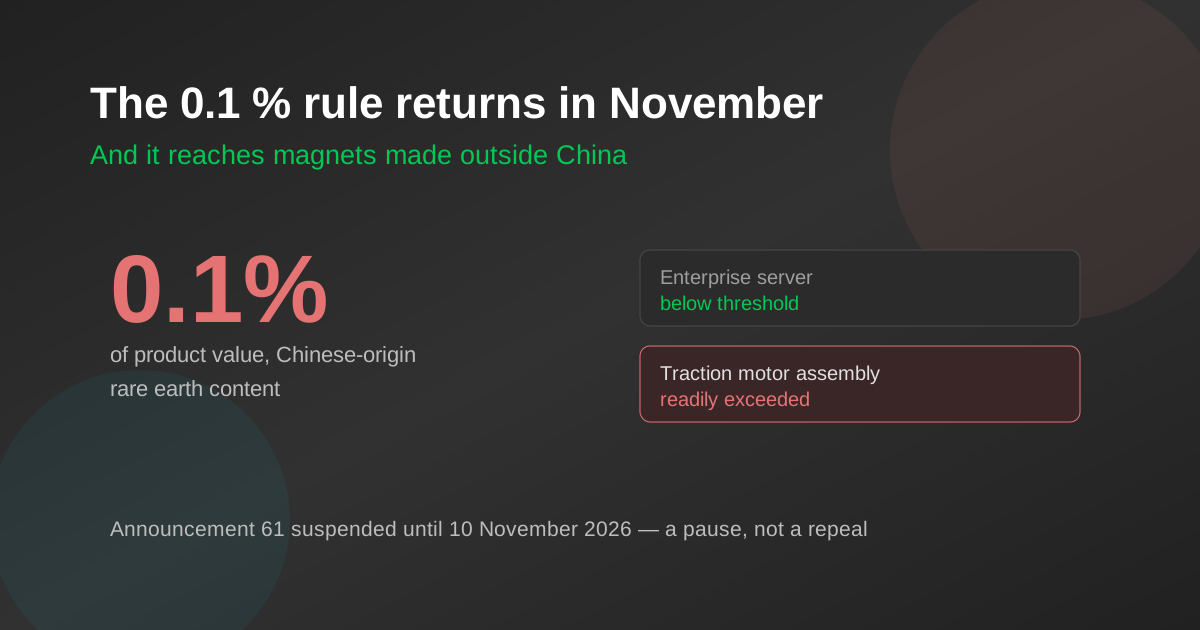
Announcement 61 extends Chinese export control to foreign-made products containing as little as 0.1 per cent Chinese-origin rare earth by value. A traction motor assembly clears that threshold easily; an enterprise server does not.
Published: 27 August 2026
Policy · 8 min read
Where things stand
Written 27 August 2026. This is a fast-moving regulatory position — confirm the suspension status before relying on anything here commercially.
China’s rare earth export control framework now runs across three separate announcements, and the one that matters most for anyone buying motors or magnets is currently suspended rather than repealed.
- •Announcement 18 (April 2025) controls rare earth materials and magnets themselves. It is in force and has never been suspended. Magnets containing controlled heavy rare earths — principally dysprosium and terbium — are treated as dual-use items requiring a Chinese export licence.
- •Announcement 61 (9 October 2025) extends control extraterritorially through a de minimis rule. It is suspended until 10 November 2026.
- •Announcement 62 controls the underlying technology and know-how. Also suspended to the same date.
The 0.1 per cent rule, and why it behaves oddly
Announcement 61 provides that a product manufactured entirely outside China can fall within Chinese export controls if Chinese-origin rare earth content reaches 0.1 per cent by value of the total product. Reporting indicates the trigger is assessed at component level rather than at the finished-product level.
Because the threshold is a share of value, it scales inversely with how expensive the finished product is.
For a high-value item such as an enterprise server, rare earth content sits well below 0.1 per cent and the threshold is never reached. For magnets, motor assemblies and specialised electronics — where the magnet is a meaningful fraction of the bill of materials — it is readily exceeded.
That is the crux for the EV supply chain. A traction motor assembly is exactly the kind of product where the rule bites, and a data-centre component is exactly the kind where it does not.
The enforcement is real
A case surfaced in May 2026 in which a listed Chinese manufacturer was fined roughly RMB 910,000 — several times the cargo value — after customs tested a shipment declared as ordinary NdFeB and found 1.2 per cent dysprosium.
The lesson is narrower than “magnets are restricted”. It is that a declared grade is not evidence of composition, and customs is testing.
What to actually do about it
The practical exposure is not that magnets are banned; they are not. It is sourcing from a supplier who cannot prove by testing what is actually inside the magnet.
- •Ask for compositional test data on heavy rare earth content, not a grade name on a datasheet. A grade code encodes an energy product and a temperature rating; it does not certify a dysprosium percentage.
- •Understand the licence status of what you are importing, including whether any upstream input was Chinese-origin. Under Announcement 61 the question is not where the magnet was pressed.
- •Treat 10 November 2026 as a live date. If no further suspension is announced, Announcements 61 and 62 reimpose simultaneously.
- •Note that Announcement 18 applies now regardless. The April regime is the permanent baseline; the November date concerns the extraterritorial extension on top of it.
Context on prices and on where the leverage sits
Reporting through the first half of 2026 describes steep increases in neodymium-praseodymium oxide, with heavy rare earths under particular pressure because commercially scaled refined supply outside China is effectively absent.
Several analyses put the Chinese share of global rare earth refining and separation capacity above 90 per cent, and note that this reflects control of the processing stage rather than of reserves — China holds only around a third of global reserves.
That distinction is the whole story, and it is why India’s magnet scheme deliberately funds oxide-to-metal conversion rather than magnet pressing alone. The mechanics of why separation is so hard to replicate are in our chapter on the separation cascade.
Sources
Reporting this piece draws on. Figures were correct as published; scheme terms and commodity prices move.
- China’s Rare Earth Export Controls — Impact on Businesses and IndustriesChina Briefing
- China Suspends Export Controls on Certain Critical Minerals and Related ItemsPillsbury Winthrop Shaw Pittman
- China Hits “Pause” on Rare-Earth Export Controls and What it Means for Supply ChainsClark Hill
- China’s Rare Earth Endgame: What Happens After November 10?InvestorNews
Frequently asked questions
What is the 0.1 per cent rule?+
Under MOFCOM Announcement 61, issued 9 October 2025, a product manufactured entirely outside China can fall within Chinese export controls if Chinese-origin rare earth content reaches 0.1 per cent by value of the total product, with reporting indicating the trigger is assessed at component rather than finished-product level. It was suspended on 7 November 2025 until 10 November 2026.
Why does the threshold affect motors but not servers?+
Because it is a share of value, so it scales inversely with how expensive the finished product is. In a high-value item such as an enterprise server, rare earth content sits well below 0.1 per cent of total value and the threshold is never reached. In magnets, motor assemblies and specialised electronics — where the magnet is a meaningful fraction of the bill of materials — it is readily exceeded.
Which controls are actually in force right now?+
Announcement 18, from April 2025, controls rare earth materials and magnets themselves and has never been suspended — magnets containing controlled heavy rare earths such as dysprosium and terbium are dual-use items requiring a Chinese export licence. Announcements 61 and 62, covering the extraterritorial de minimis rule and the underlying technology, are suspended until 10 November 2026 and would reimpose simultaneously if no further suspension is announced.
What should a magnet or motor buyer actually do?+
Ask for compositional test data on heavy rare earth content rather than accepting a grade name — a grade code encodes an energy product and a temperature rating, not a dysprosium percentage. Understand the licence status of what you import, including whether any upstream input was Chinese-origin. And treat 10 November 2026 as a live date rather than a formality. Enforcement is real: a case surfaced in May 2026 in which a listed Chinese manufacturer was fined roughly RMB 910,000 after customs tested a shipment declared as ordinary NdFeB and found 1.2 per cent dysprosium.
Why is China’s position so hard to displace?+
Because the leverage is in processing rather than reserves. Several analyses put the Chinese share of global rare earth refining and separation capacity above 90 per cent while China holds only around a third of global reserves. Separation is the barrier — adjacent lanthanides differ in ionic radius by roughly one per cent, so magnet-grade purity needs hundreds to over a thousand solvent-extraction stages in cascade, and that plant takes most of a decade to build.
Want this applied to your own numbers?
Every solution page carries a calculator that shows its own arithmetic — storage savings, lithium against lead-acid, and home pack sizing.
Get in touch