Lithium Has Doubled Off Its Low. Here Is What That Adds to a Battery.
Carbonate is back around $21,900 a tonne after bottoming below $14,000. Worked through properly, a doubling of the metal adds roughly ₹450 per kWh — low single-digit per cent on an installed system. The arithmetic, and why the headline misleads.
Published: 22 August 2026
Industry · 8 min read
Where the price is
Written 22 August 2026. Commodity prices move daily and the figures below are a snapshot around 12–21 August 2026, converted at about ₹95.75 to the dollar.
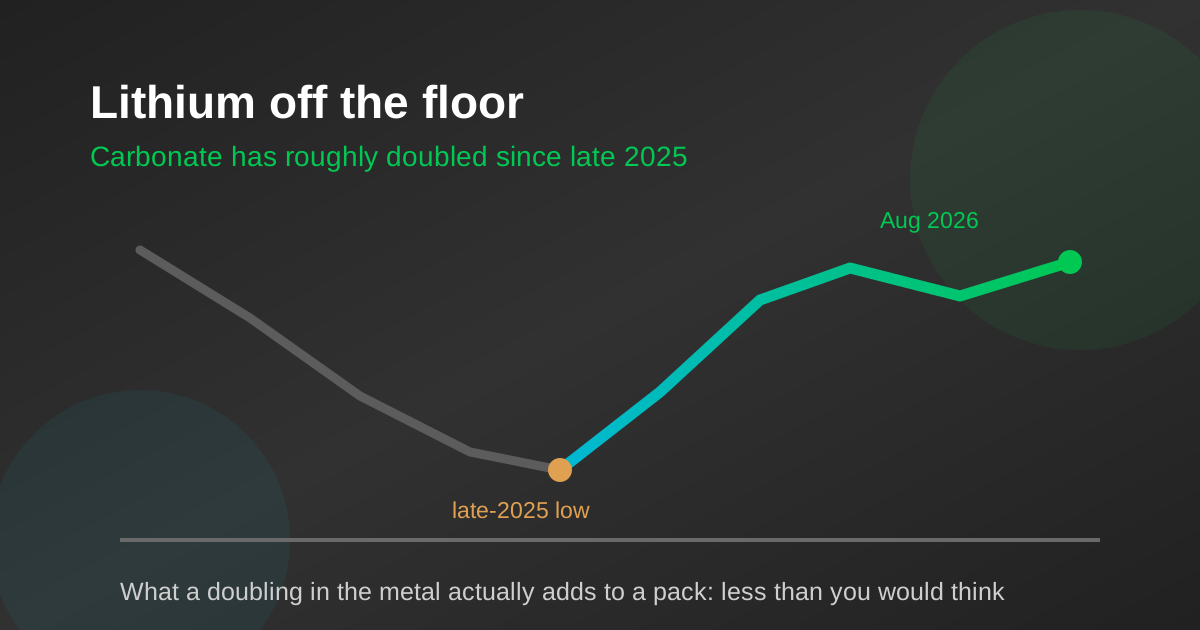
Battery-grade lithium carbonate is trading around $21,900 a tonne, with the Chinese domestic benchmark near ¥148,000 a tonne. That is roughly double the floor it found in late 2025, when the price fell below $14,000 a tonne after a two-year collapse. It is also still a long way under the 2022 mania, when carbonate briefly cleared $80,000 a tonne.
The path this year has not been a straight line. Carbonate very nearly doubled through the first quarter of 2026 on constrained spodumene concentrate and brine processing output, overshot, and has since come off that spike while staying well above the late-2025 low. Reporting from the storage industry describes the resulting volatility as a live problem for project costing, with the hedging tools that would normally absorb it still immature.
The question everyone actually asks
“Lithium has doubled — is my battery about to double?” No. And the reason is worth having at hand, because it is the difference between reading a commodity headline and understanding a quotation.
An LFP cell contains roughly 0.55 to 0.6 kg of lithium carbonate equivalent per kilowatt hour. So the move from about $14 a kilogram to about $22 a kilogram — call it $8 a kilogram — works through as:
- •0.6 kg/kWh × $8/kg ≈ $4.80 per kWh of added cell cost.
- •At ₹95.75 to the dollar, that is roughly ₹450 per kWh.
- •On an e-rickshaw pack priced around ₹17,500 per kWh, about 2.5 per cent.
- •On a home storage system at around ₹32,000 per kWh installed, about 1.4 per cent.
Those are estimates built on a stated intensity figure and a stated exchange rate, not quotations. The point is the order of magnitude: a doubling of the metal moves an installed system price by low single-digit per cent, because the metal is a minority of a cell and the cell is a minority of a system.
That estimate is consistent with what the industry is reporting from the other direction. Cell and pack prices are expected to rise in the region of 3 to 5 per cent across the rest of 2026 — not 100 per cent. If anyone quotes you a far larger increase and blames lithium, the lithium is not what is doing the work.
Why the metal is a smaller share than people assume
At $22 a kilogram and 0.6 kg per kWh, the lithium carbonate in a cell is about $13 per kWh. Against an LFP cell somewhere in the $55 to $70 per kWh range, that is around a fifth to a quarter of the cell. And the cell itself is perhaps half to two thirds of a finished pack once you add the BMS, the enclosure, thermal management, wiring, assembly, testing and warranty — less again for a full installed system, which carries an inverter, civil work, cabling and commissioning.
Each of those layers dilutes the commodity. It also means the things that move a quotation most are frequently not the ones in the news: the exchange rate, freight, duties, the quality of the cells and the length of the warranty behind them.
What it does change
- •Grid-scale procurement, where a project is thousands of kWh and a few per cent is a real number. Developers bidding fixed tariffs against cells they have not yet bought carry that risk directly, and India is running a large tender pipeline into exactly this market.
- •The direction of travel on cheap packs. The steady annual decline in pack prices that buyers got used to between 2023 and 2025 was partly a lithium collapse working through. That tailwind has stopped, and for now reversed.
- •The value of a pack that lasts. When replacement cells get more expensive, the arithmetic tilts further towards the option with the longer life — which is the same conclusion the cost-per-kilometre comparison reaches anyway, only more so.
What it does not change is the shape of the decision. Whether a battery is worth buying still turns on what it replaces and how long it lasts, and a few per cent on the capital cost rarely flips that. You can test how sensitive your own case is by moving the price inputs in the mobility or home energy calculators — put the pack price up five per cent and see whether the answer actually moves.
Sources
Reporting this piece draws on. Figures were correct as published; scheme terms and commodity prices move.
- Lithium price volatility creates BESS cost uncertainty with hedging in infancyFastmarkets
- Lithium market forecast and Q1 2026 reviewInvesting News Network
- Indian rupee spot rateTrading Economics
- Foreign Exchange Rates — H.10Federal Reserve Board
Frequently asked questions
Lithium doubled — will my battery cost double?+
No. An LFP cell contains roughly 0.55 to 0.6 kg of lithium carbonate per kWh, so an $8 per kilogram move works through as about $4.80 per kWh, or roughly ₹450 per kWh. That is about 2.5 per cent on an e-rickshaw pack and about 1.4 per cent on an installed home system. Industry reporting expects cell prices up 3 to 5 per cent across 2026, not 100 per cent.
How much of a battery’s cost is actually lithium?+
At around $22 a kilogram and 0.6 kg per kWh, the lithium carbonate in a cell is about $13 per kWh — roughly a fifth to a quarter of an LFP cell at $55 to $70 per kWh. The cell is then perhaps half to two thirds of a finished pack, and less again of a full installed system. Each layer dilutes the commodity.
What moves a battery quotation more than lithium does?+
The exchange rate, freight, duties, cell quality and the length of the warranty behind the pack. The rupee moved enough in 2026 to matter as much as the metal for anything imported.
Should I wait for prices to fall before buying?+
The steady annual decline buyers got used to between 2023 and 2025 was partly a lithium collapse working through, and that tailwind has stopped. Waiting for a repeat is a bet on a commodity cycle. A few per cent on capital cost rarely flips whether a battery is worth buying — test it by moving the price input in one of our calculators and seeing whether the answer actually changes.
Want this applied to your own numbers?
Every solution page carries a calculator that shows its own arithmetic — storage savings, lithium against lead-acid, and home pack sizing.
Get in touch