Your Motor Makes Torque Two Ways, and One of Them Is Free
A third to a half of a modern traction motor’s torque comes from rotor geometry rather than from the magnets. Understanding where it comes from explains most of what a motor spec sheet is telling you — and why the controller is part of the motor.
Published: 27 August 2026
Explainer · 7 min read
The standard answer is only two-thirds right
Ask most people how an electric motor makes torque and you get the standard answer: current in a coil interacts with a magnetic field, and the rotor turns.
That is correct, and in a modern traction motor it accounts for only about half to two-thirds of the torque. The rest comes from somewhere that has nothing to do with magnets at all.
The compass needle that isn’t magnetised
Take an ordinary steel needle — not magnetised, just plain iron — and put it in a magnetic field. It turns to align with the field.
Nothing about that needle is a magnet. It has no north or south pole of its own. It turns because magnetic flux, like current, takes the easiest path available. The needle is easy to magnetise along its length and hard across it, so there is less energy in the system when it lines up, and it rotates to get there.
That is reluctance torque, and once you build a rotor with the same kind of asymmetry deliberately designed in, you get torque for free — with no magnets involved.
How a rotor is built to have it
The trick is to make the rotor magnetically easy in one direction and hard in another.
Magnets themselves turn out to be useful for this, and not for the reason you would expect. A permanent magnet has roughly the permeability of air — flux does not like flowing through it. So burying magnets inside the rotor laminations creates barriers. Flux flows easily around them and badly through them, and the difference between those two paths is exactly the asymmetry you want.
This is why traction motors bury their magnets rather than gluing them to the surface. The V-shaped arrangement you see in an IPM rotor cross-section is doing two jobs at once: holding the magnets against 20,000 rpm of centrifugal load, and creating the flux barriers that generate reluctance torque.
A surface-magnet rotor cannot do this. Both directions look roughly the same magnetically, so there is no asymmetry and no reluctance torque — which is why you find surface magnets in servos and industrial drives and rarely in traction.
Why this needs the controller to know what it is doing
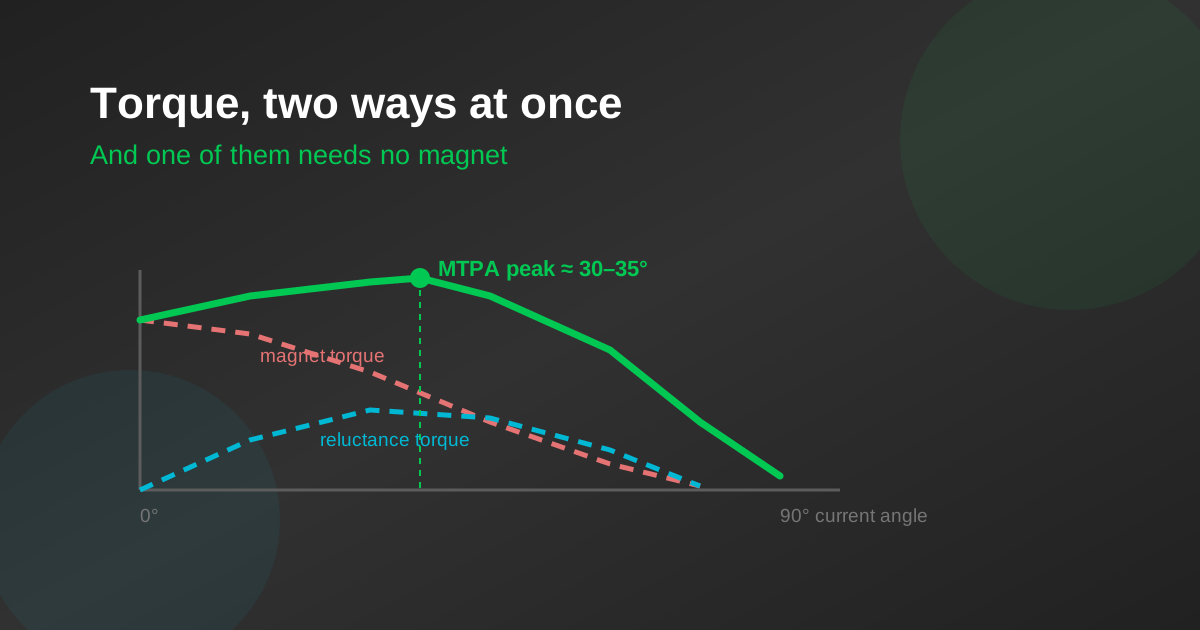
Here is where it gets interesting practically. The two torque contributions peak at different current angles.
Pure magnet torque is maximised when you feed current at one particular phase relative to the rotor. Reluctance torque is maximised somewhere else entirely. Feed the current at the angle that maximises magnet torque and you get zero reluctance torque, leaving a large fraction of the motor’s capability unused.
The optimum for the sum sits at roughly 30 to 35 degrees, not at zero. Sitting the drive on that optimum at every operating point is a control strategy called MTPA — Maximum Torque Per Amp — and it is worth tens of per cent more torque from the same copper, the same iron and the same magnets.
That is a software decision producing a hardware-sized result.
What it means for buying a motor
- •Rare-earth-free designs are viable because of this. Reluctance torque needs no magnets. A synchronous reluctance motor is a rotor of stamped flux barriers and nothing else — no magnets, no rotor current, no rotor losses, very cheap. Add low-cost ferrite into the barriers and torque density climbs substantially without touching a rare earth.
- •The controller is part of the motor. A well-built IPM motor with a controller that does not implement MTPA properly will underperform a lesser motor that does. If you are evaluating a motor and drive as a package, that package is what you are evaluating — you cannot assess the motor alone.
- •Torque scales with the square of rotor diameter. Torque is a shear stress acting on the rotor surface, so it goes as diameter squared times length. Doubling diameter quadruples torque; doubling length only doubles it. Pancake-shaped motors make torque, which is exactly why axial-flux machines exist and why they turn up in in-wheel applications.
- •And this is why traction motors are geared. Power is torque times speed, so a small motor spun fast delivers the same power as a big one spun slowly. That is why traction motors run at 12,000 to 20,000 rpm behind an 8:1 or 10:1 reduction. The gearbox is there to let the motor be small.
Where to read more
The torque equation with both terms written out, the MTPA curve, the torque–speed envelope and a comparison of six rotor topologies are in Magnets and Motors. The supply-side reason rare-earth-free designs keep getting funded is in Ore to Vehicle.
Frequently asked questions
What is reluctance torque and where does it come from?+
Torque produced by magnetic asymmetry rather than by magnets. Flux takes the easiest path available, so a rotor that is magnetically easy in one direction and hard in another is pulled into alignment with the stator field — exactly the way a plain unmagnetised steel needle aligns in a field. In a modern traction motor it supplies roughly a third to a half of total torque.
Why do traction motors bury their magnets instead of surface-mounting them?+
Because a permanent magnet has roughly the permeability of air, so burying magnets in the rotor laminations creates flux barriers: flux flows easily around them and badly through them, and that difference is the asymmetry reluctance torque needs. The V-shaped arrangement also retains the magnets against 20,000 rpm centrifugal load. A surface-magnet rotor looks the same magnetically in both directions, so it produces no reluctance torque at all.
What is MTPA and why does it matter commercially?+
Magnet torque and reluctance torque peak at different current angles, so feeding current at the angle that maximises magnet torque leaves a large fraction of the motor unused. The optimum for the sum sits near 30 to 35 degrees. Maximum Torque Per Amp control holds the drive on that optimum at every operating point, and it is worth tens of per cent more torque from the same copper, iron and magnets. It also means a motor and its controller cannot be evaluated separately.
Why does torque scale with the square of rotor diameter?+
Because torque is a shear stress acting on the rotor surface: it goes as the surface area times the lever arm, so diameter appears twice and length once. Doubling diameter quadruples torque; doubling length only doubles it. That is why pancake-shaped and axial-flux machines are intrinsically torque-dense, and it is a useful sanity check on any motor comparison.
Why are traction motors geared rather than driving the wheels directly?+
Because power is torque times speed, so a small motor spun fast delivers the same power as a large one spun slowly. Traction motors run at 12,000 to 20,000 rpm behind an 8:1 to 12:1 reduction. The gearbox exists to let the motor be small — which is a mass and cost decision, not a compromise.
Thinking about upgrading?
Talk to our team about the right pack for your vehicle, and about EMI options that keep the monthly outgo close to what you already spend.
Get in touch