How a Litre of Diesel Reaches Your Pump
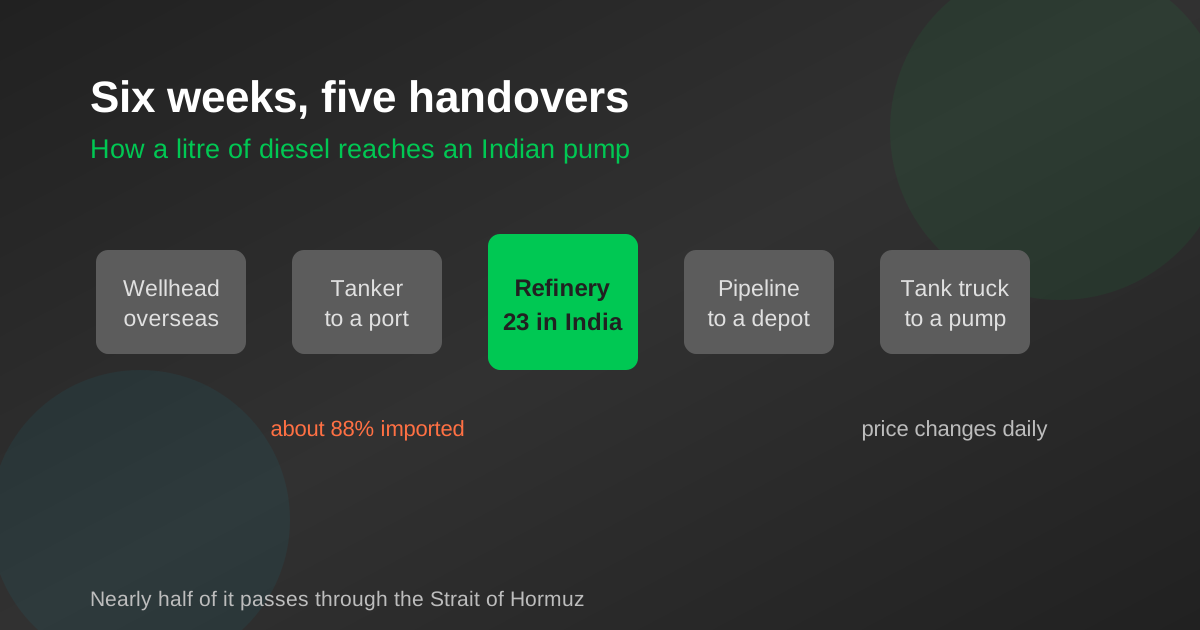
Six weeks and five handovers, from a wellhead someone else owns to an underground tank in your town. A walk through India’s fuel supply chain — and the four weaknesses that are structural rather than anyone’s fault.
Published: 26 August 2026
Industry · 12 min read
The most reliable supply chain in the country
India consumes roughly 93 million tonnes of diesel and 42 million tonnes of petrol a year, across something in the order of ninety thousand retail outlets, in a country where a great many of those outlets are a long way from anything. Almost none of them run dry.
That reliability is so complete that it has become invisible, and its invisibility is precisely why fuel feels like a fixed feature of the world rather than a logistics achievement with specific vulnerabilities. This is a walk through the chain, one handover at a time.
Step one: the crude is almost always someone else’s
India imports around 88 per cent of the crude oil it refines, and crude import dependence has been rising rather than falling — 88.2 per cent in FY2024–25 and about 88.6 per cent in FY2025–26. In volume that is roughly 4.8 to 5 million barrels a day.
The sourcing mix has become the interesting part. Iraq, Saudi Arabia and the UAE remain long-standing term suppliers, and Russian crude — which entered the mix at scale in 2022 — has stayed there, accounting for something like a third of imports across the 2024 to 2026 period and spiking to record levels in mid-2026.
One geographic fact matters more than the rest. Close to half of India’s crude imports transit the Strait of Hormuz. That is a single waterway, about 33 kilometres wide at its narrowest, carrying half the feedstock of a country of 1.4 billion people.
Diversifying suppliers does not diversify a chokepoint. Iraqi, Saudi, Emirati, Kuwaiti and Iranian crude all leave through the same strait, so five suppliers can be one point of failure. We wrote about what that did to freight in Hormuz and the cost of a container.
Step two: the tanker, and the six weeks
Crude moves in very large crude carriers holding around two million barrels. A cargo from the Gulf reaches an Indian west-coast port in a few days; a cargo from West Africa or Latin America takes weeks.
This is where the lag comes from that confuses everyone about fuel prices. The crude being refined into the diesel you buy today was purchased weeks ago, at a price agreed then. When you read that the international crude price has fallen and wonder why the pump has not moved, part of the answer is that the barrel at the pump was bought before the fall.
Step three: the refinery
India runs 23 refineries with a combined capacity of about 258 million tonnes a year, the fourth largest refining sector in the world, with plans to reach roughly 310 million tonnes by 2028. Jamnagar in Gujarat is the largest refining complex anywhere on earth.
Capacity comfortably exceeds domestic consumption, which is why India is a net exporter of refined products while importing nearly all its crude. The country’s position in the oil trade is essentially that of a processor: buy crude, add value, sell products.
Inside the refinery, the crude is separated by boiling point and then reprocessed. The key point for supply is that the proportions are only partly adjustable. A barrel yields a certain slate of products, and while cracking units can convert heavier fractions into lighter ones, no refinery can produce only what the market happens to want that month. This is why petrol and diesel prices sometimes move in opposite directions: they are joint products of the same process.
Step four: pipelines, rail and the depot
From the refinery, product moves through multi-product pipelines to storage terminals and depots spread across the country, supplemented by rail rakes and coastal shipping. A single pipeline carries different products in sequence, separated only by the interface between batches, which is itself managed and reprocessed.
The depot is where the product becomes a specific company’s fuel. The base product is largely interchangeable; the branded additive package is dosed in at this stage. It is also where marker dyes go into subsidised or restricted products, which is the basis of most adulteration detection.
Step five: the tank truck, and the last mile
The final leg is a road tanker to the retail outlet. It is the least automated, most human-dependent step in the chain and, unsurprisingly, where most of the losses and most of the adulteration occur. Modern tankers use GPS tracking and electronic locks on the discharge valves for exactly this reason.
At the outlet, the fuel goes into underground tanks and is drawn up by the dispensers. The retail price is set daily under the dynamic pricing regime introduced in 2017, and the three public sector oil marketing companies — IOCL, BPCL and HPCL — own around 90 per cent of India’s outlets.
What the chain tells you about its own weaknesses
- •It is long, and length is lag. Weeks separate the purchase of a barrel from the sale of a litre. No amount of daily price revision removes that.
- •It is denominated in dollars. Crude is bought in dollars and sold in rupees. A rupee that weakens raises the cost of every litre regardless of what happened to the oil price, and that channel is often larger than the commodity move itself.
- •It has one geographic knot. Half of it goes through the Strait of Hormuz, and no supplier diversification fixes that.
- •It is joint-product constrained. You cannot refine more diesel without producing more of everything else, so a shortage in one product cannot be solved quickly by making more of it.
- •Its last mile is a person. Almost every quality problem an ordinary buyer encounters happens between the depot and the dispenser.
The comparison worth drawing
An electricity supply chain has a different shape. Its fuel is often domestic — coal, hydro, sun, wind — and the last mile is a wire that does not require a truck to make a delivery. Its weaknesses are real and different: generation adequacy, transmission congestion, distribution reliability. We have written on how power actually moves across that network.
The point of understanding the fuel chain is not that it is fragile. It is remarkably robust, and it took a century to make it so. The point is that its costs and risks are structural — import dependence, currency exposure, a chokepoint, a six-week lag — rather than the result of anyone doing a bad job. Those are the things that do not get better with effort, and they are the reason the arithmetic of an electric three-wheeler keeps working out the way it does.
Frequently asked questions
How much of India’s oil is imported?+
About 88 per cent of the crude India refines, and the share has been rising rather than falling — 88.2 per cent in FY2024–25 and roughly 88.6 per cent in FY2025–26. In volume that is around 4.8 to 5 million barrels a day. India is nevertheless a net exporter of refined products, because its refining capacity comfortably exceeds domestic consumption.
Where does India buy its crude oil from?+
Iraq, Saudi Arabia and the UAE are long-standing term suppliers, and Russian crude — which entered at scale in 2022 — has stayed in the mix at roughly a third of imports across the 2024 to 2026 period, spiking to record levels in mid-2026. The more important fact than any single supplier is that close to half of India’s crude transits the Strait of Hormuz.
Why does diversifying suppliers not remove the Hormuz risk?+
Because Iraqi, Saudi, Emirati, Kuwaiti and Iranian crude all leave through the same waterway. Five suppliers behind one chokepoint is one point of failure, not five. That is a geographic fact no procurement strategy changes.
How many refineries and petrol pumps does India have?+
Twenty-three refineries with a combined capacity of about 258 million tonnes a year — the fourth largest refining sector in the world, with Jamnagar the largest single complex anywhere — feeding something in the order of ninety thousand retail outlets. The three public sector oil marketing companies, IOCL, BPCL and HPCL, own around 90 per cent of those outlets.
Why do petrol and diesel prices sometimes move in opposite directions?+
Because they are joint products. A barrel of crude yields a fixed slate of fractions, and while cracking units can convert heavier cuts into lighter ones, no refinery can produce only what the market wants that month. You cannot make more diesel without making more of everything else, so a shortage in one product cannot be solved quickly by making more of it.
Where does fuel adulteration usually happen?+
In the last mile — the road tanker between the depot and the retail outlet. It is the least automated and most human-dependent step in the chain, which is why modern tankers carry GPS tracking and electronic locks on the discharge valves, and why marker dyes are dosed at the depot.
Thinking about upgrading?
Talk to our team about the right pack for your vehicle, and about EMI options that keep the monthly outgo close to what you already spend.
Get in touch