India’s ₹7,280 Crore Magnet Scheme Drew 20 Bids. First Output Is Still 2028.
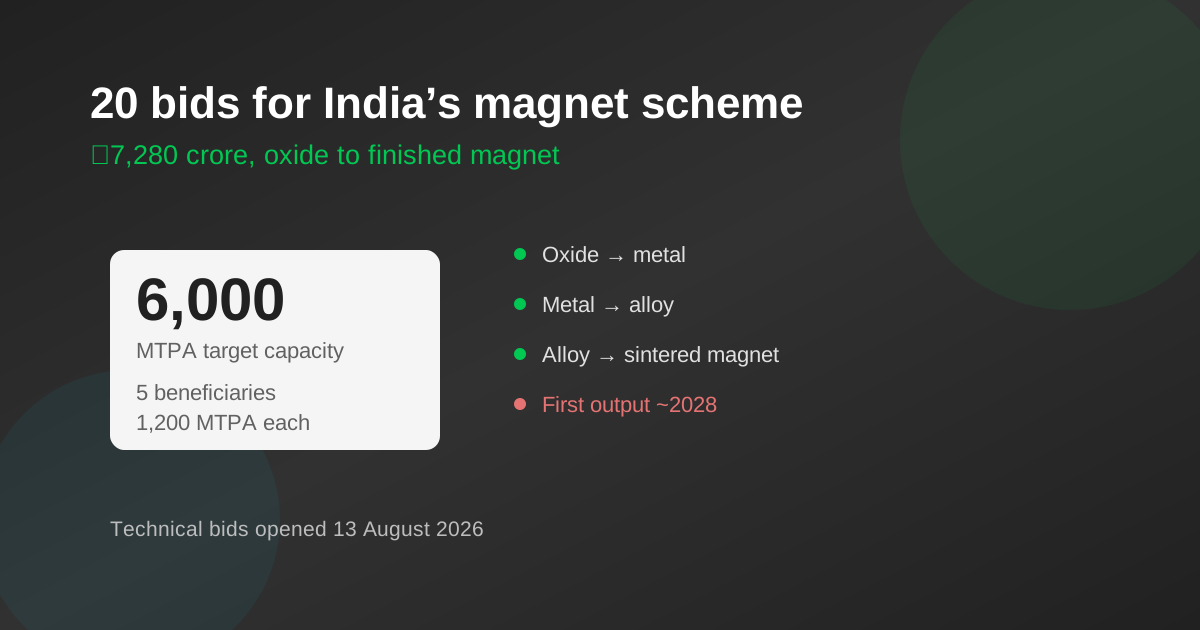
Technical bids opened on 13 August for 6,000 MTPA of integrated rare earth magnet capacity, with L&T, Coal India, ReNew and two overseas magnet makers among the bidders. The scheme funds oxide-to-metal conversion, not just pressing — which is the part that matters.
Published: 27 August 2026
Policy · 7 min read
Where things stand
Written 27 August 2026. Beneficiary selection had not been announced at the time of writing.
The Ministry of Heavy Industries received 20 bids under India’s Scheme to Promote Manufacturing of Sintered Rare Earth Permanent Magnets. Bidding closed on 12 August 2026 and technical bids were opened the following day, 13 August, at the ministry in the presence of bidders.
Reported bidders include Larsen & Toubro, Coal India, ReNew, Attero Recycling, Lohum, 20 Microns, Prozeal Green Energy, and the overseas magnet specialists NEO Performance Materials (Singapore) and Proterial (India).
What the scheme actually funds
Approved by the Union Cabinet in November 2025 with an outlay of ₹7,280 crore, it targets 6,000 metric tonnes per annum of integrated magnet manufacturing capacity, allocated across five beneficiaries selected by global competitive bidding, each eligible for up to 1,200 MTPA.
- •₹6,450 crore in sales-linked incentives over five years.
- •₹750 crore in capital subsidy.
- •A two-year gestation period before incentive disbursement begins.
- •A limited assured raw material supply from IREL (India) Ltd for selected beneficiaries.
What distinguishes this from a conventional assembly subsidy is its scope. It covers the full chain — converting rare earth oxides to metals, metals to alloys, and alloys to finished magnets.
Separation and metal-making, not magnet pressing, are the genuinely hard steps and the ones India has never had at scale. A scheme that funded only the pressing would have produced a plant that still imported its inputs.
The timeline has already slipped once
The RFP was issued on the CPP Portal on 20 March 2026 with a pre-bid conference on 7 April. The submission deadline moved from July to 12 August, with technical opening on 13 August.
That is a modest slip by the standards of Indian industrial schemes, and the bidder list suggests the delay bought participation rather than costing it — the presence of two established overseas magnet makers alongside domestic industrial and recycling firms is a more serious field than the scheme looked likely to attract when it was announced.
Why it matters here, and what it does not fix
India sourced between roughly 60 and 81 per cent of its permanent magnet requirement from China across 2022–23 to 2024–25, and domestic consumption is projected to double by 2030 on the back of electric mobility and renewables. For anyone building traction motors, pumps or generators in India, a domestic magnet source changes the risk profile.
But not for several years, and not completely.
- •Two years of gestation before production means the first output arrives around 2028 at the earliest.
- •It arrives into a market where the harder constraint is heavy rare earth separation rather than magnet sintering. Dysprosium and terbium are what let a magnet survive a hot rotor, and they are the elements under the tightest export control.
- •The assured IREL supply is limited, and IREL’s current scale is small relative to 6,000 MTPA of magnet capacity.
The Union Budget 2026–27 added Dedicated Rare Earth Corridors in Odisha, Kerala, Andhra Pradesh and Tamil Nadu, covering mining, processing, research and manufacturing — which is the right shape of response, since the binding constraint sits upstream of the magnet plant rather than at it.
Our chapter on the separation cascade covers why that upstream step is the hard one, and why rare earths are not rare covers what the alternatives to importing them actually are.
Sources
Reporting this piece draws on. Figures were correct as published; scheme terms and commodity prices move.
- India’s rare earth magnet scheme gets 20 bids; L&T, Coal India, ReNew among biddersANI · 13 August 2026
- Coal India, L&T, NEO Performance among 20 bidders under Rs 7,280-cr rare earth magnet scheme: MHIPSU Watch
- Ministry of Heavy Industries invites global bids to set up rare earth magnet manufacturing unitsNewsOnAir · 20 March 2026
- Cabinet approves Rs 7,280 crore rare earth permanent magnets schemeThe Tribune
Frequently asked questions
How many bids did India’s rare earth magnet scheme receive?+
Twenty. Bidding closed on 12 August 2026 and technical bids were opened the following day at the Ministry of Heavy Industries. Reported bidders include Larsen & Toubro, Coal India, ReNew, Attero Recycling, Lohum, 20 Microns, Prozeal Green Energy, and the overseas magnet specialists NEO Performance Materials (Singapore) and Proterial (India).
What does the ₹7,280 crore scheme actually fund?+
6,000 metric tonnes per annum of integrated magnet capacity across five beneficiaries, each eligible for up to 1,200 MTPA, through ₹6,450 crore of sales-linked incentives over five years plus ₹750 crore of capital subsidy. Crucially it covers the full chain — oxide to metal, metal to alloy, alloy to finished magnet — rather than magnet pressing alone, plus a limited assured raw material supply from IREL.
When will Indian-made magnets actually be available?+
Around 2028 at the earliest. The scheme carries a two-year gestation period before incentive disbursement begins, and beneficiary selection had not been announced as of late August 2026. The timeline has already slipped once — the bid deadline moved from July to 12 August.
Does this solve India’s magnet dependence?+
Partly, and not soon. India sourced roughly 60 to 81 per cent of its permanent magnet requirement from China across 2022–23 to 2024–25, and consumption is projected to double by 2030. But the harder constraint is heavy rare earth separation rather than magnet sintering — dysprosium and terbium are what let a magnet survive a hot rotor, and they are the elements under tightest export control. The Union Budget 2026–27 added Dedicated Rare Earth Corridors in Odisha, Kerala, Andhra Pradesh and Tamil Nadu, which addresses the upstream half.
Want this applied to your own numbers?
Every solution page carries a calculator that shows its own arithmetic — storage savings, lithium against lead-acid, and home pack sizing.
Get in touch