CNG, LPG, Ethanol and Hydrogen: What They Are and Where They Come From
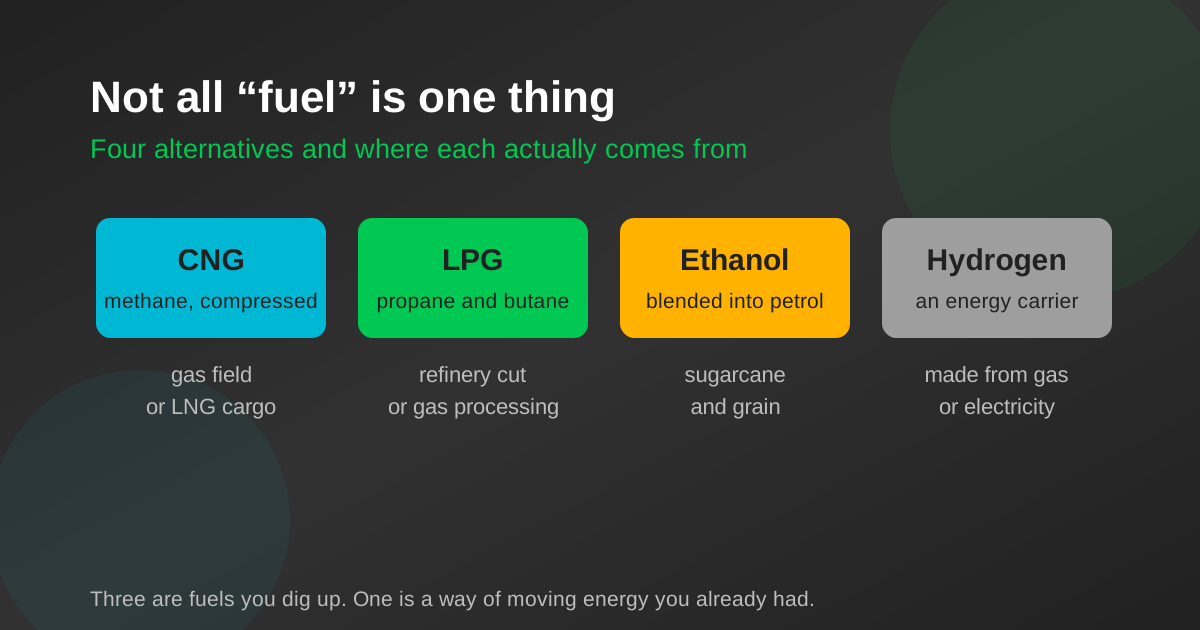
Three of these are fuels you dig up. One is a way of moving energy you already had. That distinction decides most of the argument — and it is the one usually left out of it.
Published: 26 August 2026
Explainer · 12 min read
Start with the distinction that matters
“Alternative fuel” is a category that hides the most important thing about its members. Some of these are energy sources — you extract them from the ground and they arrive containing energy nobody had to put in. Others are energy carriers — you spend energy to make them, and you get some of it back later.
CNG, LPG and petroleum-derived fuels are sources. Ethanol is close to a source, since the sun does most of the work. Hydrogen and electricity are carriers. Confusing the two categories is behind most of the bad reasoning about energy in public debate, so it is worth holding onto through everything below.
CNG: methane, squeezed
Compressed natural gas is mostly methane — the simplest hydrocarbon, one carbon and four hydrogens — stored at around 200 to 250 bar. It comes either from domestic gas fields or from imported LNG, which is the same methane chilled to liquid for shipping and regasified on arrival.
The supply chain is completely unlike petrol’s: no refinery, no tanker truck, no depot. Gas moves through the national pipeline grid to city gas distribution networks, which feed CNG stations and piped gas into homes. India had connected 250 geographical areas to the network by early 2026, with PNGRB targeting 18,336 CNG stations and 126 million piped connections by 2034.
What CNG gets right is combustion chemistry. One carbon per molecule means less CO₂ per unit of energy than any other hydrocarbon, and far less particulate matter and NOx — which is why Delhi’s commercial fleet was converted to it. What it gets wrong is storage. Methane will not liquefy at room temperature at any pressure, so it must be carried as a compressed gas in heavy cylindrical tanks, and even at 250 bar it holds perhaps a quarter of the energy of petrol per unit of volume. That is why CNG suits fleets that return to a depot and struggle everywhere else.
LPG: the fraction that liquefies easily
Liquefied petroleum gas is propane and butane — three and four carbon chains. They sit in exactly the right place on the scale: heavy enough to liquefy under modest pressure at room temperature, light enough to be gaseous the moment you release them. That single property is why LPG comes in a cylinder you can carry rather than a tank you must bolt down.
It arrives two ways: as a light cut from crude distillation, and as a byproduct of natural gas processing. India consumes roughly 32.7 million tonnes a year, overwhelmingly for cooking, and imports a large share of it.
Auto LPG exists and works, but it has been squeezed from both sides — by CNG where the pipeline reached, and by electric where the duty cycle suited. Its more consequential story in India was never automotive. It was replacing biomass cookstoves, which was a genuine public health achievement and remains underrated.
Ethanol: agriculture in the fuel tank
Ethanol is alcohol, made by fermenting sugars from sugarcane juice, molasses, or increasingly surplus grain. It is blended into petrol rather than sold separately, and India reached roughly 20 per cent average blending during the 2024–25 ethanol supply year — about five years ahead of the original E20 target, with more than 1,000 crore litres blended. The roadmap now points at E25, E27 and eventually E30, phased against BIS standards and vehicle compatibility.
The case for it is genuinely strong on the terms it was argued: it displaces imported crude with a domestic crop, and the money goes to sugarcane farmers and distilleries instead of overseas. For a country importing 88 per cent of its oil, that is a real strategic gain.
The honest caveats are three. Ethanol carries about a third less energy per litre than petrol, so E20 costs you a small but measurable amount of mileage — a few per cent, which is real but frequently exaggerated. Older vehicles not designed for E20 can suffer corrosion in fuel system elastomers and metals. And sugarcane is thirsty: growing fuel in water-stressed districts moves a problem rather than solving it.
Ethanol is the clearest case in Indian energy policy of a real success with a real cost that is rarely stated in the same sentence. Import substitution and farm income on one side; water, land and a few per cent of mileage on the other. Both halves are true.
Biodiesel and the rest
Biodiesel — fatty acid methyl esters made from vegetable oils or used cooking oil — blends into diesel the way ethanol blends into petrol. India’s programme remains at low single-digit percentages, far behind the ethanol effort, mostly because the feedstock is not there. A country that imports edible oil does not have a surplus to burn.
Compressed biogas made from agricultural and municipal waste is the more interesting adjacent idea, because the feedstock is genuinely waste and the output is methane that can enter the same CNG infrastructure. It is small today and the economics are difficult, but the logic is sound in a way biodiesel’s is not.
Hydrogen: the one that is not a fuel
Hydrogen is not mined. There are no hydrogen wells. Every kilogram of it in use was manufactured, either by stripping it out of natural gas — which releases CO₂, and accounts for the overwhelming majority of production today — or by splitting water with electricity, which is only as clean as the electricity used.
So hydrogen is a way of moving and storing energy you already had, and every conversion in that chain has a cost. Make hydrogen from electricity at perhaps 60 to 70 per cent efficiency, compress or liquefy it, transport it, then convert it back through a fuel cell at perhaps 50 to 60 per cent, and something in the region of 30 per cent of your original electricity reaches the wheel. Put the same electricity into a battery and roughly 85 per cent does.
That ratio is why hydrogen keeps losing arguments about cars and keeps winning arguments about other things. Where batteries are genuinely poor — steelmaking, fertiliser, refining, long-haul shipping, seasonal storage — hydrogen has a real case, because nothing else works and the alternative is coal. For a vehicle that returns home every night and can be plugged in, it is spending three units of electricity to do one unit’s work.
Comparing them honestly
- •Compare cost per unit of useful work, not per litre or per kilogram. These fuels have wildly different energy densities and are sold in different units. Cost per kilometre for your actual vehicle is the only comparison that means anything.
- •Ask where the energy came from. A fuel is only as clean as its production chain. Hydrogen from natural gas and hydrogen from solar are the same molecule with completely different footprints. So is electricity from a coal plant and from a rooftop.
- •Count the conversions. Every step from source to wheel loses energy. Fewer steps beat cleverer steps, almost always.
- •Check whether the infrastructure exists where you are. CNG is excellent if a station is on your route and irrelevant otherwise. This is a local question, not a national one.
- •Be suspicious of any option that is best at everything. Each of these fuels has a shape it fits. Anyone presenting one as universally superior is selling it.
Where we actually land
We sell batteries, so take the following with that in mind — but the reasoning is available for you to check.
For a vehicle that runs a predictable daily distance and parks somewhere it can be plugged in, electric wins on the physics, not on the subsidy: no conversion of heat into motion, no fuel chain, no six-week import lag. That describes almost every e-rickshaw, delivery three-wheeler and commuter two-wheeler in India, and it is why electric took 65 per cent of Indian three-wheeler registrations without anyone needing to be persuaded.
For long-distance heavy freight today, diesel remains hard to beat and CNG is a reasonable intermediate where the corridor has stations. For cooking, LPG and piped gas are not going anywhere soon. For heavy industry, hydrogen has a genuine role that batteries cannot fill.
The useful question is never “which fuel is best”. It is “what does this particular vehicle do all day, and what does that cost per kilometre on each option”. Our calculator answers the second half if you can answer the first, and if the numbers come out against us, that is a useful thing to have found out.
Frequently asked questions
What is the difference between CNG and LPG?+
Different molecules with a decisive physical difference. CNG is mostly methane — one carbon — which will not liquefy at room temperature at any pressure, so it must be carried as a compressed gas at 200 to 250 bar in heavy tanks holding perhaps a quarter of petrol’s energy per unit of volume. LPG is propane and butane — three and four carbons — which liquefy under modest pressure at room temperature, which is why LPG comes in a cylinder you can carry.
Where does India get its CNG and LPG from?+
CNG comes from domestic gas fields or from imported LNG regasified on arrival, and moves entirely by pipeline — no refinery, no tanker truck, no depot. India had 250 geographical areas connected to the network by early 2026, with PNGRB targeting 18,336 CNG stations and 126 million piped connections by 2034. LPG comes both as a light cut from crude distillation and as a byproduct of gas processing; India consumes around 32.7 million tonnes a year, overwhelmingly for cooking, and imports a large share.
Has India actually achieved 20 per cent ethanol blending?+
Yes, roughly. Average blending reached about 19.2 to 20 per cent across the 2024–25 ethanol supply year, with more than 1,000 crore litres blended and individual months touching 19.9 per cent — about five years ahead of the original E20 target. The roadmap now points at E25, E27 and eventually E30, phased against BIS standards and vehicle compatibility rather than mandated outright.
What are the downsides of ethanol blending?+
Three, and they deserve stating alongside the benefits. Ethanol carries about a third less energy per litre than petrol, so E20 costs a few per cent of mileage. Older vehicles not designed for E20 can suffer corrosion in fuel system elastomers and metals. And sugarcane is water-intensive, so growing fuel in water-stressed districts moves a problem rather than solving it. Against that sits genuine import substitution and farm income, which are also real.
Is hydrogen a good fuel for vehicles?+
Rarely, on the arithmetic. Hydrogen is not mined — every kilogram was manufactured, mostly by stripping it from natural gas, which releases CO₂. Made from electricity instead, the chain runs at roughly 60 to 70 per cent to produce it, then compression or liquefaction, transport, and 50 to 60 per cent back through a fuel cell, leaving something near 30 per cent of the original electricity at the wheel. A battery delivers about 85 per cent. Hydrogen’s real case is where batteries genuinely cannot go — steel, fertiliser, refining, long-haul shipping, seasonal storage.
How should I compare fuels honestly?+
Compare cost per unit of useful work for your actual vehicle, not per litre or per kilogram — these fuels have wildly different energy densities and are sold in different units. Ask where the energy came from, since hydrogen from gas and hydrogen from solar are the same molecule with different footprints. Count the conversion steps, because each one loses energy. Check whether the infrastructure exists on your route rather than nationally. And be suspicious of any option presented as best at everything.
Thinking about upgrading?
Talk to our team about the right pack for your vehicle, and about EMI options that keep the monthly outgo close to what you already spend.
Get in touch