PM Surya Ghar Passed 50 Lakh Homes. Storage Is the Missing Half.
Rooftop solar tripled its installation rate in nine months and crossed 14.8 GW. What actually unblocked it was paperwork, not panels — and the economics still rest entirely on net metering, which is exactly what storage would replace.
Published: 22 August 2026
Home storage · 8 min read
The milestone
Written 22 August 2026, from MNRE figures reported in the first week of August 2026.
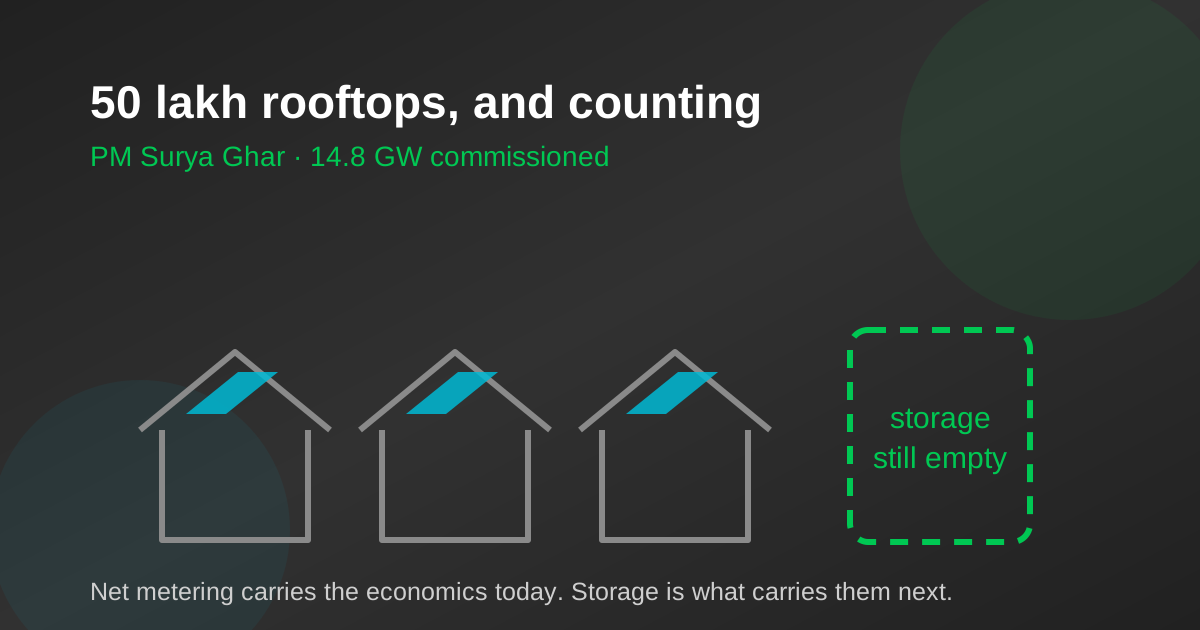
PM Surya Ghar: Muft Bijli Yojana has passed 50 lakh households — 50.06 lakh installations and about 14.8 GW of rooftop capacity commissioned. More striking than the total is the acceleration. Daily installations went from about 5,038 in October 2025 to roughly 16,328 in July 2026, a factor of 3.2 in nine months, and July was the scheme’s biggest month yet at around 5.06 lakh households.
Around ₹28,024 crore of subsidy has gone out by direct benefit transfer, and close to 19 lakh households now report zero electricity bills. The delivery machinery behind it has grown accordingly: some 34,219 registered vendors, of which about 29,469 are active, and more than 2.32 lakh people trained.
What actually unblocked it
Rooftop solar schemes in India have historically underperformed their targets, and the reason was rarely the panel price. It was the paperwork and the distribution company. Most of what changed in the last year is administrative rather than technical.
- •A fully digital application path, with API integration into more than 80 DISCOMs, so an application is a transaction rather than a series of visits.
- •Net metering charges removed in 32 states and union territories.
- •Deemed approval and waived feasibility studies for systems up to 10 kW — which covers essentially every residential installation.
- •Digital net metering agreements, paperless loan processing, vendor star ratings and subsidy paid directly to the household.
Worth sitting with: the binding constraint on Indian rooftop solar was process, not hardware or finance. Remove the feasibility study and the sanction queue for small systems and the volume triples in nine months.
The part that is holding the economics up
Almost all of these 50 lakh systems are grid-tied without storage, and their economics rest on net metering. A household generates a surplus at noon, exports it, and draws it back in the evening against the credit. The grid is doing the storing, free.
That is a good deal, and it is a deal that becomes more expensive for the distribution company with every rooftop added. The pattern in other markets that reached high rooftop penetration is consistent: net metering at full retail rates gets replaced by net billing, where exports are valued at something closer to a wholesale rate and the gap between export price and import price opens up. India has not done this at scale, and there is no announced plan to. But 14.8 GW of household rooftop is the level at which the question starts being asked.
The moment that spread opens, storage stops being a backup product and becomes an arbitrage product. A battery that holds the midday surplus for the evening peak is worth the difference between the two rates, every day, whether or not the power ever goes out.
PM Surya Ghar 2.0 — and why we are not going to tell you it is coming
There have been repeated reports that MNRE is working on a redesigned scheme, referred to as PM Surya Ghar 2.0, that would reward actual generation rather than installed capacity, add support for battery storage, and extend benefits to households that cannot access the current scheme — renters and flat-dwellers without an exclusive roof.
None of that is confirmed policy. It is reporting about an intention. We are flagging it because it is the single change that would most alter the case for home storage in India, and because you will see it written about as though it were already decided. Do not buy a battery today on the strength of a subsidy that has not been notified. If it arrives, the arithmetic improves and you can act then.
If you already have a rooftop system
The useful question is not whether to add storage in the abstract, but which of two different jobs you want it to do, because they size very differently.
- •Backup. Sized from your essential-load list and the hours you want covered. This is worth doing wherever outages are frequent, and it does not depend on any tariff change.
- •Self-consumption. Sized from your daily export surplus. Today, with full net metering in most states, this earns you comparatively little — you are already getting retail value for exports. It becomes the main event only if export rates are cut.
Our home energy calculator sizes the first from a load list and prices the second from your surplus and tariff. Be aware that it values stored surplus at the full retail rate, which is an upper bound while net metering is intact — and note that if it tells you a tubular battery is cheaper for your case, it will say so.
Sources
Reporting this piece draws on. Figures were correct as published; scheme terms and commodity prices move.
- Rooftop solar installations reached 50 lakh households: Pralhad JoshiBusiness Standard · 4 August 2026
- PM Surya Ghar rooftop solar scheme surpasses 5 million householdspv magazine India · 4 August 2026
- PM Surya Ghar rooftop solar installation crosses 50L milestoneThe Hans India
Frequently asked questions
How many homes has PM Surya Ghar reached?+
About 50.06 lakh households and 14.8 GW of commissioned rooftop capacity as of early August 2026. Daily installations rose from roughly 5,038 in October 2025 to about 16,328 in July 2026, and around ₹28,024 crore of subsidy has been paid out by direct benefit transfer.
What unblocked rooftop solar in India?+
Process, not hardware. A fully digital application path integrated with more than 80 DISCOMs, net metering charges removed in 32 states and union territories, and deemed approval with waived feasibility studies for systems up to 10 kW — which covers essentially every home installation.
Is PM Surya Ghar 2.0 with battery subsidy confirmed?+
No. There has been repeated reporting that MNRE is working on a redesign that would reward generation rather than installed capacity, support battery storage and extend access to households without an exclusive roof. It is reporting about an intention, not notified policy. Do not buy a battery on the strength of it.
Should I add a battery to my rooftop solar now?+
Decide which job you want it to do. As backup, sized from your essential-load list, it is worth it wherever outages are frequent and does not depend on any tariff change. As a self-consumption play it earns comparatively little today, because full net metering already gives you retail value for exports — that changes only if export rates are cut.
Want this applied to your own numbers?
Every solution page carries a calculator that shows its own arithmetic — storage savings, lithium against lead-acid, and home pack sizing.
Get in touch